
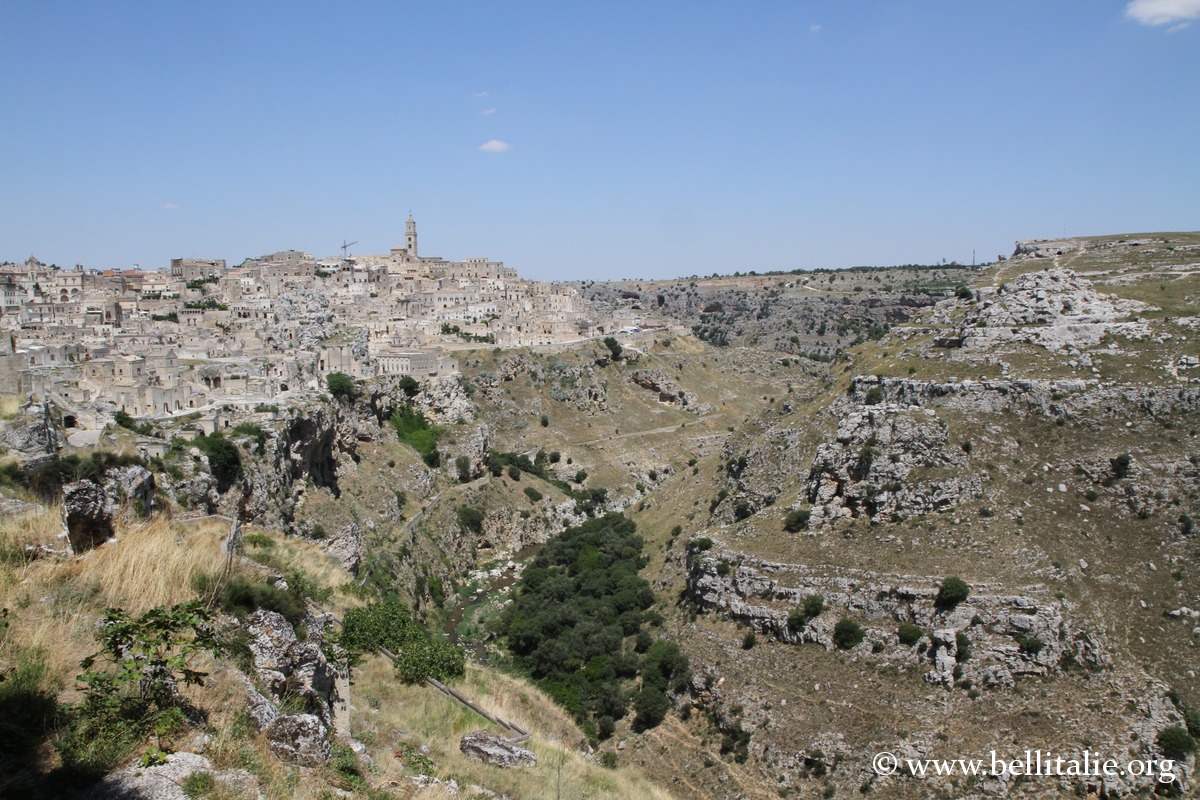
Matera
The coast of Basilicata was part of Magna Graecia – La Magna Grecia -, populated by Greek colonies.
Archaeological sites are numerous, as are the museums where the objects found are exhibited.
Basilicata is essentially mountainous, with a small but sublime coast to the west on the Tyrrhenian Sea around Maratea.
Inland, one will especially note the exceptional city of Matera with its troglodyte houses – the sassi. Let us mention the Roman city of Venosa, the castle of Melfi, or even Tricarico.
On the eastern coast, the ruins of the ancient Greek city of Metapontum (Metapontum) are not far from the coastline of the Gulf of Taranto.
Historical overview
Basilicata was part of Magna Graecia – La Magna Grecia -, populated by coastal Greek colonies (including Sybaris) and subsequently included in the Roman region of Bruttium, which also comprised Calabria.
The Romans eventually distinguished Lucania (present-day Basilicata) from Calabria, the name coming from the Lucanians who invaded the region around the middle of the 5th century BC, pushing the indigenous peoples toward the inland mountains (peoples whom the Greeks called Oenotrians and Choni). The language spoken by the Lucanians is an Oscan language (Indo-European). Strabo reports that they adopted a democratic constitution, except in time of war, when they chose a dictator from among the magistrates.
Conquered by Rome, it was then conquered by the Byzantines, then by the Normans around the year 1000 with the Hauteville family. Its underdevelopment became obvious, as it was overexploited by the House of Anjou, the House of Aragon and by the Spanish Bourbons. Only the Bourbons of the Two Sicilies, who governed it from their capital, Naples, removed the region from the latifundia and the barons. With the Piedmontese invasion of 1860, the region experienced massive deforestation that led to soil erosion and the mass departure of its inhabitants. It is also a land of exile under the fascist regime (hence Charles Levi’s novel, Christ Stopped at Eboli – Eboli being one of the last towns in Campania, the main railway station, before entering Basilicata).
 Show interactive map

