

The Liguria region presents itself as a coastal strip 360 kilometres long and on average about thirty kilometres wide. It is usually divided into two parts: the Riviera di Ponente, oriented towards the east, which is the westernmost, from the border with France to Genoa, the regional and historic capital city; and the Riviera di Levante from Genoa eastwards to Tuscany.
The first has more beaches and seaside resorts, with the Riviera dei Fiori and the Riviera delle Palme, passing through San Remo, Imperia, Albenga, Finale Ligure or Noli ; whereas the second is rockier and wilder with small harbours nestled in coves from Portofino to Portovenere, passing through the Bay of Silence of Sestri Levante, the Cinque Terre, before reaching the charming Gulf of Poets.
Genoa 
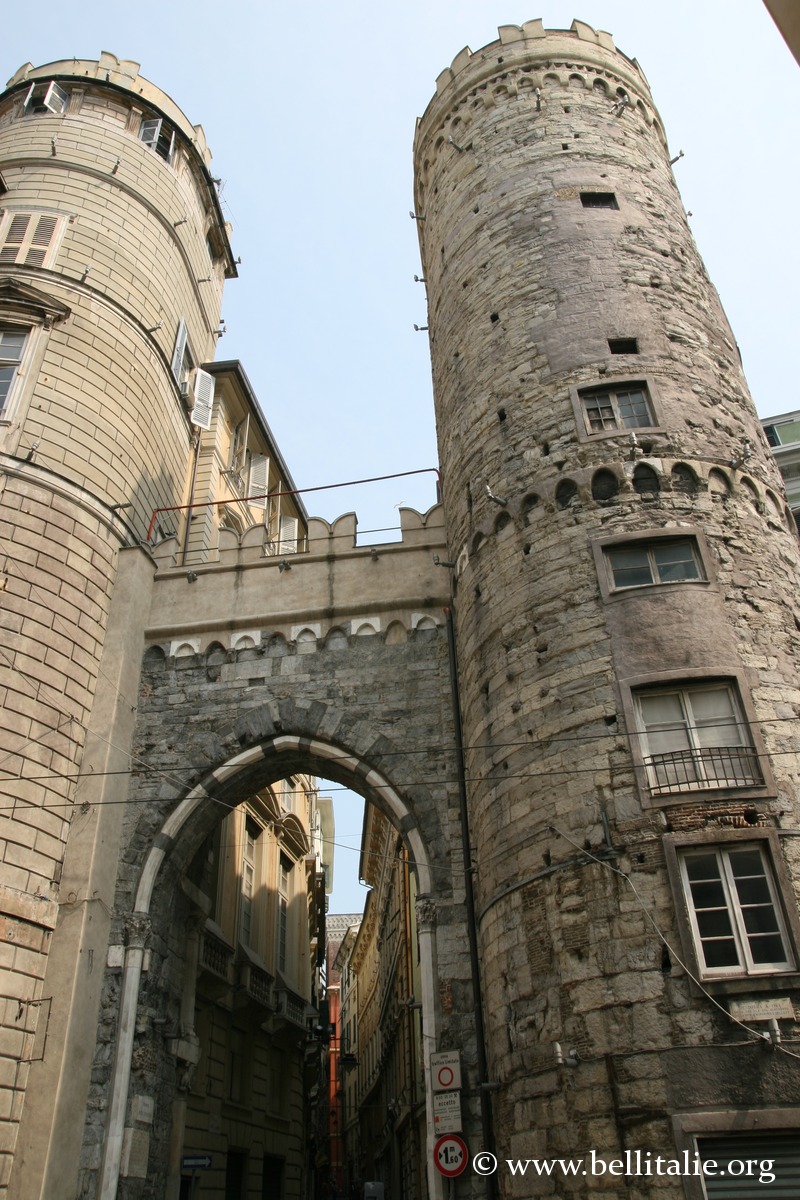
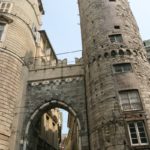
Porta dei Vacca
Genoa is the only large city in Liguria, with 560,000 inhabitants in 2021. For centuries it was a powerful maritime Republic, today a city full of contrasts, which lacks tourist renown although it is a fascinating destination.
It was built between the coast with the very lively old port and the relief of the hinterland, with its old town admirably preserved, made up of tall houses, narrow alleys, small squares and historic buildings such as the cathedral, the Renaissance and Baroque palaces, but also the old port with one of the most important aquariums in Europe and museums.
Cinque Terre 
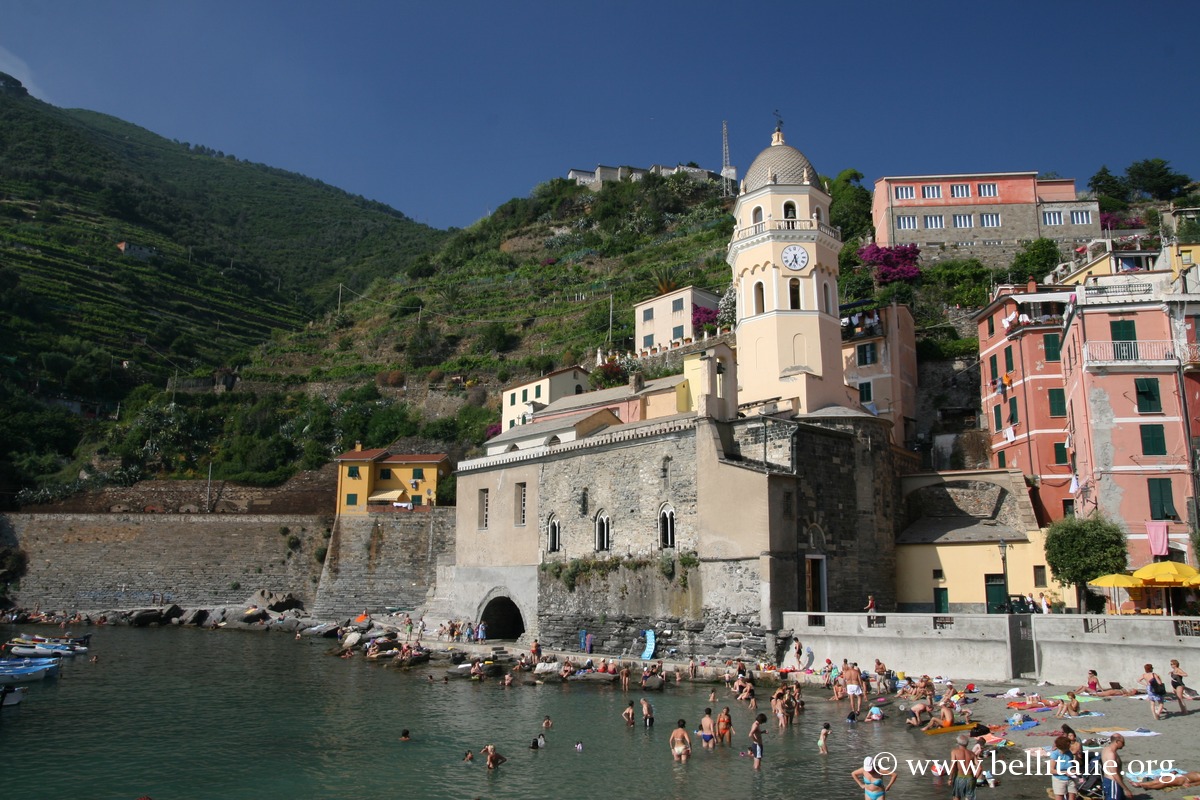
Vernazza
The Cinque Terre are five fascinating small localities embedded on a rocky portion of the eastern coast of Liguria: Monterosso al Mare, Vernazza, Corniglia, Manarola and Riomaggiore. Their charm is linked to the particular marriage between nature and the ingenuity of urban planning to settle on hostile terrain.
Since 1997, they have been inscribed on the Unesco World Heritage list. Being difficult to access by car, it is strongly recommended to visit them on foot, using the train or the splendid paths. Despite the high numbers of visitors on fine days, the panoramas remain sublime. Each village has its own personality, with their pretty colourful houses and small harbours, on rocks or between cliffs.
Riviera of Ponente
Riviera dei Fiori and province of Imperia 
Located in the province of Imperia, the Riviera dei Fiori is prized for its coast and its pleasant climate, stretching from Ventimiglia near the French border to Capo Mimosa towards Cervo.
Its coastline has many pretty towns, being very built-up and concreted in places. Seaside tourism is very developed there with many sand or pebble beaches, and some rocky ones.
Its hinterland is very hilly, living in particular from the olive oil produced from the Taggia olive.
The best-known destinations of the Riviera dei Fiori are Sanremo, Bordighera and Imperia, the first being the most upmarket.
Several pleasant cycle paths run alongside portions of the coast, including one of 24 km between Ospedaletti to the west of Sanremo as far as the outskirts of Porto Maurizio and Imperia.
Ventimiglia and Bordighera
Close to the border with France, Ventimiglia is already a real little Italian town with its 20,000 inhabitants, lively and dynamic, enlivened by trade thanks to the French coming there to do their shopping for Italian products.
From its long history, the town retains fine remains. Thus, caves bear witness to prehistory, a period also documented in the museums. The Roman era is recalled there with the remains of the theatre and other buildings, and the Middle Ages also bequeathed fine Romanesque monuments such as the cathedral.
Former fishing village, Bordighera became a fashionable tourist destination at the beginning of the 20th century thanks to its seafront, its mild climate and its pretty upper town of medieval origin and still protected by old ramparts.
Nowadays it is a small active and pleasant town, embellished by elegant houses and villas, with its gardens and parks including the Pallanca Exotic Garden. Its beaches, often pebbly, come alive in summer with numerous bars and restaurants.
From Sanremo to Taggia
Considered the capital of the Riviera dei Fiori, Sanremo is an elegant town famous for its annual Italian music festival, and frequented notably for its casino.
Tourism and the construction of luxurious villas developed there from the end of the 19th century, when the upper middle class came there to enjoy the climate.
Although unattractive at first sight with its dense traffic, Sanremo has many prestigious monumental villas and hotels, gardens, and indeed its picture-postcard seafront with its rows of palm trees. In complete contrast to this modernity is the district of La Pigna, the historic urban core, where stairways and typical alleys climb up to the sanctuary and the vast panorama.
Dating back at least to the 9th century AD, Bussana Vecchia is a medieval village that was destroyed in the 1887 earthquake. Restored in the middle of the 20th century, it has become a village of artists and craftspeople enjoying a pretty medieval centre, with cobbled alleys, evocative remains such as the castle or the church, gardens and artists’ workshops open to the public.
Near the mouth of the Argentina valley, Taggia is an old village with an old castle, fine Romanesque or Baroque churches, labyrinthine alleys, the Villa Curlo and its garden, and a rock sanctuary. It is known for its olives and the olive oil drawn from them. Dating back to the 13th century, its monumental bridge Ponte Antico is 275 metres long.
See: Sanremo, Bussana Vecchia and TaggiaFrom Imperia to Cervo
Imperia is a medium-sized town and a recent municipality that brings together 11 former villages, including coastal and historic ones, some living from fishing, others from olives. Its finest features are found on the one hand in the friendly and elegant district of Oneglia with its seafront near the old port. On the other hand, to the west of the modern port, Porto Maurizio is a historic village built on the Parasio hill. It has fine old buildings, pleasant alleys, sanctuaries and panoramic esplanades.
A few kilometres further east, Diano Marina is a quiet seaside town on the Gulf of Diano, with a fine promenade and a long sandy beach.
Cervo is a little marvel of the Riviera dei Fiori, an old village perched on a promontory very close to the coast. Its small historic centre is pedestrian, with stairs and cobbled streets, its craftspeople, and the majestic Baroque church that dates back to the time of the Knights of Malta.
Mountains of Ponente
Dolceacqua and Apricale
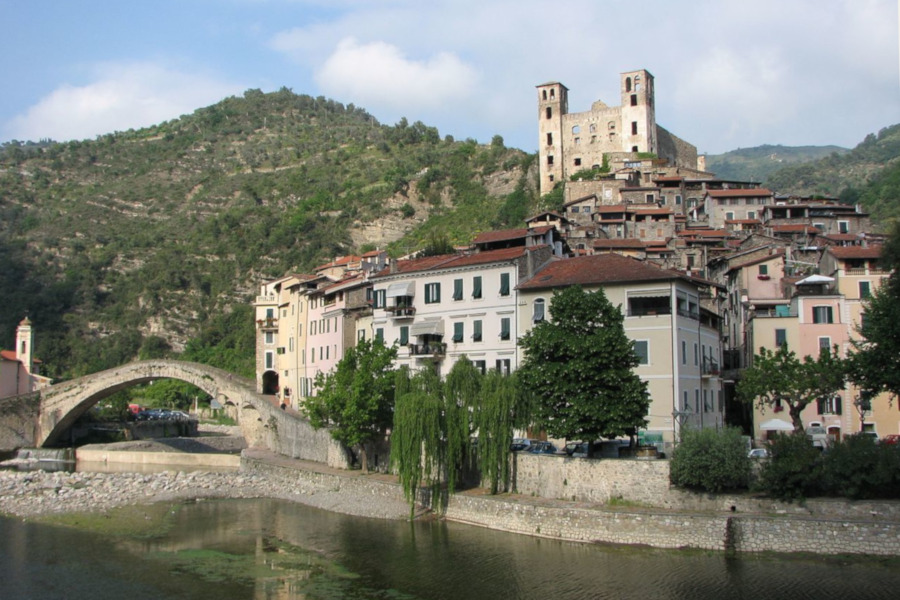 In the hinterland of Ventimiglia, the two nearby villages of Dolceacqua and Apricale are worth the detour. The first is a medieval village with a pretty old bridge immortalised by Monet, the remains of its old Doria castle and a surprising medieval centre. The latter is one of the most remarkable in Liguria, very evocative of the past thanks to its typical partly covered alleys, the carugi, which climb up to the fortress.
Apricale is another medieval village perched on a hill located in a valley covered with dense, verdant nature. Its charms are expressed in the harmonious central square, the houses decorated with artists’ paintings, and the maze of medieval alleys.
Dolceacqua and ApricaleSeborga, Pigna and Rochetta Nervina
In the hinterland of Bordighera and Sanremo, the small picturesque village of Seborga has the peculiarity of being a tiny principality, but unrecognised. A scholar committed himself to its independence in the 1960s relying on legal flaws. Occupied by the Templars in the 12th century, Seborga retains a few traces of them and historic buildings.
At the foot of the Alpine peaks and listed among the most beautiful villages in Italy, Pigna is perched on a hill in the upper Nervia valley. It was fortified in the 13th century, made up of a labyrinth of medieval alleys, stairs and vaulted passages. Its wooded surroundings also offer fine geological discoveries including hydrothermal springs.
A typical old medieval village reached by a Roman bridge, Rocchetta Nervina is known for its remarkable lakes with coloured waters, its canyons suitable for canyoning, and the fine walks to explore the valley.
Seborga, Pigna and Rocchetta MinervaTriora, Argentina valley and Ligurian Alps
Triora is perched at 900 metres above sea level in the foothills of the Ligurian Alps. This locality is known as “the town of witches” because of the violent persecutions that women suffered there in the 16th century. From an impregnable fortress under the Republic of Genoa, Triora has now become a charming village of the beautiful Argentina Valley, with palaces, fine bourgeois houses, porticoes, charming churches, remains and traces of its past and its “witches”.
From Monte Saccarello to the beaches of Arma di Taggia, the Argentina Valley is a pleasant destination, cool in summer, with its mountain landscapes, forests, bathing spots and historic villages.
The Ligurian Alps Park, almost 6,000 hectares in size, encompasses three valleys: the Nervia Valley, the Roia Valley and the Argentina Valley.
Triora, Argentina Valley and Ligurian AlpsRiviera of the Palms and province of Savona
The Riviera delle Palme (Riviera delle Palme in Italian) is the second portion of the Riviera di Ponente, in the province of Savona, from Capo Mimosa at Cervo to the mouth of the Arrestra river west of Cogoleto. Wide sandy beaches alternate with more beautiful and rocky portions such as the coast between Finalborgo and Savona.
The hinterland is very hilly and rich in paths. Among its natural beauties there are several famous caves, above all that of Toirano, or Monte Beigua in the Ligurian Alps with its nature park.
From Laigueglia to Albenga
Laigueglia is a fairly quiet small coastal town that has kept its character as a fishing village, unlike many other localities on the coast. Its alleys lead to the church of San Matteo, or pass through small squares. Near the small harbour, the sandy beach runs along the foot of the aligned houses. Paths set off to explore the pretty surrounding hills.
Alassio is a rather pleasant seaside destination, with its beautiful coast and sandy beaches, the main one being 4 km long. The heritage is interesting, with the “Wall of Alassio” decorated with ceramics signed by international artists, but also for the historic centre laid out in the Middle Ages, formed by a long pedestrian street parallel to the shore, with its shops and a historic pastry shop.
An ancient Roman town, Albenga preserves a remarkable and rich historic centre. Its medieval remains distinguish it, like Noli, from the other coastal localities. Let us mention pell-mell: the Romanesque cathedral, the early Christian remains, the medieval towers and the palaces. Offshore, the island of Gallinara has become a nature reserve, both land and sea. Several museums in the town document all these riches. Another attraction of Albenga is its Le Caravelle water park, to delight young and old.
Hinterland of Albenga
In the hinterland of Albenga, in the Neva Valley, Zuccarello is a charming village that stretches along the river, crossed by its main street flanked by arcades, with its small defensive towers, its Roman bridge and its sanctuaries. A 3 km path leads to Castelvecchio passing by the medieval castle and then crossing the hills.
Castelvecchio di Roca Barbena is perched at 1,100 metres above sea level. It is the most beautiful fortified village in the valley, at the foot of its powerful castle built by the Clavesana in the 11th century, whose medieval centre is very well preserved with several churches.
In the middle of the woods of the Pennavaire Valley, Colletta di Castelbianco is an unusual village, resembling a Berber village with its cubic houses. It was originally restored to be the first telematic medieval village, connected to allow remote working.
Hinterland of AlbengaFrom the Toirano caves to Pietra Ligure and Verezzi
Loano is a seaside resort with charm, benefiting from a seafront adorned with palm trees, with its beach and tourist facilities. Moreover, its historic centre is well preserved, with alleys, squares, palaces, small museums and the old castle.
5 km from the coast, the Toirano caves form one of the vastest underground karst complexes with its two main cavities, visited for their beauty, the countless stalactites and stalagmites, the traces of the cave bear but also those of human prehistory. In Toirano, the museum is devoted to the Val Varatella valley.
Pietra Ligure is a seaside resort and a pleasant town, divided between the modern town of Borgo Nuovo (with its promenades and pretty beaches), and the historic village of Borgo Vecchio (with its fine Romanesque basilica, the old castle, or the clock museum in Bardino Nuovo). Moreover, the hinterland has beautiful hills with many possible hikes, highly appreciated mountain-bike trails, climbing sites and caves.
Borgio Verezzi brings together two villages: Borgio on the coast and Verezzi on the heights. The latter is very small, on the side of a hill at the spot of a balcony over the Ligurian coast that opens between the old stones and the Mediterranean maquis. This village seems to have come straight out of a past century.
From Finale Ligure-Finalborgo to Noli-Bergeggi
With its rich and varied territory, Finale Ligure is a tourist destination for various reasons. On the one hand, it has fine seaside qualities as at Finalmarina and Finalpia, with one of the most beautiful coastlines of Ponente. On the other hand the hinterland has a great deal to offer, starting with the superb medieval village of Finalborgo which preserves a rich and evocative historic centre protected by its walls. Moreover, the natural riches of the hills and their paths are highly appreciated by mountain bikers, horse riders or climbers.
With its old little houses lined up facing a pleasant beach, Varigotti recalls Arab villages. It is a peaceful and quiet place, away from the rest of the sometimes tumultuous coast. Not far away, the Bay of the Saracens has one of the prettiest beaches in the region.
Finale Ligure and FinalborgoNoli is a superb small coastal town, and surely one of the most beautiful destinations in Liguria with its picture-postcard setting: the sandy beach of the bay in front of the pretty historic town from which palaces and a medieval tower emerge, the backdrop where the proud medieval castle stands on top of a hill striped by the old wall.
Its heritage dates back to the time of the first crusade for which Noli committed itself. It was even considered the fifth maritime republic.
As far as Bergeggi and beyond, beautiful beaches follow one another. Bergeggi is a small village built on the slopes of a hill, near a beautiful coast with, offshore, a verdant islet and an underwater park.
Noli and BergeggiFrom Savona to Arenzano
A small town of nearly 60,000 inhabitants, Savona is an important commercial and tourist port, whose main attraction is the Priamar, a large Genoese military fortress of the 16th century. It also houses several museums (art, archaeology, picture gallery, ceramics, computing), and in the centre one finds some sanctuaries and the old towers near the port.
Celle Ligure is an attractive small town on the riviera, as much for sports activities as for relaxation, on the coast and in the hills. It is formed by the modern district of Piani di Celli and by a historic village where the colourful houses line the seafront and the beautiful beach.
Varazze is a coastal town rich in history and a seaside resort, with its sand and pebble beaches, its beautiful villas, or its churches and fortresses that date back to the Middle Ages. The historic centre is crossed by the typical Ligurian alleys. The nearby Monte Grosso dominates the coast with its 400 metres of height.
The Lungomare Europa is a beautiful seafront linking Varazze to Cogoleto, a former railway line converted over 5 km, with a cycle path passing in front of beaches and caves.
On the other side, the Lungomare from Varazze to Celle which runs alongside the road has been laid out over 4 km and offers beautiful views of the coast and the vegetation.
20 km from Genoa, in the province of the latter, Arenzano is a nice town between sea and mountains, having beautiful villas and parks, late 19th and early 20th century in particular, churches and a botanical garden.
Savona, Celle Ligure, Varazze and ArenzanoHinterland, from Millesimo to Campo Ligure
In the hinterland of Savona, on the mountainous route towards Piedmont that has been travelled at least since Roman times, Millesimo is a wine-growing and historic village. The alleys of the historic centre lead to its castle and its charming fortified bridge is a rare example of its kind. Several churches have inherited a fine heritage from the past, and the town remembers historic events such as the passage of Napoleon.
30 km from Genoa and Arenzano, in a beautiful environment with its landscapes and rivers, Campo Ligure stands out with its proud castle and its medieval village, the Roman bridge or the palaces. The village is also one of the world centres of filigree jewellery.
In the surroundings, the Beigua Nature Park rises in the Ligurian Alps, highly appreciated for its geological and naturalistic qualities, and crossed by numerous paths.
Millesimo, Campo Ligure and Beigua ParkRiviera of Levante
The Riviera di Levante (Riviera di Levante in Italian) is the most prized coast of the region, between gulfs, coves, beaches and small villages: the Gulf of Paradise (Golfo Paradiso) from Nervi to Camogli; the promontory of Portofino; Portofino and the Gulf of Tigullio with the bays of Sestri Levante as far as that of Levanto; the fabulous Cinque Terre, the five small villages built on the rocky coast listed by Unesco (Monterosso al Mare, Vernazza, Corniglia, Manarola, Riomaggiore); or the Gulf of Poets from Portovenere to Lerici, passing through La Spezia.
Gulf of Paradise
The Gulf of Paradise which precedes the Promontory of Portofino is a beautiful coastal portion, between Nervi not far to the east of Genoa, as far as Camogli, with a succession of coves, small beaches, and picturesque villages such as Bogliasco or Recco.
From Bogliasco to Camogli
Close to Genoa, Bogliasco is a small village with a traditional character with its fishing boats and its typical houses, but also its surfers’ beaches.
Recco is only 20 km east of Genoa, known throughout Italy for the appetising and nourishing focaccia filled with cheese.
It is a fairly popular town, without anything exceptional, whose historic centre nevertheless has some interest with churches and buildings. It is also a good base for exploring the surroundings.
On the edge of the promontory of Portofino, Camogli has a historic centre, above all a fabulous and inspiring seafront whose bay is separated into two parts by a rock on which the old castle emerges from the water beside a church. Its charm also owes much to the typical tall colourful houses that line the beach and the small harbour.
Promontory of Portofino and San Fruttuoso
A nature reserve extends over the promontory of Portofino which culminates at more than 600 metres above sea level. It is crossed by beautiful paths with remarkable sites such as the hamlet of San Rocco, the summit of Portofino Vetta, the cove of San Fruttuoso and Punta Chiappa.
San Fruttuoso is a unique place, with an old abbey of the 11th century and a small fishing hamlet, located in a cove accessible only by sea or by steep paths.
Offshore, the Christ of the Abyss has been submerged since 1954, a bronze statue of nearly 4 metres whose head is 8 metres deep.
Portofino
At the western tip of the Gulf of Tigullio, Portofino is a chic and fashionable destination, with a touch of glamour, expensive for accommodation, where the small harbour is often “crushed” by yachts.
Beyond its luxurious appearance, it is nevertheless a charming place nestled in a bay between pretty wooded hills, where its colourful houses line the shore forming a pretty curve.
Its monuments and places are interesting, such as the church of San Martino in the historic centre, the promontory with the Brown Castle, the hermitage, the lighthouse, the nature park of the promontory and its marine reserve.
Gulf of Tigullio
Santa Margherita Ligure and Rapallo
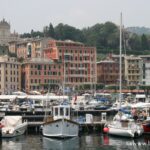
Santa Margherita Ligure is a pretty coastal town close to Portofino and often overlooked in favour of the latter. Yet it has a fine appearance with its pastel-coloured houses, its pretty villas such as the 17th-century Villa Durazzo, its gardens, its seafront, its beaches, its castle and several churches.
Another beautiful coastal town, popular and less fashionable than Portofino & co, Rapallo has beautiful seafront promenades. It stands out above all for its evocative fortress with its feet in the water, accessible by a footbridge. It is well supplied with bars and restaurants, and the small harbour and the old town have charm, with churches and the Villa Tigulio. One can also reach the nearby sanctuary of Montallegro, by cable car or on foot, with a superb balcony open towards the coast at nearly 600 m of altitude.
Santa Margherita Ligure and RapalloChiavari and Lavagna
These two small towns, of 28,000 and 13,000 inhabitants respectively, are more ordinary than the rest of the coast, on a coastal portion without relief. They are more popular and have large marinas and vast beaches. The centre of Chiavari is enhanced by its long medieval arcades. It also has a beautiful botanical garden, noble houses and villas.
Lavagna stands out for its sandy beach, but its historic centre is also of interest, with a medieval tower, the basilica or the old bourgeois house Casa Carbone.
The banks of the Entella river are protected by an oasis for fauna and flora.
From Sestri Levante to Levanto
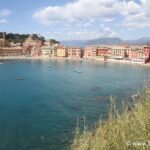
In the middle of the Riviera di Levante, Sestri Levante is somewhat eclipsed by its famous neighbour Portofino. Nicknamed “town of the two seas”, it nevertheless hides little treasures, in particular the enchanting Bay of Silence , a small idyllic spot, with its beach and its architecture, almost closed off by the tongue of the promontory of Isola.
The houses of the town centre are charming, painted with the traditional trompe l’oeil whose use dates back to the 15th century. It also preserves remarkable palaces.
Moneglia is a coastal village somewhat away from mass tourism. This reduced number of visitors contributes to its charm, benefiting from an advantageous position on its own small bay, where a peaceful and pleasant atmosphere is breathed, without pretensions, and where artisanal fishing still survives. Beyond its seaside beach, pleasant paths explore the surroundings.
Further south, Deiva Marina is appreciated for its large beach, and also its historic centre and the surroundings.
Two pleasant localities occupy small coves north of Levanto, easily accessible by train: the village of Bonnassola set at the bottom of its cove, and Framura with several hamlets on the hillside, and at the bottom an intimate beach.
Levanto, a pretty town in itself, is also a gateway to the Cinque Terre, for which one can easily take the train there. The town is framed by verdant hills, has sandy beaches and evocative old buildings such as medieval monuments, a loggia, churches, the ramparts and the castle. Its surroundings allow beautiful excursions, including paths leading to the Cinque Terre.
LevantoCinque Terre
The Cinque Terre are a unique place of the Riviera di Levante, a portion of the coast protected by a land and sea nature park, with landscapes blending nature, traditional agriculture and human architecture. It was inscribed in 1997 on the Unesco World Heritage list.
Along the rugged coastline, five old villages are nestled, between the maquis and the cliffs, four of which have a small harbour on clear waters, from north to south: Monterosso al Mare, Vernazza, Corniglia, Manarola and Riomaggiore.
Gulf of Poets, from Portovenere to Lerici
The Gulf of Poets is not the most visited coastal portion of Liguria, although it is rich in natural beauties and heritage. It unfolds between Portovenere to the north-west, a little south of the Cinque Terre, as far as Lerici and Tellaro, passing through La Spezia, and the Montemarcello regional nature park.
Portovenere and La Spezia
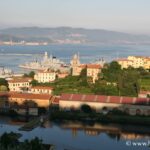
Close to La Spezia, Portovenere is located at the western tip of the gulf. Originally a small fishing town, it is very attractive, for example for the medieval remains of the walls and the castle, the harbour lined by the “Palazzata a Mare”, the row of tall pastel houses, the rocky promontory with the singular and very old church of San Pietro. Offshore from the latter, the island of Palmaria emerges, now a vast nature reserve, with beaches, hills and sea caves.
La Spezia is the “big city” of the Gulf of Poets, with its modern district, its active port, its arsenal and its industry. This city changed its face radically when Napoleon decided to build a naval base there. Little frequented by tourists, it nevertheless offers reasons to visit it, with its large seafront, the port, the museums (the naval museum in particular), or its stairways that climb up towards the upper town.
La SpeziaFrom Lerici to Sarzana
A small town on the Gulf of Poets, Lerici is a charming and popular seaside resort of the Riviera di Levante. It is appreciated for its sandy beaches and the beauty of the views over the bay. Standing on a rock with its feet in the water, the powerful medieval castle dominates the bay from its fine height. It also has a palaeontological museum, villas such as the Villa Marigola and its landscaped garden open to the sea, and not far north the castle of San Terenzo with its pretty little bay. Among the poets who passed through here, Lord Byron, Percy and Mary Shelley appreciated it in particular.
A few kilometres further south, Tellaro is an enchanting and old fishing village, very well preserved. Its photogenic rocky promontory is adorned with colourful houses accompanying the little pink church.
The promontory that closes the bay is occupied by the Montemarcello Regional Nature Park. Montemarcello is a pleasant and typical Ligurian village, from which one can reach the panorama of Punta Corvo, the old abbey, or take mule tracks to explore the beautiful surrounding garrigue.
In the coastal plain on the other side of the Magra river, there is the archaeological site of the Roman town of Luni, founded by the Romans. The places retain interesting remains, including mosaics and sculptures, and its museum houses beautiful works of art.
Sarzana has long been a lively border town, with its two castles including the fantastic Fortress of Sarzanello which dominates the territory from the top of the hill, rebuilt by the Medici. The historic centre is interesting, with the fine cathedral of Santa Maria Assunta founded in the 13th century and blending several architectural styles.
Mountains of Levante and hinterland of Genoa
In the mountains of the hinterland of the Riviera di Levante, pretty villages nestle between the hills.
A charming village of medieval origin, Brugnato enjoys a gentle atmosphere with its streets leading to the 12th-century cathedral built on two older churches, passing through small squares, with houses adorned with decorations, palaces, churches and the Roman bridge.
Varese Ligure is a village of originally defensive origin, noted for its organic production in its beautiful natural environment of meadows and woods. Moreover its historic centre is singular, with the Borgo Rotondo in the shape of an ellipse lined with fine colourful houses, and also its churches or the Fieschi castle.
The Antola regional park, considered the Genoese backyard, are mountains of the foothills of the Ligurian Apennines, particularly flowery in spring. On the border of three Italian regions, it culminates with Monte Antola at 1,600 metres. Well-marked paths cross its beautiful nature, between rocks and mixed forests, small rustic villages and old castles such as that of La Pietra which leans between two rocks.
Brugnato, Varese Ligure and Antola parkMap of the sites
 Show interactive map


Comments