


Seborga
In the hinterland of Bordighera and Sanremo, the picturesque village of Seborga has the peculiarity of being a tiny principality, not internationally recognized, which dates back to the 10th century. It was officially annexed to Savoy in 1729.
History
In 954, the Count of Ventimiglia ceded the territory of Seborga to the abbey of the Lérins Islands opposite Cannes. Its monks remained the princes of Seborga until 1700 when the fief was sold to the King of Sardinia Victor Amadeus II as a personal possession.
In the 1960s, a history scholar, Giorgio Carbone, noticed that the acts of annexation of Seborga to the Kingdom of Italy and then to the Italian Republic were not legitimate. He worked for the independence of the Principality of Seborga, assuming the title of Prince of Seborga under the name of Giorgio I and had his own currency minted. Today it is Princess Nina who continues the work.
In the Middle Ages Seborga was called “Castle of the Four Towers” and Bernard of Clairvaux, the founder of the Order of the Templars, named the first 8 knights there in 1117. As a testimony remains the austere Chapel Bernardo l’Antico which he had built.
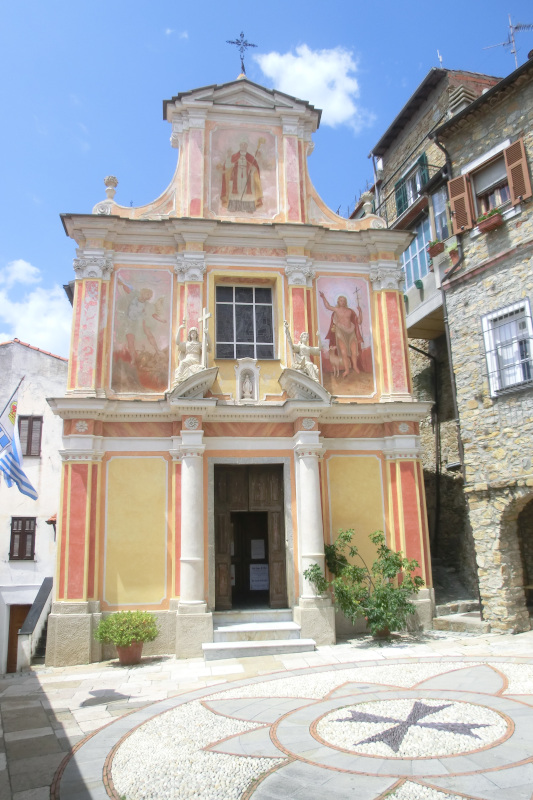
San Martino in Seborga
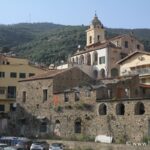
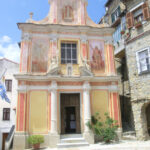
In Seborga you can see several monuments, such as the baroque church of San Martino from 1615, or the Palace of the Monks of medieval origin with a spring under the portico, which was the seat of the monk-princes.
The town has a Museum of Musical Instruments with 130 instruments, including special pieces, designed from the 18th century to the present day. You can also see the old prisons, the old baptismal font or the grotto of Seborga. This one was discovered recently, it served as a baptismal font for the monks, as a place for the initiation rites of the Templars. You can also discover an interesting educational farm.
Pigna
Also classified among the “most beautiful villages in Italy”, Pigna is located in the upper Nervia valley, in the heart of green hills that become increasingly wooded with chestnut and conifer trees as you go up the valley, preceding the Toraggio and Pietravecchia mountains.
The village is perched on a small hill where the bell tower of San Michele emerges, made up of a labyrinth of concentric medieval alleys with its staircases and vaulted passages.
The Counts of Ventimiglia fortified the place in the Middle Ages. In 1258 it passed under the control of the Counts of Anjou of Provence, then to Savoy in 1388. Located on the border of Savoy and the territory of Genoa, it was the scene of several confrontations.
Among the curiosities, on Piazza XX Settembre is the medieval loggia, the museum is dedicated to the traditional rural life of the 19th century in the Nervia Valley, or the church of San Michele from the 13th-15th centuries is well preserved.
An excursion called Anello di Pigna allows beautiful geological and naturalistic discoveries, including hydrothermal springs. The medieval hamlet of Buggio has recently found a second life thanks to the settlement of Europeans.
Rocchetta Nervina
The village of Rocchetta Nervina is known for its remarkable lakes and canyons.
A Celtic temple has been identified on Mount Abelio and the territory was occupied by the Romans. In the Middle Ages, the village was in the diocese of Ventimiglia which included the Roya Valley and the Nervia Valley, from Monaco to Bordighera. It was a possession of Savoy from 1388, on the border with the territory of Genoa.
Its lakes are very beautiful, with multicolored waters, fed by the Barbaira stream and its canyon suitable for canyoning. Beautiful walks roam this valley.
A pretty Roman bridge leads to the old village and its pretty partly covered alleys, the Ligurian caruggi.
It has small churches and in the heart of the center San Stefano founded in the 16th century on the main square.
Weather in Seborga
Map
If you see this after your page is loaded completely, leafletJS files are missing.
Information
- Seborga: en.wikipedia.org, www.principatodiseborga.com, www.inviaggioconmonica.it, www.agriturismolegirandole.com
- Pigna: en.wikipedia.org, www.touringclub.it, www.agriturismolegirandole.com
- Rocchetta Nervina: en.wikipedia.org, www.rocchettanervina.com
- What to see in Liguria
- Genoa
- Cinque Terre
- Sestri Levante
- Lerici, Tellaro and Montemarcello
- Portovenere
- Albenga
- Noli
- Rapallo
- Ventimiglia and Bordighera
- Other places of the Riviera di Levante
- Dolceacqua and Apricale
- From Savona to Arenzano
- Imperia and Cervo
- Finale Ligure and Finalborgo
- Gulf of Paradise – From Bogliasco to Camogli
- Sanremo, Bussana and Taggia
- Seborga, Pigna and Rocchetta Nervina
- Levanto
- From Moneglia to Bonassola
- Santa Margherita Ligure
- Triora, Argentina Valley and Ligurian Alps


Comments