


Millesimo
On the mountainous road of the Langhe, which was once a Roman route to reach Piedmont, Millesimo was the homeland of the marquises Del Carretto. The village surrounded by vineyards also bears witness to the past industrialization of the Bormida Valley, and to the passage of Napoleon.
The old peasant houses line the Bormida river crossed by a famous bridge. The streets of the historic centre lead up to the castle at the top. You can also discover the palace of the Del Carretto built on part of the old medieval walls.
The Gaietta Bridge is one of the rare Italian examples of a fortified bridge, dating back to the 12th century. The town was founded in 1206 and the castle was built to control this strategic route between Piedmont and Liguria. Its oldest elements date from the 13th century.
At the foot of the castle, the Villa Scarzella surrounded by a magnificent garden was built in 1855, and today houses the Napoleonic Museum and the Visitor Centre of Bric Tana and the Valley of the Three Kings.
In the Town Hall, the council chamber preserves precious suits of armour, and the altar where in August 1809, Pope Pius VII, who was then a prisoner of Napoleon, attended Mass. Bonaparte received the flags of the Piedmontese in April 1796 after the capture of the castle of Cosseria.
Sant’Antonio Abate was one of the three monasteries of Millesimo, consecrated in the 15th century. Santa Maria extra muros is a Romanesque basilical building from the 12th century with a 15th-century bell tower and a beautiful interior.
The monastery of Saint-Étienne is also of medieval origin, now privately owned, whose church was remodelled in the Baroque style in the 17th century, with a 15th-century cloister, and a courtyard with a remarkable 14th-century fresco (Virgin, Saint Stephen and the del Carretto family).
Campo Ligure
In the Ligurian hinterland about 30 km from Genoa or Arezano, Campo Ligure is classified among the “most beautiful villages in Italy”, at the junction of the Stura, Angassino and Ponzema rivers. Its name is inherited from a Roman camp of the 3rd century BC. It is located in the Beigua Natural Park, the largest in Liguria and among the most appreciated for its particular features.
The village is remarkable notably for its proud medieval castle of the Spinola dominating the town, the elegant Roman bridge over the Stura, the Spinola palace and its beautiful painted facade on the main square, the colourful houses, or the caruggi of the village. Along these alleys are artisan workshops.
Campo Ligure is also known for the making of filigree jewellery (Filigrana), a particular and highly elaborate jewel, in gold and silver in particular, whose history is documented by a museum.
The surroundings are full of charm with beautiful landscapes, swimming rivers, mountain hikes, or the Pratorondanino botanical garden.
Beigua Park
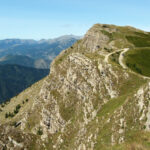
Entering the Ligurian Alps of the hinterland, the Beigua Park is a regional natural park protecting nearly 400 km². Besides its geological interest and its fossils bearing witness to 200 million years, it is home to beautiful fauna and flora, including several ecosystems such as the Mediterranean maquis, coniferous forests, moors and flowering meadows. Birds of prey thrive there, including the peregrine falcon, along with roe deer, and the discreet Italian wolf.
The trails are numerous, for hiking, cycling, or horse riding.
Weather in Millesimo
Map
If you see this after your page is loaded completely, leafletJS files are missing.
Information
- Millesimo: en.wikipedia.org, www.agriturismolegirandole.com, borghipiubelliditalia.it
- Campo Ligure: en.wikipedia.org, www.lascimmiaviaggiatrice.it, borghipiubelliditalia.it
- Beigua Park: en.wikipedia.org, www.parcobeigua.it
- What to see in Liguria
- Genoa
- Cinque Terre
- Sestri Levante
- Lerici, Tellaro and Montemarcello
- Portovenere
- Albenga
- Noli
- Rapallo
- Ventimiglia and Bordighera
- Other places of the Riviera di Levante
- Dolceacqua and Apricale
- From Savona to Arenzano
- Imperia and Cervo
- Finale Ligure and Finalborgo
- Gulf of Paradise – From Bogliasco to Camogli
- Sanremo, Bussana and Taggia
- Seborga, Pigna and Rocchetta Nervina
- Levanto
- From Moneglia to Bonassola
- Santa Margherita Ligure
- Triora, Argentina Valley and Ligurian Alps


Comments