


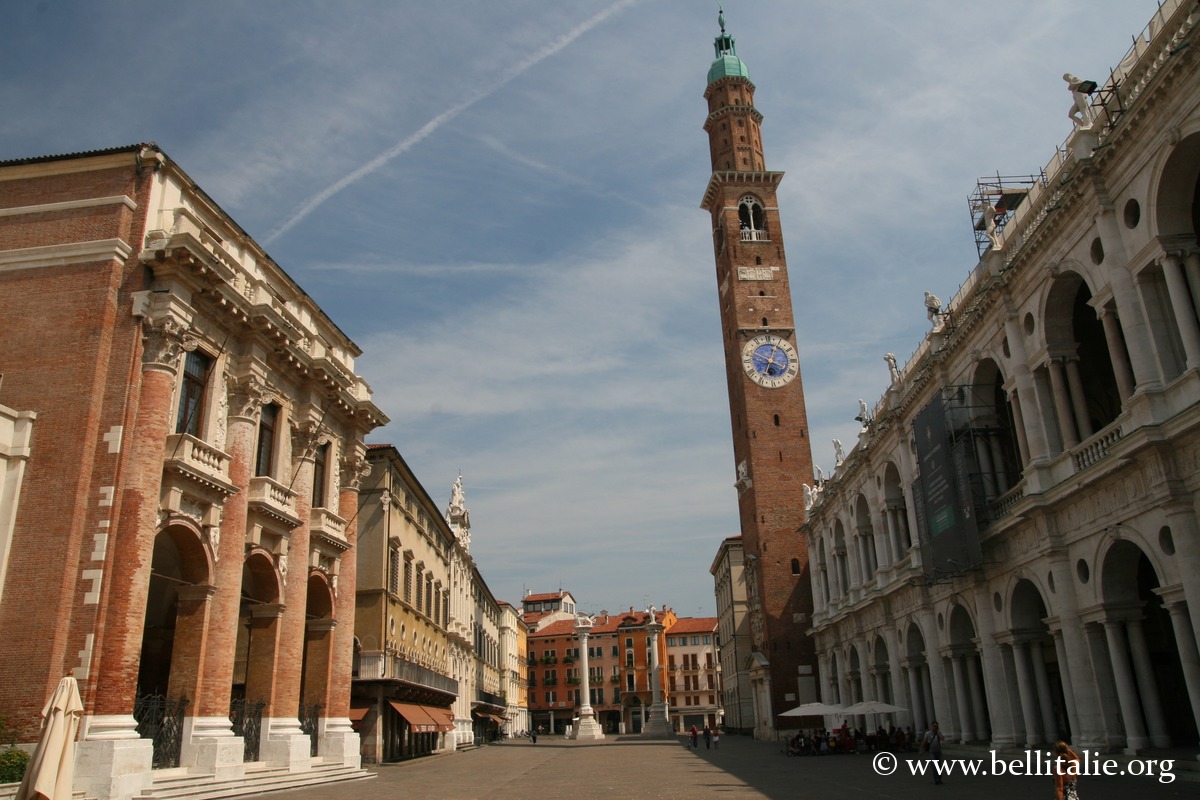
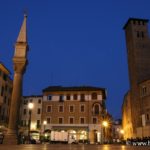
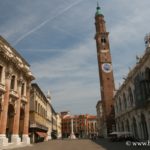
 Of moderate size with nearly 111,000 inhabitants in 2021, Vicenza is a magnificent small town inscribed as a UNESCO World Heritage Site, located between Venice and Verona. Much of its monumental heritage comes from Andrea Palladio, a local mason who became an outstanding architect of late Baroque in the 16th century. Vicenza’s architecture had a great influence on European urban planning. It is around the Piazza dei Signori that the city’s most beautiful buildings are found, with the Palladian Basilica, the Palazzo del Capitaniato, then the Olympic Theatre and the Villa Rotonda, or by strolling along the Corso Palladio.
History
The occupation of the territory of Vicenza dates back at least to the Bronze Age, by a Euganean people. The city was conquered in 157 BC by the Romans, who named it Vincentia (the victorious). At the fall of Rome, it was ruined by invaders and only regained its stature under the Ostrogothic kingdom, then under the Lombards.
Like many cities in northern Italy, it became a republic in the 12th century, a supporter of the Lombard League. But it was pillaged by Frederick II in 1236, then subsequently passed into the hands of great families, including the Romano, then the Della Scala, before being integrated into the Venetian province in 1404.
It underwent a French invasion in 1796, followed by Austrian rule, before being annexed to the Kingdom of Italy in 1805, then to the Kingdom of Lombardy-Venetia in 1815, until the war of the Risorgimento with the unification of Italy, which it joined in 1866.
Tourist sites in Vicenza
See also the page of Places to see in Vicenza, with the Interactive tourist map of Vicenza
- Other places in Vicenza: Roman Cryptoporticus, Palazzo Thiene, Loggia Valmarana, Palladio Museum of Palazzo Barbaran, Walls of Vicenza, Palazzo Valmarana Braga, San Michele Bridge, Querini Park, Palazzo Leoni Montanari, Church of Santa Corona, Natural History and Archaeological Museum, Diocesan Museum, Jewelry Museum, Contrà Porti, Sanctuary of Monte Berico.
Weather in Vicenza
Information
- Tourism portals: www.vicenzae.org (province of Vicenza), www.veneto.eu (Veneto region)
- Wikipedia page: en.wikipedia.org
Maps
If you see this after your page is loaded completely, leafletJS files are missing.


Comments