
In the mountains of the hinterland of the Riviera di Levante, pretty villages are nestled among the hills, such as Torriglia, Sesto Godano, Varese Ligure, Brugnato and Montoggio.
Brugnato
On the banks of the Vara in the Montemarcello-Magra Natural Park, Brugnato is a charming town with a Provençal atmosphere, with small intimate squares (Piazza Maggiore, Piazza San Pietro), although the houses have the local pastel colours. The two alleys of the very centre join the cathedral built in the 12th century, like two arms.
The elliptically shaped town was in the past protected by moats, now filled in.
Religious and other ornaments are found on the portals of the houses or in the niches, witnesses of faith in the ancient household guardians, derived from the “lares” of antiquity.
The 12th-century cathedral is divided into two naves separated by columns, formed over two older churches, the oldest of which, beneath the main nave, dates back to the Byzantine era (6th century). In the apse are sculpted Saints Peter, Lawrence and Columbanus. On a column is depicted Abbot Saint Anthony in a 15th-century fresco, other 16th-century frescoes have recently been revealed.
The neighbouring episcopal palace dates back to the 12th century, on the site of the former abbey of San Colombano, remodelled in the 17th century (Baroque), now the seat of the Diocesan Museum.
Among the sanctuaries, near the gates are the oratories of San Bernardo, of Saints Rocco and Caterina; the monastery and the church of San Francesco from the 17th century; on a hill the sanctuary of Our Lady of the Olive Tree rebuilt in the 17th century.
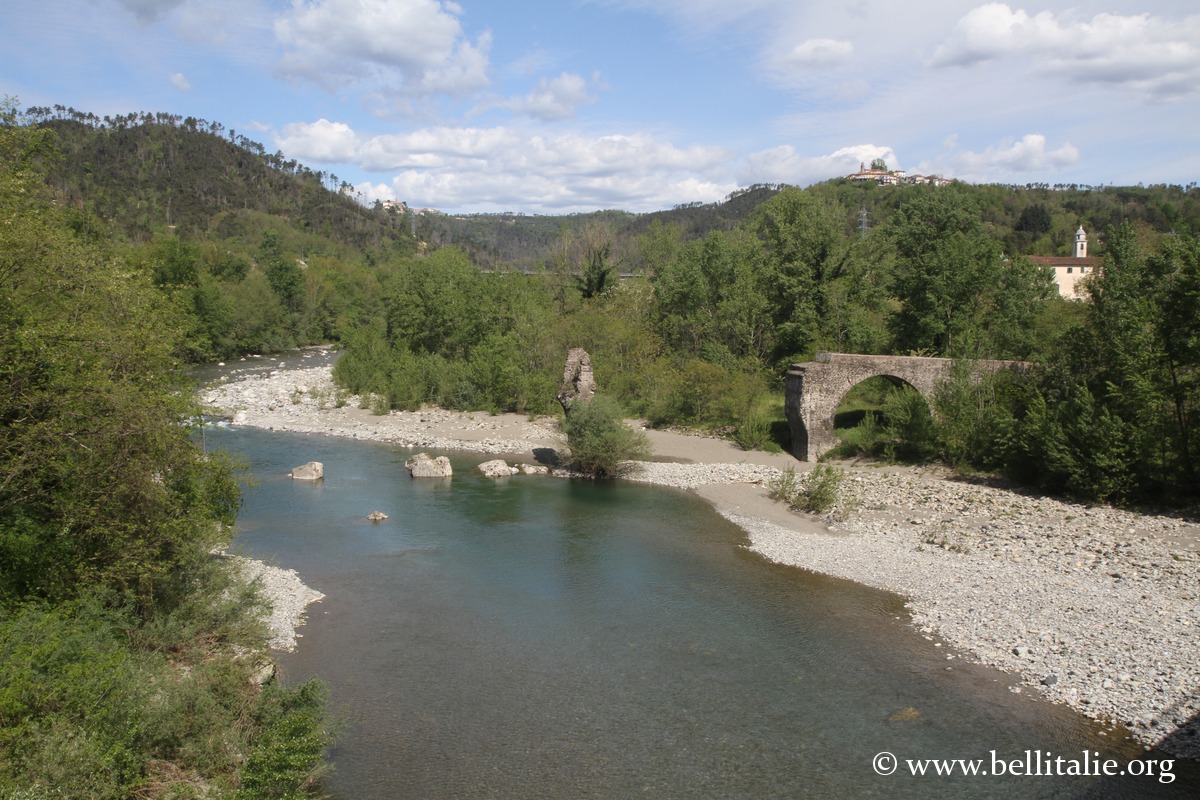
The Roman bridge over the Vara is probably of Roman origin.
Antola Regional Park
The Antola Regional Park extends across the hinterland of Genoa, over beautiful “flowering mountains” of the Ligurian Apennines, where the meadows bloom in spring, with many rare species.
It lies on the border of three regions: Liguria, Piedmont and Emilia-Romagna.
It includes around Mount Antola and its 1,600 metres of altitude, the upper valleys of the Scrivia and Trebbia, crossed by many pleasant well-marked trails, with a pre-Alpine landscape, an artificial lake, remarkable rocks, mixed forests of beech, oak, chestnut, hornbeam, maple, etc.
The villages preserve centuries-old craft traditions.
In the Vobbia Valley, the peculiar castle of La Pietra stands out between two rocks, said to date from the 12th century.
Varese Ligure
The town of Varese Ligure is recognised for its organic production, which accounts for 95% of its agricultural activity, and has recently been enhanced, unique with its Borgo Rotondo, the medieval core of a fortified village shaped like an ellipse with colourful houses, arcades, artisans; the Fieschi castle.
Nestled between valleys of the Ligurian Apennines on the border with Emilia-Romagna, which can be reached via the panoramic road leading to Borgotaro passing through the Cento Croci pass, crossing meadows and woods.
The castle with its tower dates from 1435. The houses have beautiful stone portals and the churches are interesting: San Filippo Neri and Santa Teresa d’Avila from the 17th century; San Giovanni Battista from the 17th century, with an alabaster Virgin and Child from the 16th century, the wooden choir, etc.; 17th-century Oratory of Saints Antonio and Rocco.
In the surroundings, the elegant Grexino Bridge dates from the 16th century.
Map
If you see this after your page is loaded completely, leafletJS files are missing.
Information
- Brugnato: www.terredilunigiana.com, borghipiubelliditalia.it
- Varese Ligure: www.visitlevanto.it, borghipiubelliditalia.it
- Antola Park: www.parcoantola.it, www.genovatoday.it
- What to see in Liguria
- Genoa
- Cinque Terre
- Sestri Levante
- Lerici, Tellaro and Montemarcello
- Portovenere
- Albenga
- Noli
- Rapallo
- Ventimiglia and Bordighera
- Other places of the Riviera di Levante
- Dolceacqua and Apricale
- From Savona to Arenzano
- Imperia and Cervo
- Finale Ligure and Finalborgo
- Gulf of Paradise – From Bogliasco to Camogli
- Sanremo, Bussana and Taggia
- Seborga, Pigna and Rocchetta Nervina
- Levanto
- From Moneglia to Bonassola
- Santa Margherita Ligure
- Triora, Argentina Valley and Ligurian Alps


Comments