


Notable places in Vicenza, with the Vicenza tourist map below.
1. Piazza dei Signori
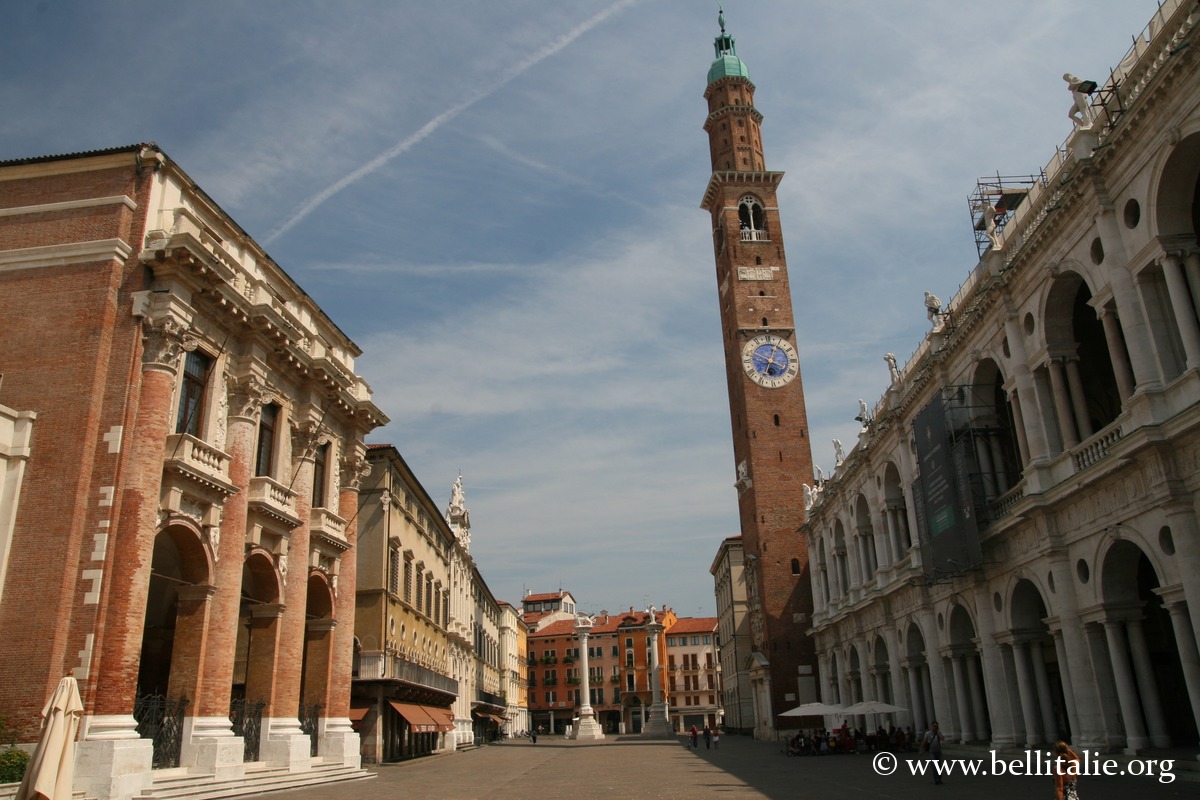
Piazza dei Signori
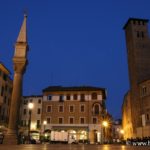
The splendid Piazza dei Signori is the central square of Vicenza, surrounded by remarkable buildings. Two nearby columns stand out at one of its ends: the one with the lion of Saint Mark (1473), erected upon the submission to the Republic of Venice, and the one with Christ the Redeemer (1647).
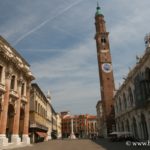
On the south side of the square, the Palladian Basilica is the masterpiece of Andrea Palladio, adjacent to the Bissara Tower, which rises to a height of 82 meters. On the other side, the Palazzo del Monte di Pietà (1486) frames the pretty church of San Vincenzo (Baroque and Gothic, 14th-18th century). Then the Palazzo del Capitaniato was also built by Palladio in 1565, as the seat of the captain, the representative of the Republic of Venice, with its loggia of four columns, vaulted and topped by a large hall. On the Contra del Monte side, the statues and stucco coats of arms celebrate the victory of Venice at the Battle of Lepanto in 1571.
2. Palladian Basilica
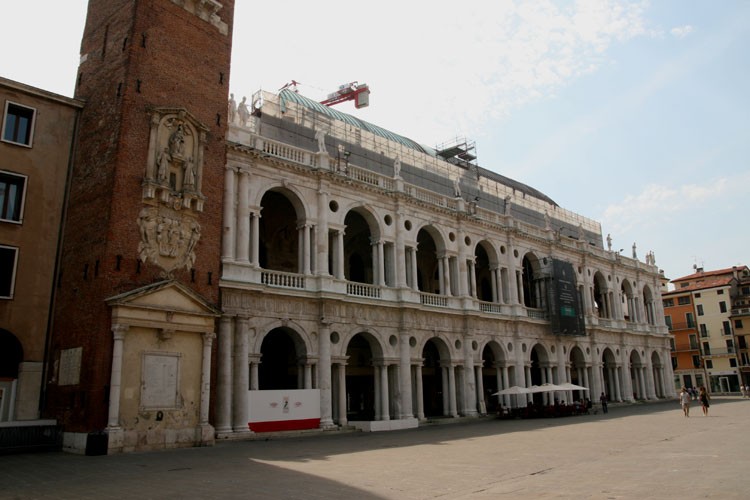
Palladian Basilica
Named “basilica” by Andrea Palladio (basilica palladiana in Italian) in reference to the basilicas of ancient Rome, it is indeed not a place of worship, but as in antiquity the place where politics and legal affairs were conducted.
Palladio added the superb white marble loggias to the previous Gothic building known as Palazzo della Ragione (15th century), a time when the vast hall occupying the upper floor (hall of the Council of the Four Hundred) was fitted out and covered. The marble staircase provides access to the upper loggia with its terrace.
3. Olympic Theatre
Designed by Andrea Palladio around 1580, and whose construction was completed by his son Silla in 1585, the Olympic Theatre (Teatro Olimpico in Italian) in Vicenza is a marvel considered the architect’s masterpiece. At the time there were still no “fixed” theaters, performances taking place in improvised venues, halls, courtyards and others.
It is inspired by ancient Roman open-air theaters, with an elliptical cavea, tiers and a colonnade with niches occupied by statues. The stage is the most beautiful part of the work, formed of two levels, with arcades, half-columns, niches, statues and bas-reliefs.
Moreover, the set of the first performance (1585) has remained, built for Sophocles’ Oedipus Rex, where the scenography reproduces with a perspective effect the seven streets of Thebes.
4. Corso Andrea Palladio
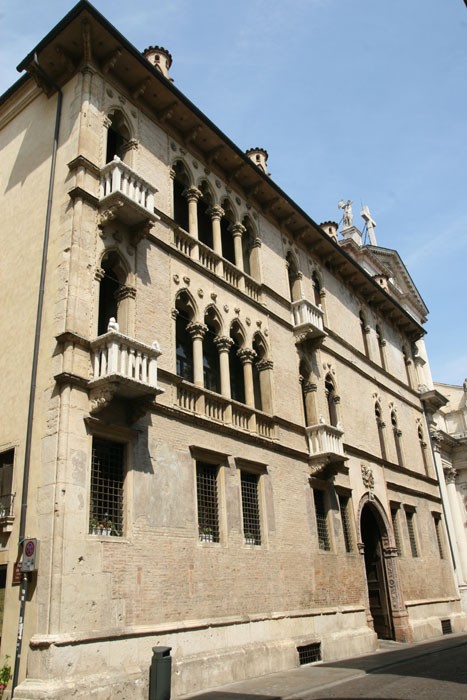
Palazzo da Schio
Parallel to Piazza dei Signori, corso Andrea Palladio is the main artery of Vicenza, a pedestrian and shopping street lined with porticoes, with palaces mostly designed by Palladio, churches and museums. At the western end is Piazza del Castello, with the Palazzo Thiene Bonin Longare and the unfinished Palazzo Porto Breganze. Then one passes the Church of San Filippo Neri, the Palazzo Trissino-Baston which houses the town hall, then the charming Palazzo da Schio (or Ca’ d’Oro) in Venetian style, the church of San Gaetano, the church of Santa Corona, the Palazzo Leone Montanari with its interesting museum.
On Piazza Matteotti, the eastern end of the corso, stand two major Palladian buildings: the Olympic Theatre and the Palazzo Chiericati, which houses the picture gallery.
5. Vicenza Cathedral and archaeological area
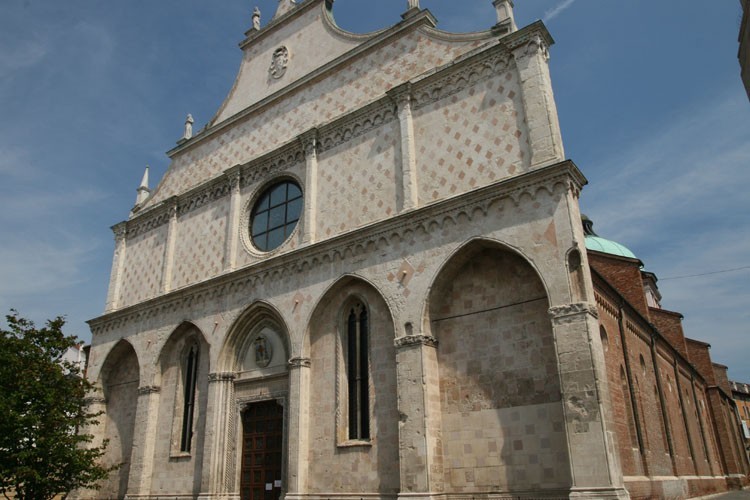
Vicenza Cathedral
The Cathedral of Santa Maria Annunziata (or Duomo of Vicenza), was erected in the 13th century and remodeled over the centuries, now displaying a late Gothic style of the 15th century.
The dome, the portal and the Alberico chapel were worked on by Palladio in the 16th century.
Inside, with a single nave, the apse is a Renaissance addition. The marble altar of 1541 is framed by 12 large 17th-century canvases.
In the underground areas, an archaeological area of nearly 750 m2 extends, with remains of Early Christian and Romanesque buildings (5th to 13th century), a Roman road and a vast domus.
6. Palazzo Chiericati and museum
Palladio was commissioned to build this palace for Count Girolamo Chiericati. Construction began in 1550 but was interrupted in 1557 by the count’s death, only to be fully completed much later. The palace evokes the architecture of classical antiquity, with three loggias on the ground floor, Doric columns below, Ionic above, and a roof adorned with statues.
The interior preserves period decorations such as the frescoed ceilings and loggias, as well as documents on the history of Vicenza.
The palace houses the civic museum with the picture gallery, enriched over the centuries by works of major artists from the Middle Ages to the Baroque, such as Tintoretto, Veronese, Tiepolo, or Bassano. It also preserves sculptures and a collection of contemporary art, thanks to the donation of a local publisher, enriched in 2012 by around a hundred works from the collection of Marquis Giuseppe Roi.
7. Villa Rotonda
Located about 2 km from the center of Vicenza, the Villa Rotonda is a major work by Palladio, praised for centuries by travelers for its architectural beauty.
It was built for the pontifical prelate Paolo Almerico, who wanted a home outside the city where he could retire.
The construction is directly inspired by the Pantheon in Rome, though with four identical facades, each with stairs, six columns and a triangular pediment, and at the center a circular hall topped by a dome.
The interior decoration is no less remarkable, with the dome’s balcony, its reliefs and its frescoes depicting religious allegories, and below figures of gods from Greek mythology.
9. Villa Valmarana ai Nani
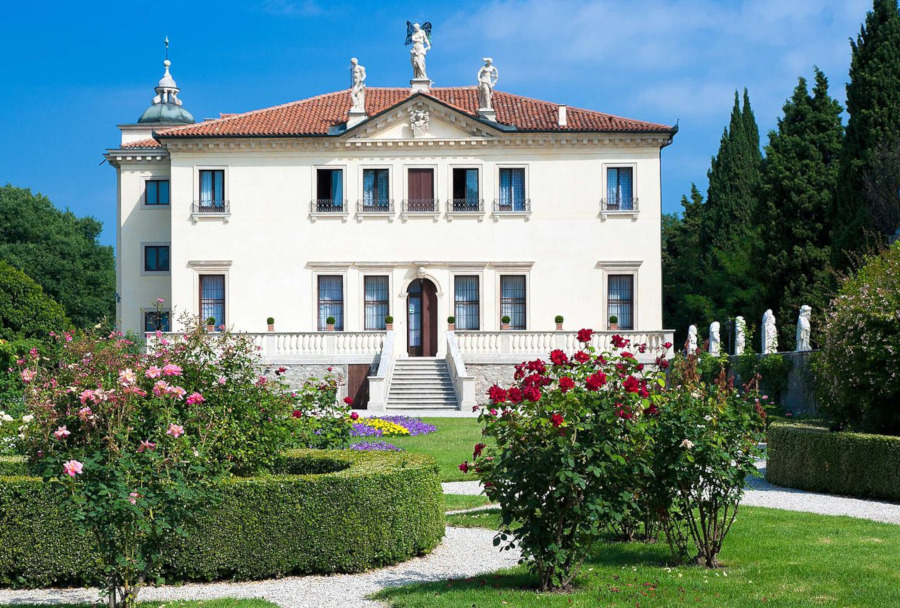
Villa Valmarana ai Nani
When you discover the Villa Valmarana, near the Villa Rotonda, you immediately notice the statues of dwarfs (nani in Italian) on the boundary wall. These curious figures in 18th-century clothing are said to have been the guardians of a nobleman’s young daughter who suffered from dwarfism.
The building preserves beautiful interior frescoes: father and son Giambattista and Giandomenico Tiepolo, who shared the work. They depict great epic themes executed by the father, drawn from the Iliad, the Aeneid, Orlando Furioso, etc. The son Giandomenico was responsible for the decorations of several salons.
10. Church of San Lorenzo
The beautiful Church of San Lorenzo was founded in 1280. It combines Cistercian and Romanesque architectural elements. The facade is marked by its slender inlaid arches, the central rose window and the oculi, four elegant sarcophagi and a remarkable portal sculpted by Andriolo de’ Santi. The pretty cloister dates back to the 15th century.
The Gothic interior with its powerful columns preserves valuable works including the Pojana Altar, the Piovene Altar, the counter-facade or the Chapel of Saint Francis of Assisi.
Other places in Vicenza
Roman Cryptoporticus
On the south side of Piazza Duomo, you can access the Roman Cryptoporticus (Criptoportico Romano), one of the main ancient remains in Vicenza, with its three branches forming a U, which was perhaps a portico attached to a noble house of the 1st century BC.
Palazzo Thiene
This important palace of the powerful Vicenza family of the Thiene was probably built by Giulio Romano, then later remodeled by Palladio, then an emerging architect. It has Gothic exterior facades, an interior courtyard with an atrium probably by Romano, and on the upper floor reliefs with capitals by Palladio. The palace was bought in 1872 by the Banca Popolare di Vicenza, is today the historic headquarters of the Institute and preserves art collections.
Loggia Valmarana
Near Piazza Castello, the small Giardini Salvi hide the pretty little monument of the Loggia Valmarana, with its feet in the water at the corner of the elongated basin, with its six columns supporting a triangular pediment.
Palladio Museum of Palazzo Barbaran
The Palladio Museum is located in the elegant Palazzo Barbaran da Porto, designed by Palladio. It houses a museum dedicated to the life and work of Palladio, enhanced by models of the architect’s creations or portraits of him. The facade stands out with its Ionic columns on the ground floor and its Corinthian columns on the first floor.
Contrà Porti
Perpendicular to Corso Andrea Palladio, the narrow street Contrà Porti is home to some of the most beautiful palaces in Vicenza: the Gothic-Venetian Palazzo Thiene Cavalloni, Palazzo Thiene, Palazzo Barbaran da Porto, the courtyard of Palazzo Porto Breganze, Palazzo Iseppo da Porto, and the Gothic-Venetian Palazzo Colleoni-Porto.
Walls of Vicenza
A few portions of boundary walls dating from various periods remain in Vicenza.
The walls along Viale Giuseppe Mazzini date from the 14th century. Several access gates remain from this enclosure, including Porta Santa Croce, Porta Nova, Porta Santa Lucia and Porta San Bartolo.
On the wall dating back to antiquity and the early Middle Ages, there remain for example near Porta Castello the Tower of Porta Castello (erected in the 12th century), the Porton del Luzo or the Ponte delle Barche.
Palazzo Valmarana Braga
Work by Andrea Palladio from 1565 with six tall bays on the facade.
Ponte San Michele
17th-century pedestrian bridge, the prettiest in the city.
Querini Park
The pleasant Querini park is one of the main green spaces in Vicenza, made up of varied expanses and groves. On a small island in the middle of the pond stands a small neoclassical temple built in 1820 by Antonio Piovene.
Palazzo Leoni Montanari
The Palazzo Montanari is a 17th-century Baroque building that houses the Gallerie d’Italia (Gallerie d’Italia in Italian), with three art collections belonging to Banca Intesa San Paolo. On the ground floor, a rotating selection of vases and ceramics is exhibited; on the first floor mainly 18th-century paintings, most notably the Fall of the Rebel Angels by Agostino Fasolato, a Carrara marble pyramid representing sixty angels made in the 18th century. The upper floor is devoted to an important collection of Russian icons.
Church of Santa Corona
The Church of Santa Corona was founded in 1270. It preserves remarkable works, including the Baptism of Christ by Giovanni Bellini, the Valmarana Chapel by Palladio, and works by Paolo Veronese, Giovanni Battista Pittoni and Bartolomeo Montagna.
The remains of Andrea Palladio were kept there from 1580 until the middle of the 19th century, before being moved to the main cemetery.
Natural History and Archaeological Museum
Around the two Dominican cloisters of the church of Santa Corona is arranged the Natural History and Archaeological Museum of Vicenza. The archaeological section mainly displays a few discoveries from the surroundings ranging from the Paleolithic to the Lombard period.
Diocesan Museum
The Episcopal Palace houses the recent Diocesan Museum, dedicated to the religious history of Vicenza and its churches, from the beginnings of Christianity, with sarcophagi, steles, a collection of paintings, manuscripts and precious liturgical objects.
Jewelry Museum
Small museum dedicated exclusively to jewelry and design, occupying part of the Palladian Basilica, on Piazza dei Signori.
Sanctuary of Monte Berico
Located about 1.5 km from the center of Vicenza, the Basilica of the Madonna of Monte Berico is said to have been built on the site where Mary appeared several times to a peasant woman, in 1426 and 1428, during devastating outbreaks of plague. She is said to have declared that she would deliver the city from the plague if a sanctuary were built for her.
The Piazza della Vittoria in front of the building was laid out in 1924 in memory of the dead of the First World War.
The church preserves 16th-century works, and in particular the statue of the Virgin of Mercy on the altar, made by Nicolò da Venezia in 1430.
Map of places
 Show interactive map
Information
- Wikipedia page: en.wikipedia.org
- Tourist portals: www.vicenzae.org (province of Vicenza), www.veneto.eu (Veneto region)
- Blogs: souvenirdiviaggio.it


Comments