

This page dedicated to the heritage of the Camonica Valley complements the general presentation, by travelling through the valley from south to north, from the lower valley to the upper valley, from the shores of Lake Iseo to the Passo del Tonale.
Also see more specifically the page with most of the rock art archaeological sites of Val Camonica.
 Show interactive map
 Lake Iseo 
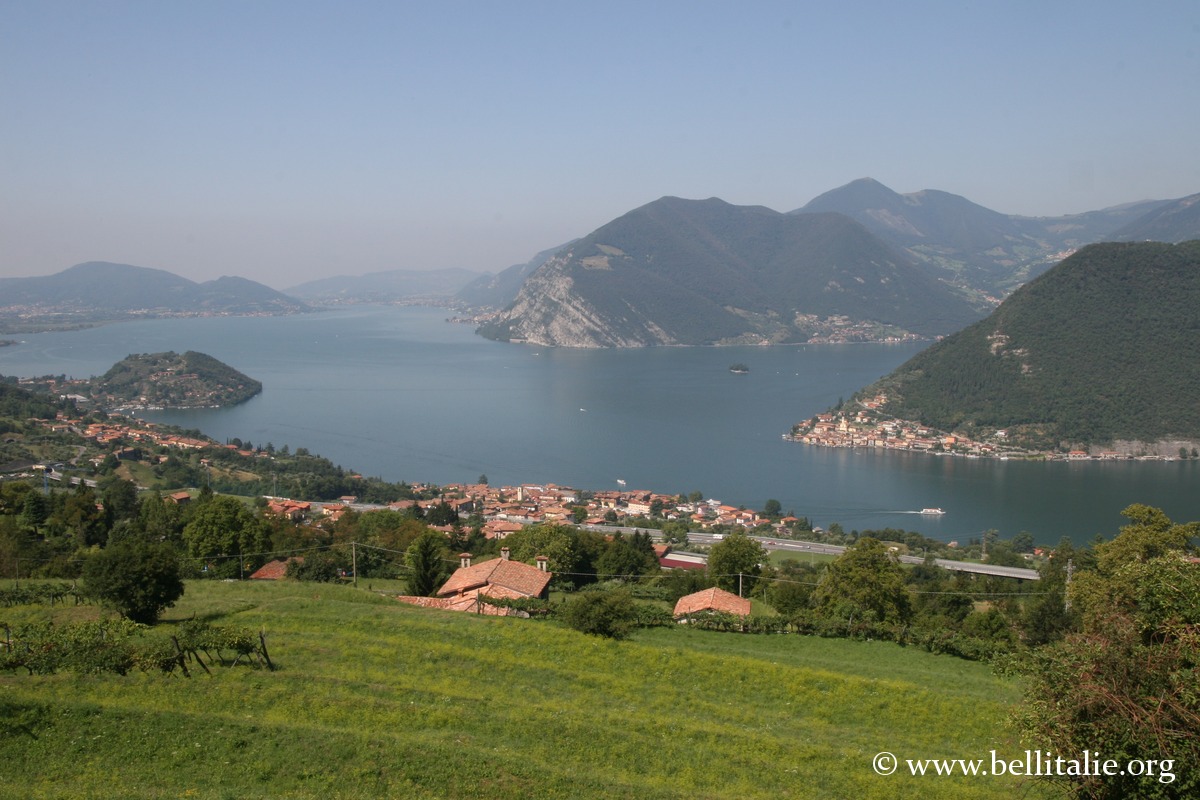 At the mouth of the valley, Lake Iseo is bordered by two charming villages including Lovere, one of the most beautiful villages of Lake Iseo, with its lovely harbour, pretty palaces, square and alleys; and Pisogne, which notably has beautiful frescoes by Romanino.
→ Read the page about Lovere, Pisogne and the section on Lake Iseo
Darfo Boario Terme and surroundings
Darfo Boario Terme is the main town of the lower Camonica Valley, industrially active, frequented for its thermal baths and for the heritage of the region, including a church from the late 14th century near the old Montecchio bridge of 1686, the archaeological park of the rock engravings of Luine, or in the surroundings the beautiful park of the small Lake Moro.
At Gorzone, there is a castle, austere on the outside, with a beautiful interior, remains from the 14th-17th centuries such as loggias, wells and courtyards.
At Erbanno are the frescoes of the church Santa Maria del Restello and the 14th-century cemetery of San Martino.
Near the picturesque Montecchio bridge over the river Oglio, the church of the Chiesa dei Disciplini or Oratorio dei Morti (Oratory of the Dead) was built at the end of the 14th century, subsequently remodelled. In 1962, the restoration brought to light the remarkable original 15th-century frescoes with the great Christ Pantocrator surrounded by the armies of Apostles, Evangelists, Popes and Fathers of the Church.
 Luine Archaeological Park
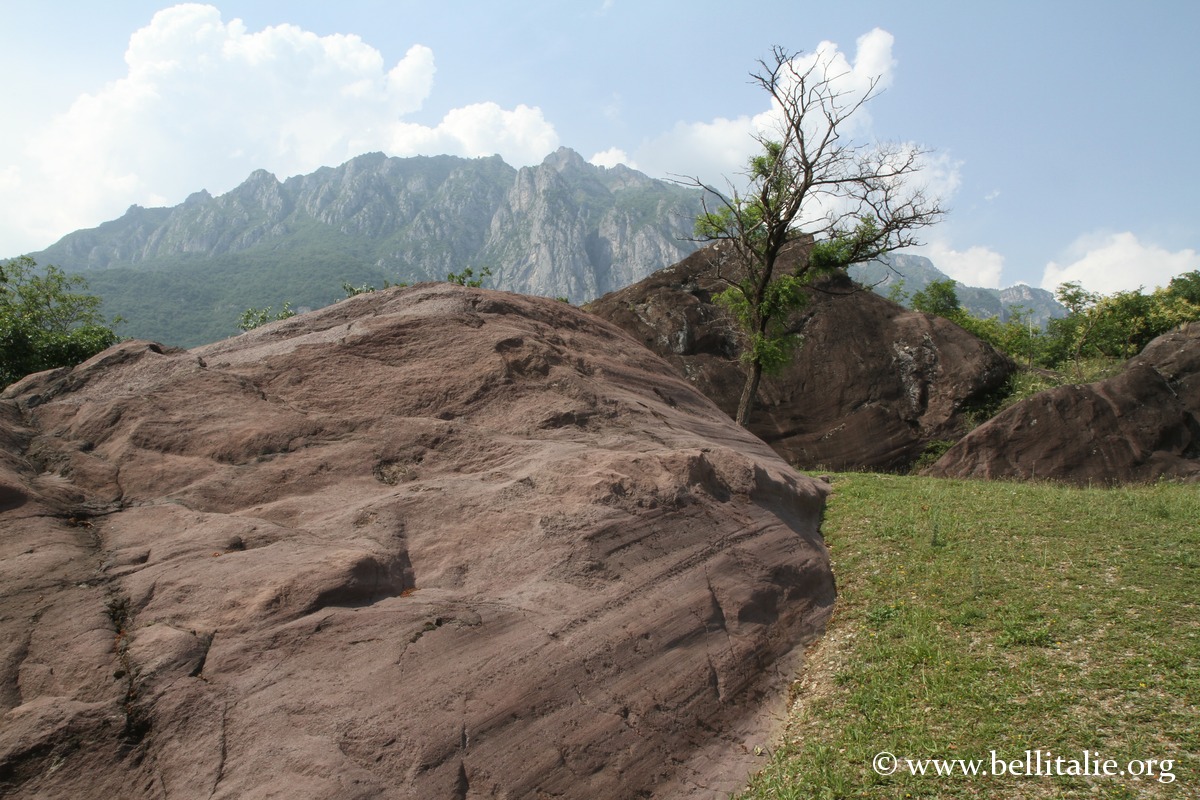
Very beautiful site of the Luine hill, with red rocks, where the oldest engravings of the Camonica valley are found. It has 104 rocks with 20,000 images, on three routes (see Luine archaeological park).
Lago Moro Park and Angolo Terme
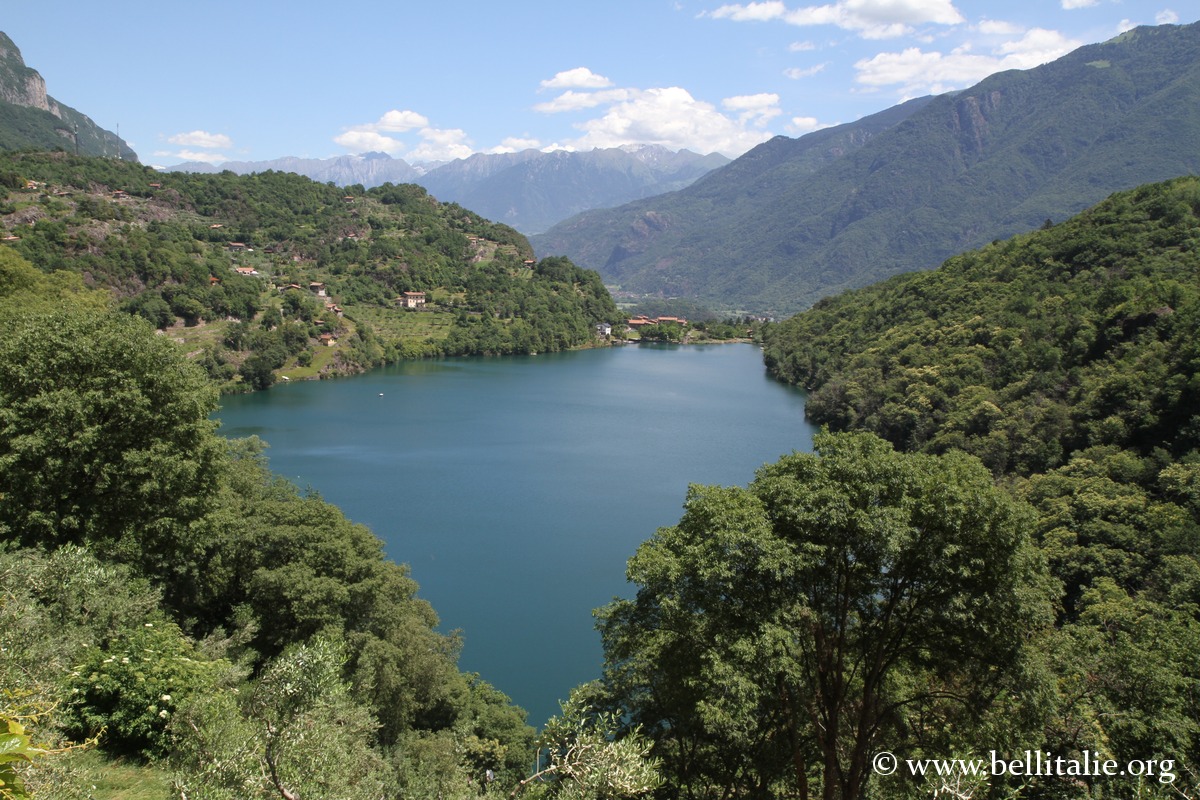
In the lower Camonica valley, the beautiful small Lago Moro park occupies a small basin surrounded by lush nature. In summer, given the number of visitors, a shuttle leaves from Corna di Darfo.
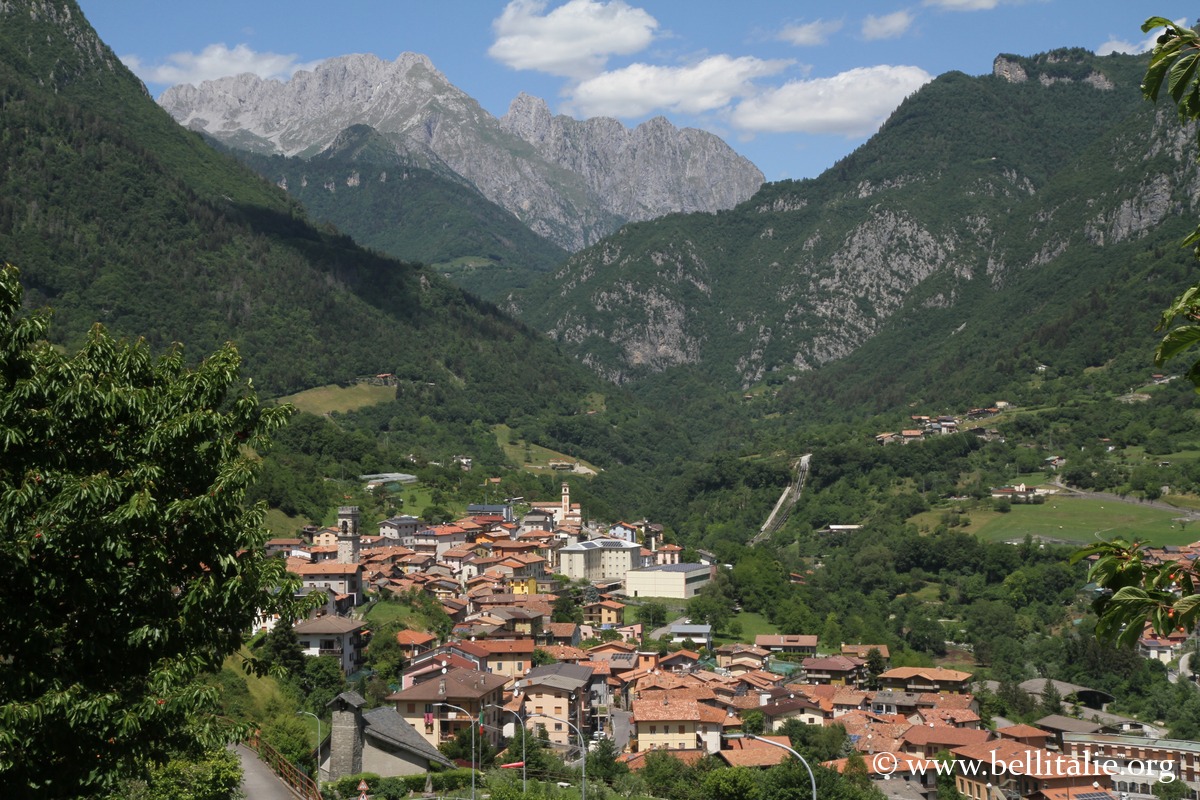
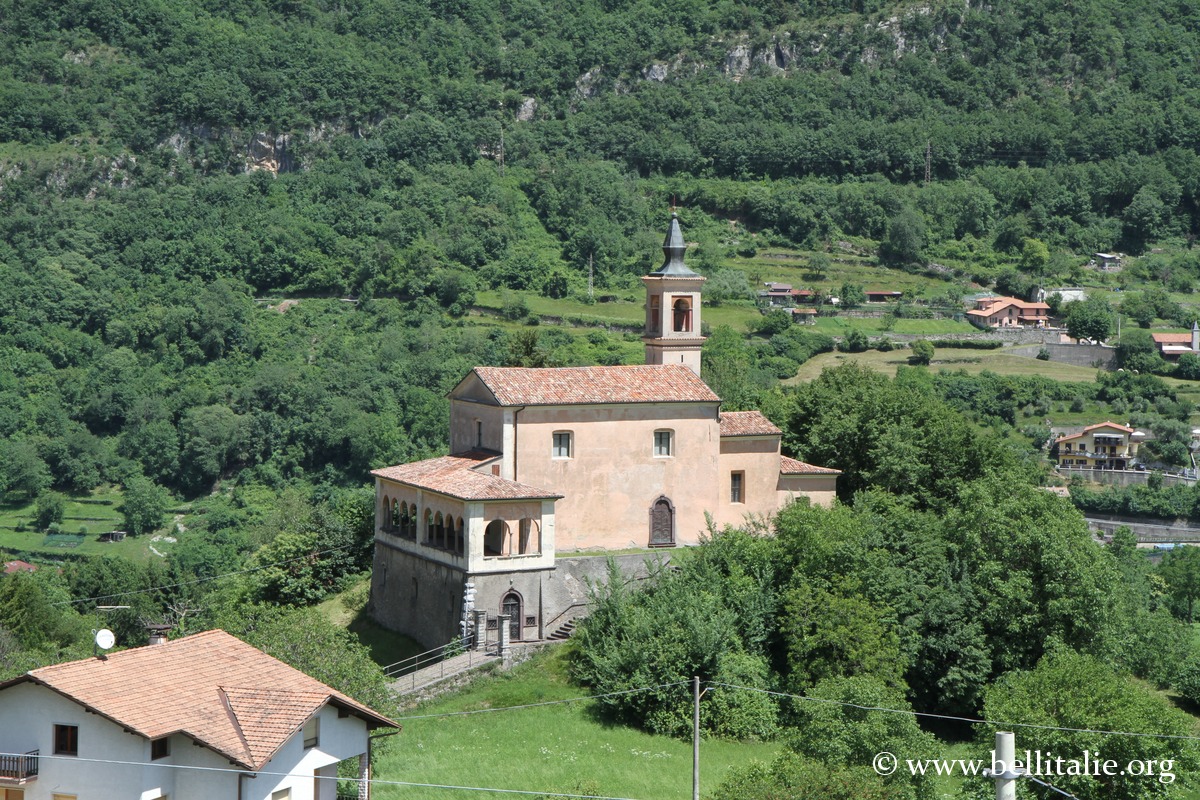
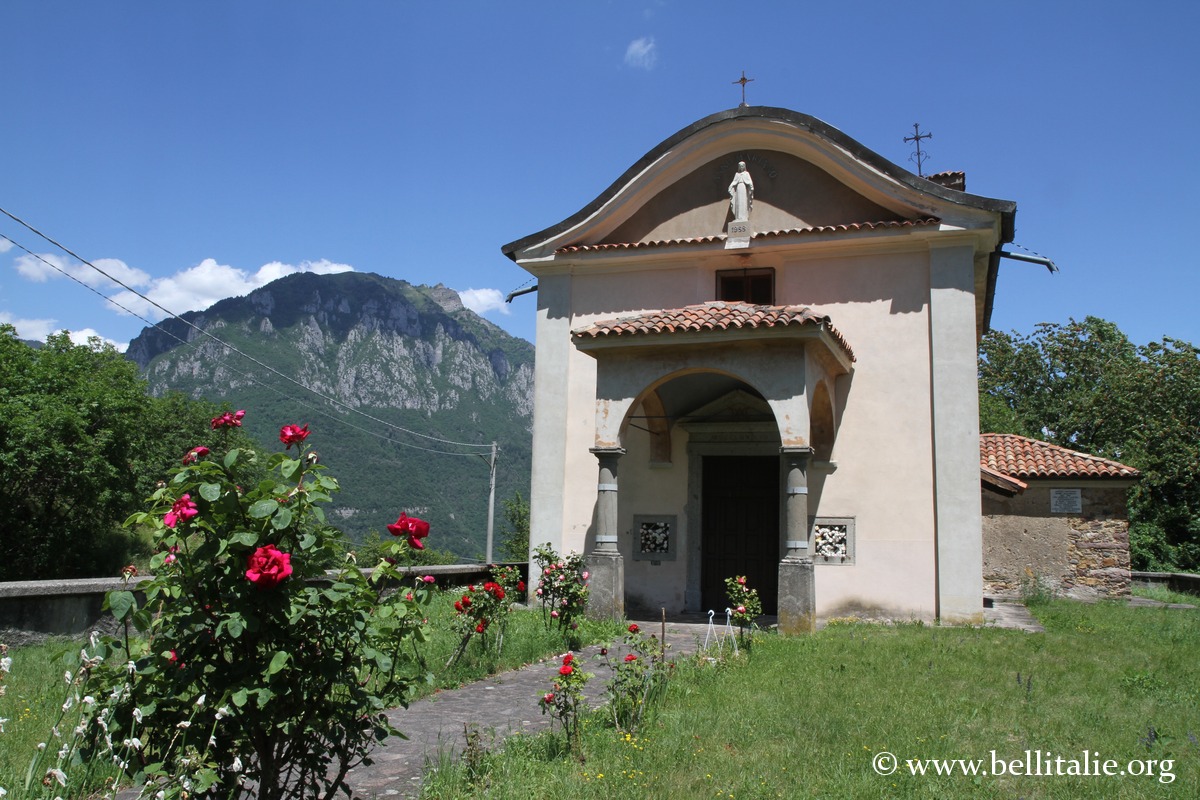
Not far away, Angolo Terme is a spa town with interesting heritage (Madonna delle Neve, etc.)
-
- Lago Moro
-
- Angolo Terme
-
- San Silvestro, Angolo Terme
-
- Madonna delle Nevi, Angolo Terme
Piancogno and Esine
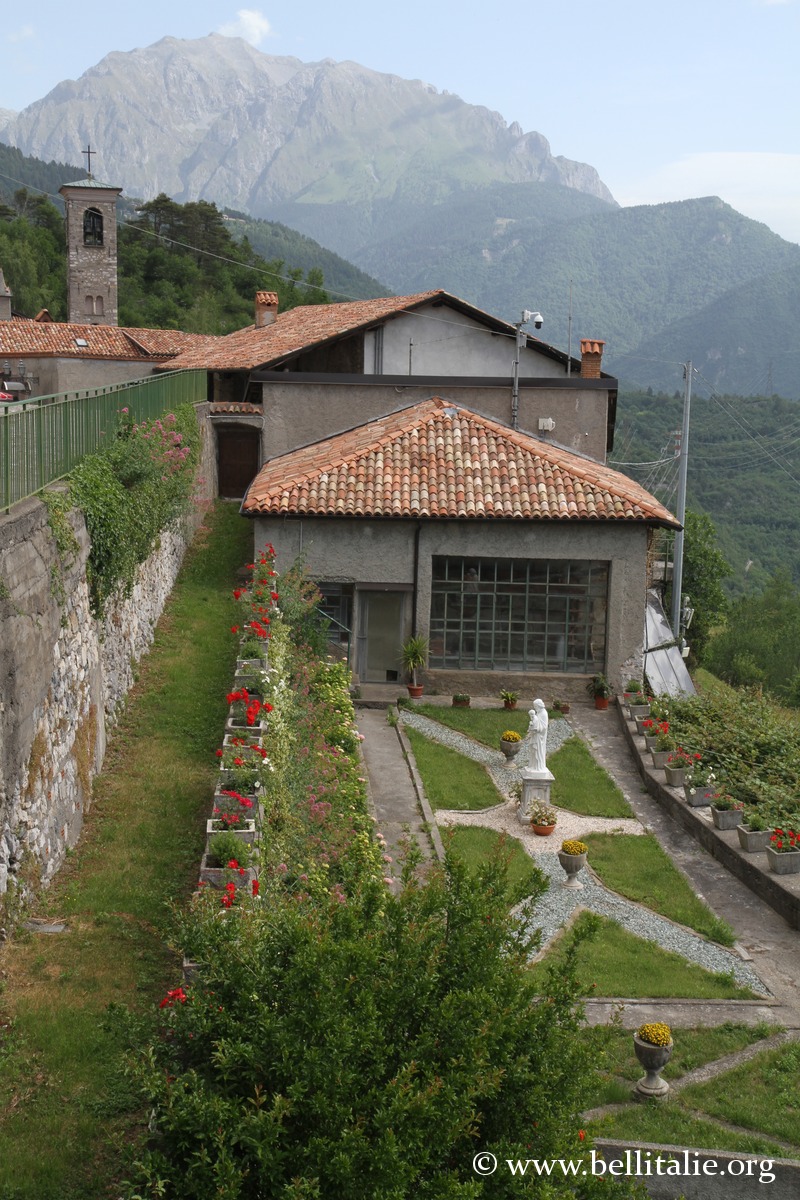
The Sanctuary of the Annunciation of Piamborno is located in the open countryside on a terrace overlooking the valley, with its convent. It is an important place of spirituality and culture. The church in the late Lombard Gothic style preserves frescoes by Pietro da Cemmo and an altarpiece attributed to Palma il Giovane, the cloister of Saint Anthony and the cell, or a permanent nativity scene.
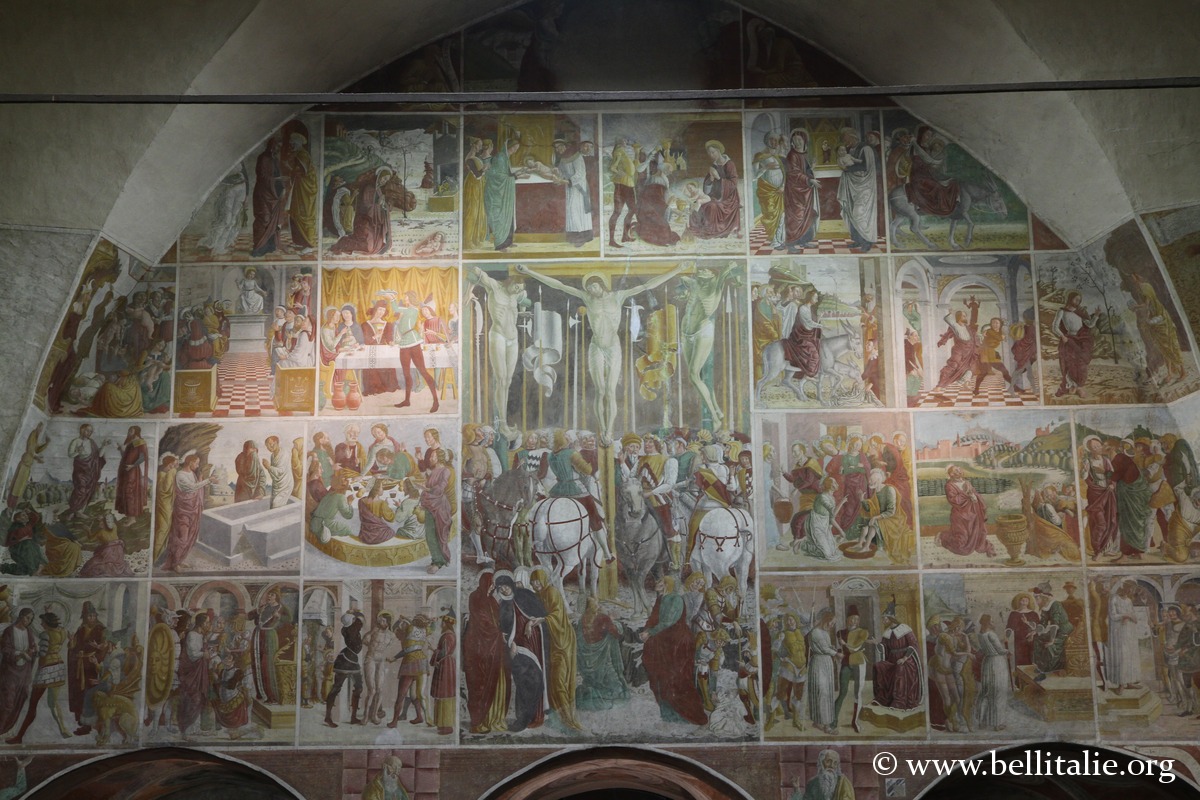
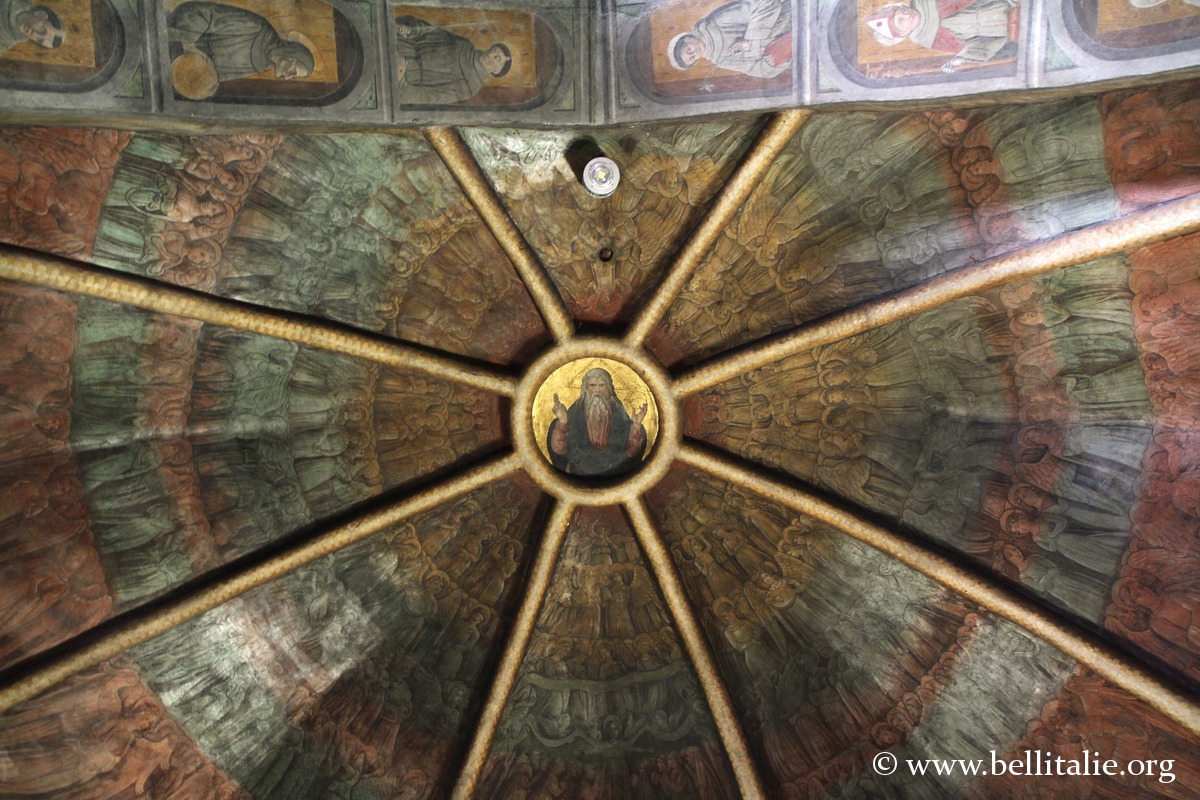
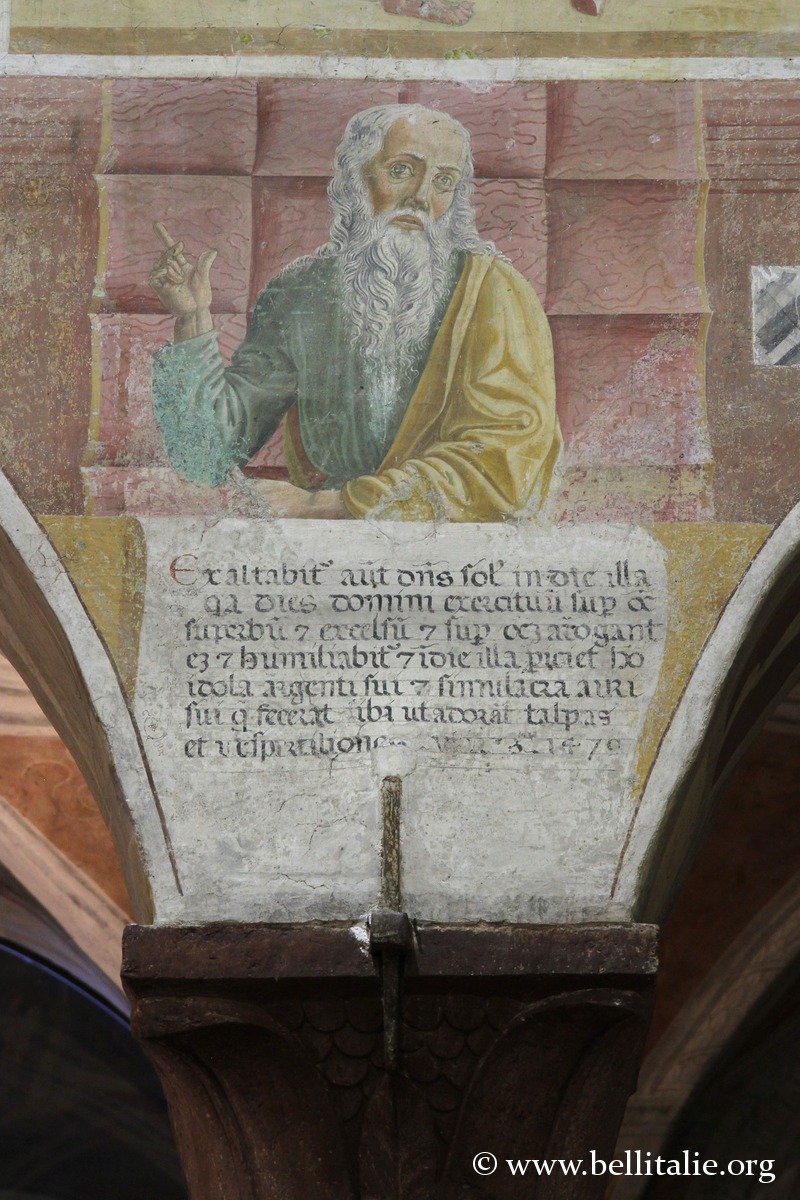
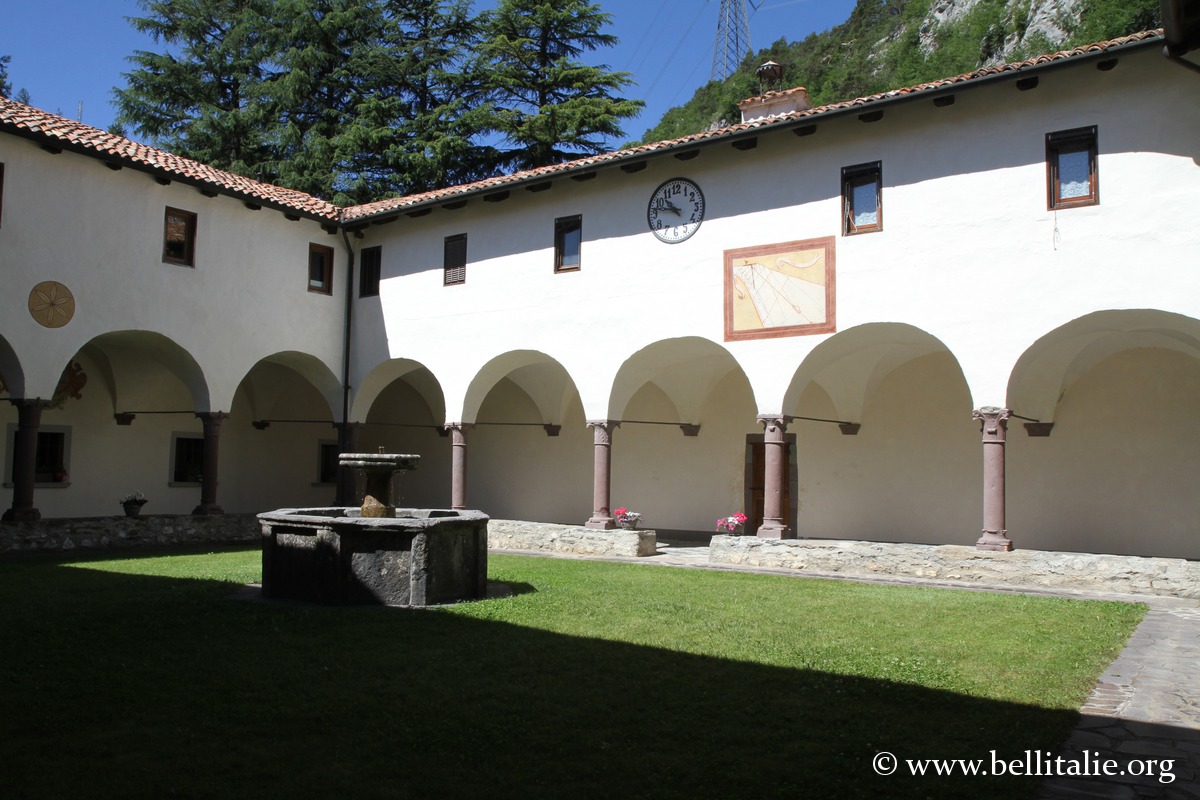
The Archaeological Route of the Annunciation of Piancogno has more than 60 engraved rocks, most of them date from the Celts and pre-Romans (see Piancogno archaeological park).
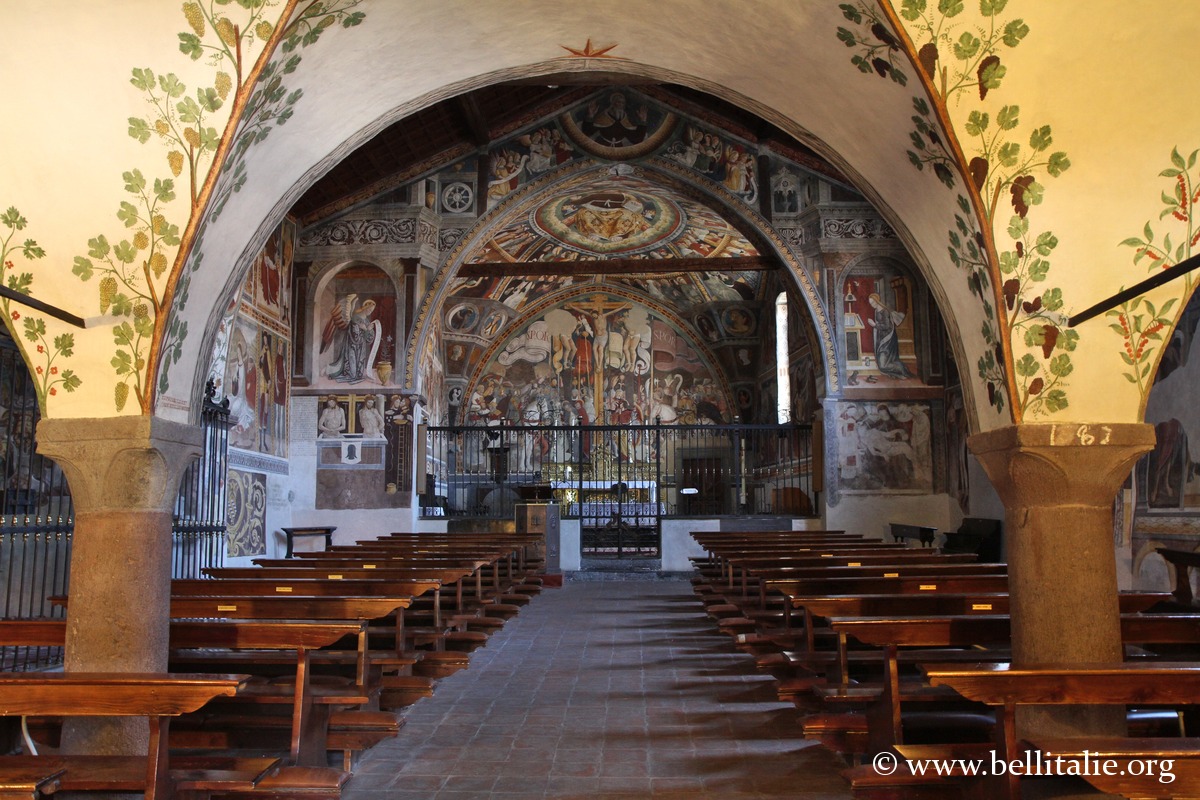
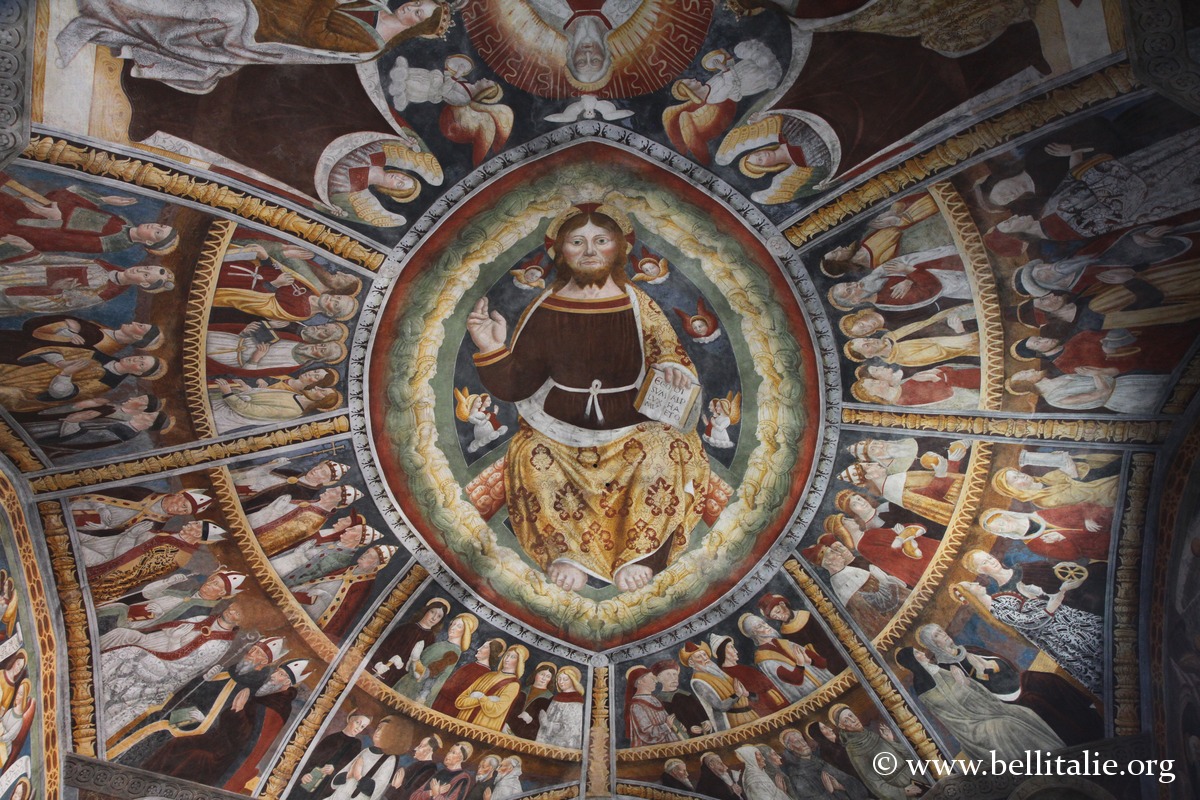
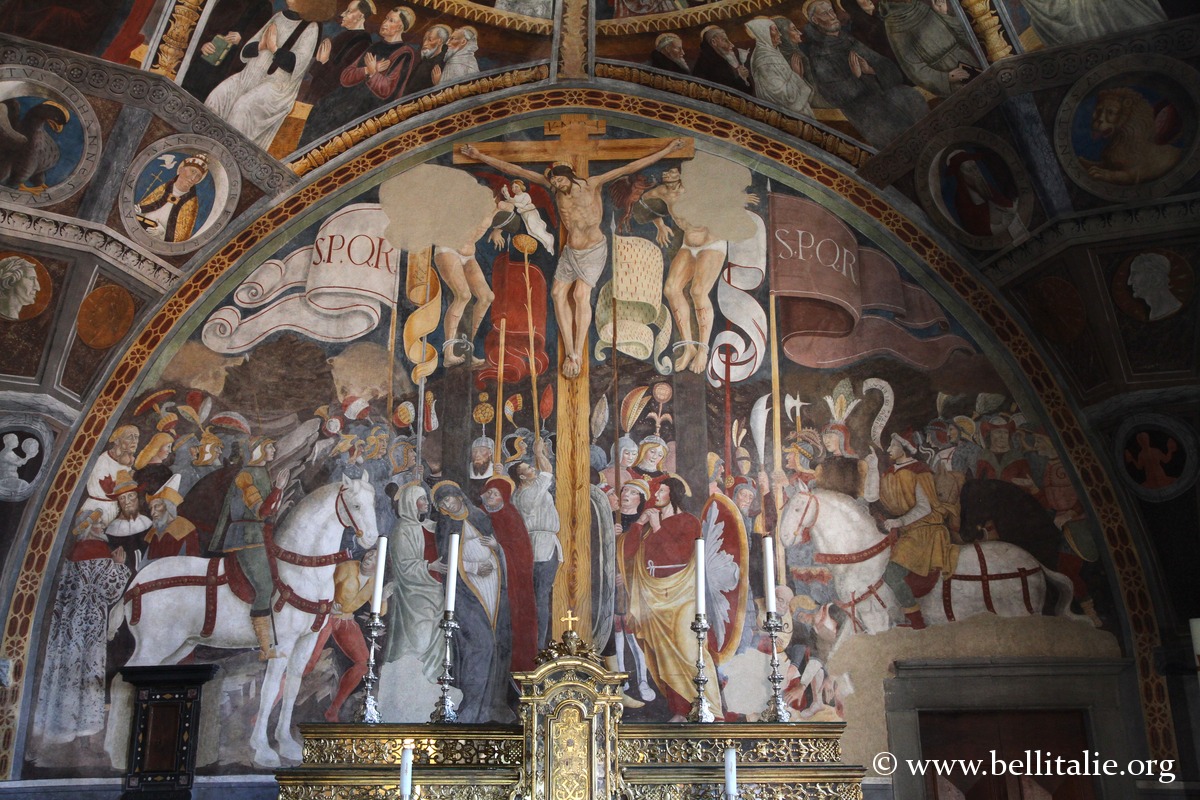
At the top of the centre of the village of Esine, the church Santa Maria Assunta is magnificently decorated with frescoes by Pietro da Cemmo, including the great Christ Pantocrator surrounded by the Saints and the grandiose Crucifixion.
Bienno
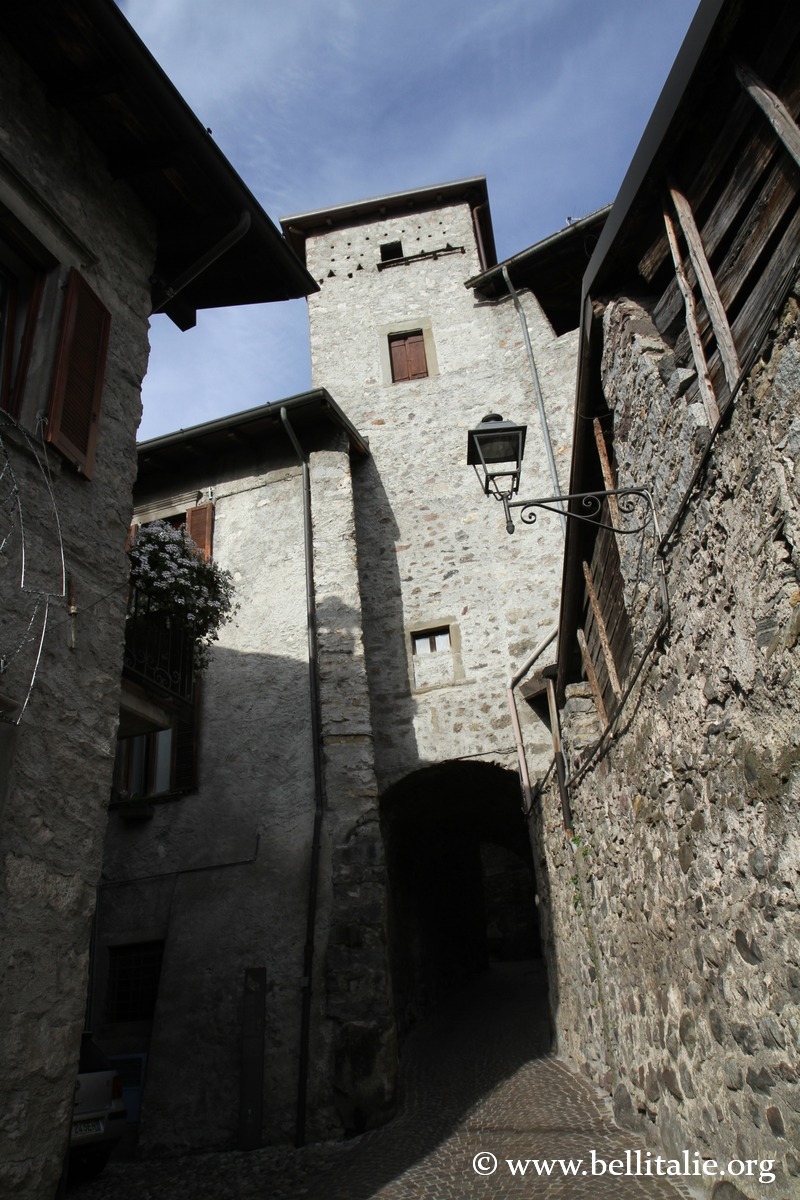
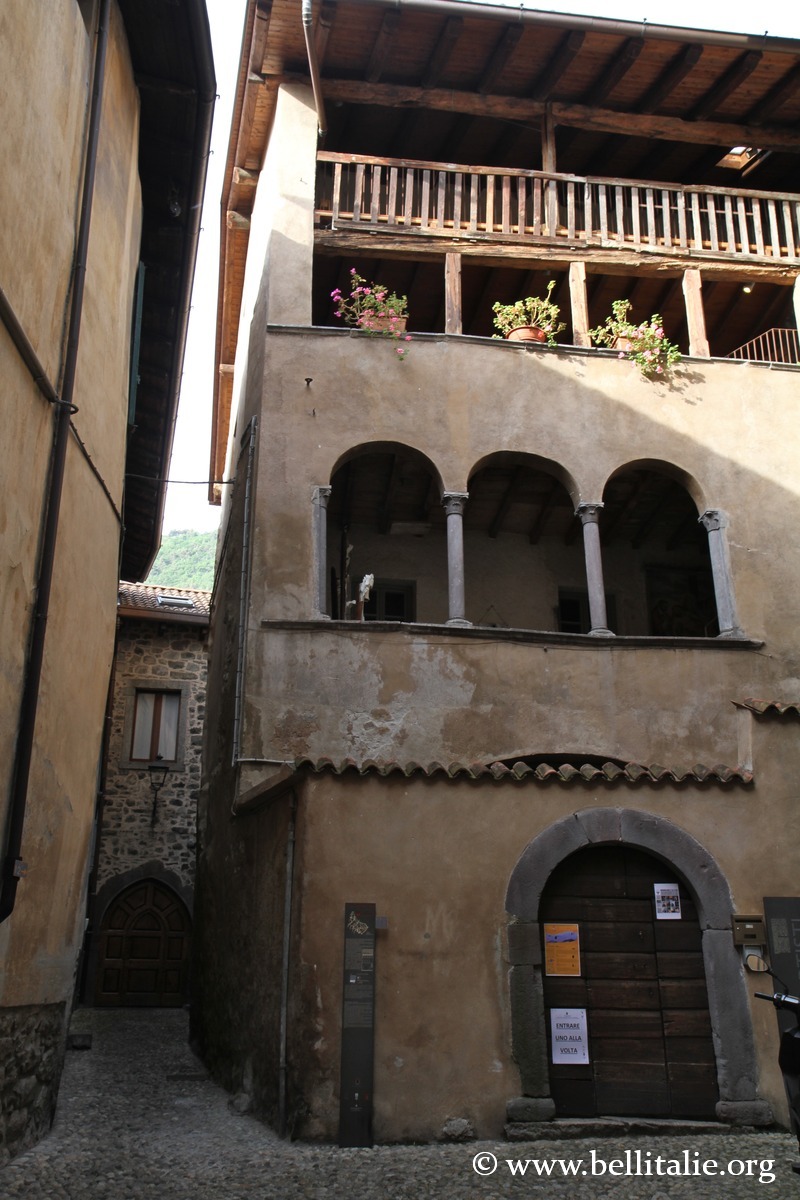
Bienno is one of the most visited villages of the middle Camonica Valley, classified among “the most beautiful villages of Italy”, with its Renaissance historic centre made up of picturesque alleys, towers and old houses with loggias or stone portals, and an old water mill. It is also a village of artists and craftsmen, whose activities are promoted by the town.
The first settlements here date back to the Bronze Age, with evidence at the top of the Cerreto hill, such as a rock with rock engravings.
It was the working of iron that made the fortune of this town, helped by the river Vaso Re which crosses it. The Romans already exploited the ore in the valley, here in particular, and Bienno still preserves old forges.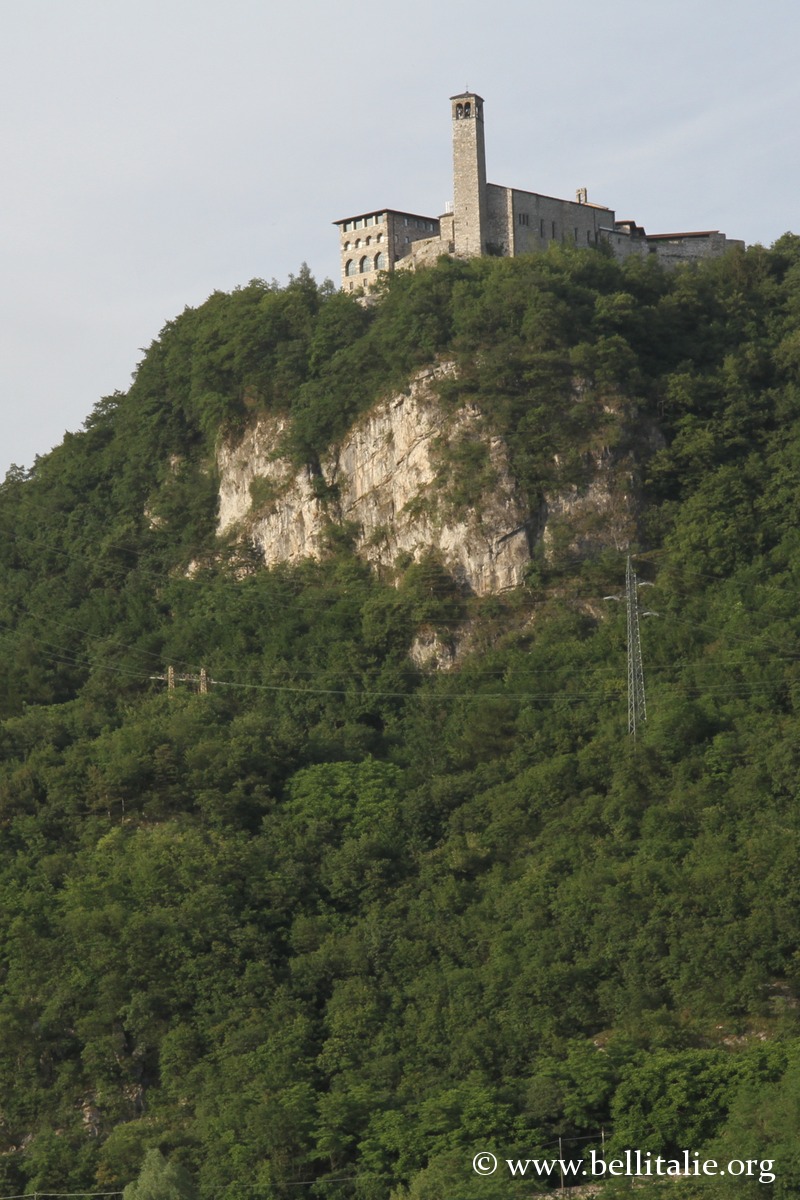 You can see a panorama from the golden statue of the Christ the Redeemer next to the pretty Sanctuary of the Maddalena and at the top of a rocky outcrop, you can enjoy the peace of the Hermitage of Saints Peter and Paul with its terrace over the valley, its two cloisters and its rose garden.
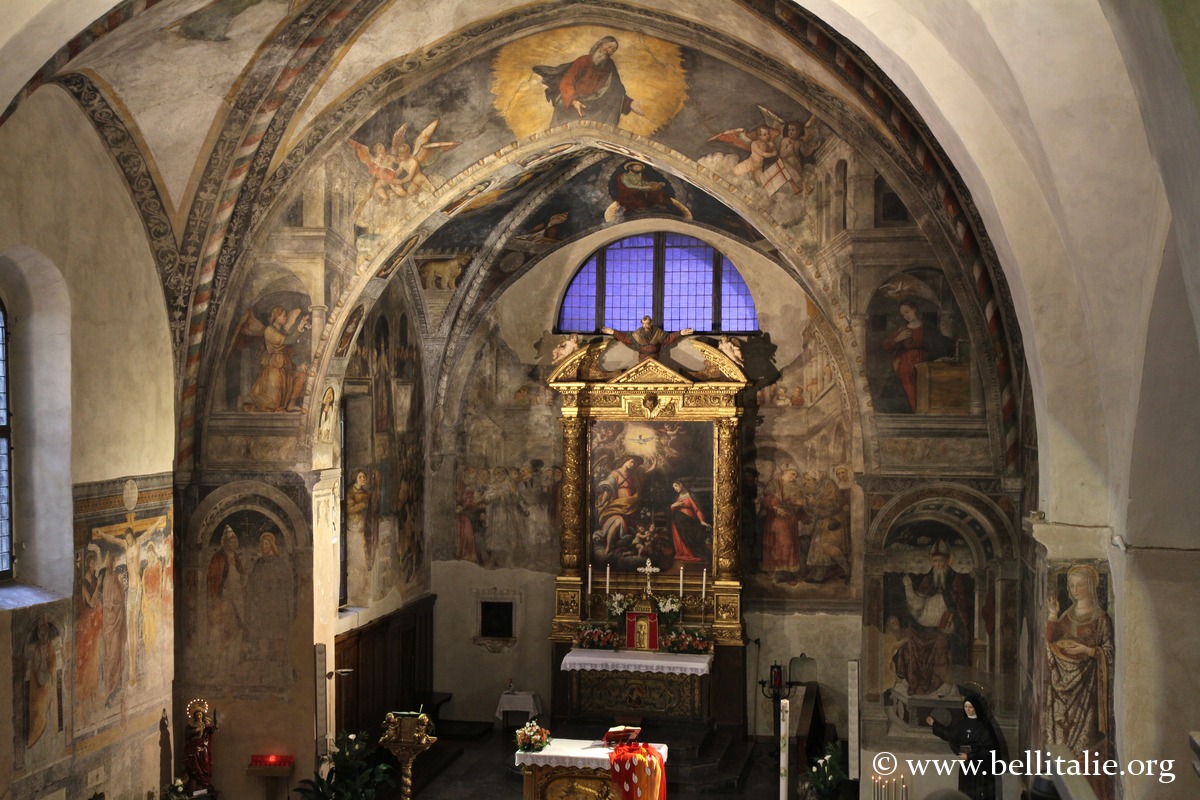
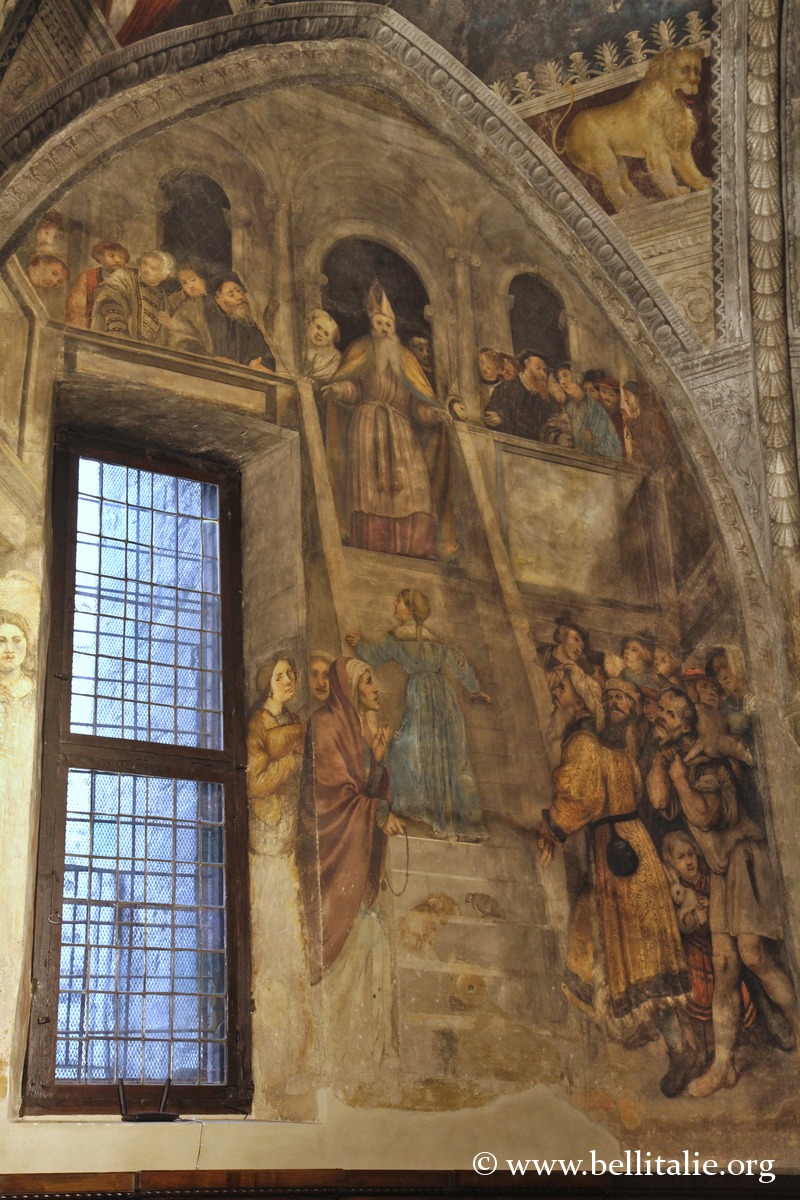
the Fucina Museum is a core of the vast Ethnographic Museum of Iron, with the 17th-century forge and its enormous hammer. The church Santa Maria Annunciata of the 15th century has pretty frescoes, including some by De Cemmo, others with the child Simonino of Trento, in the presbyterium by Romanino (16th century), or with the 17th-century altarpiece by Giovanni Mauro della Rovere.
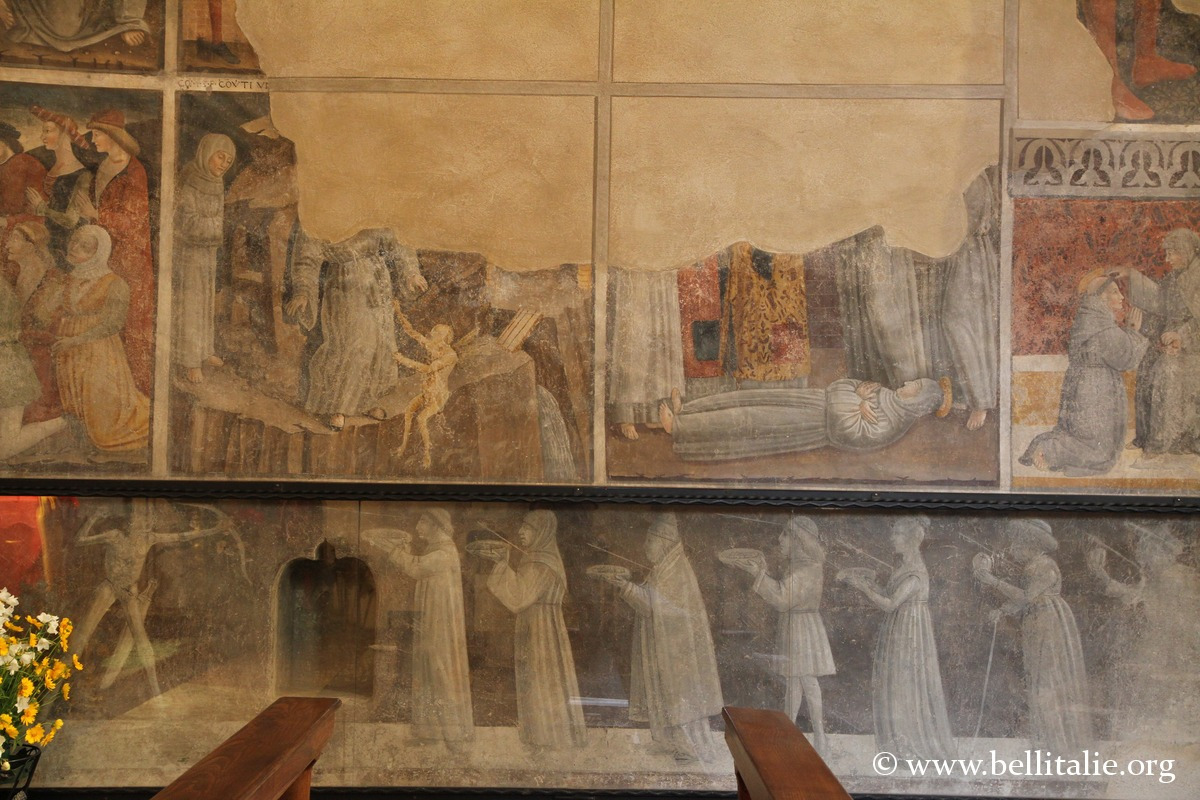
Cividate Camuno
Cividate Camuno preserves the most important Roman remains of the valley, with those of the Roman town in the archaeological park: theatre, amphitheatre, baths, etc.
The National Archaeological Museum of the Camonica Valley gathers statues and objects from the Roman period coming from the town and the region in several sections: the territory with the excavations at Cividate and Santo Stefano from the Mesolithic to the Iron Age; the ancient cults in the valley with the sanctuaries, with their gods and their heroes, including the statue of the goddess Minerva found at the sanctuary of Breno; the necropolises with epigraphs and funerary objects from various places in the valley.
 Borno and Ossimo
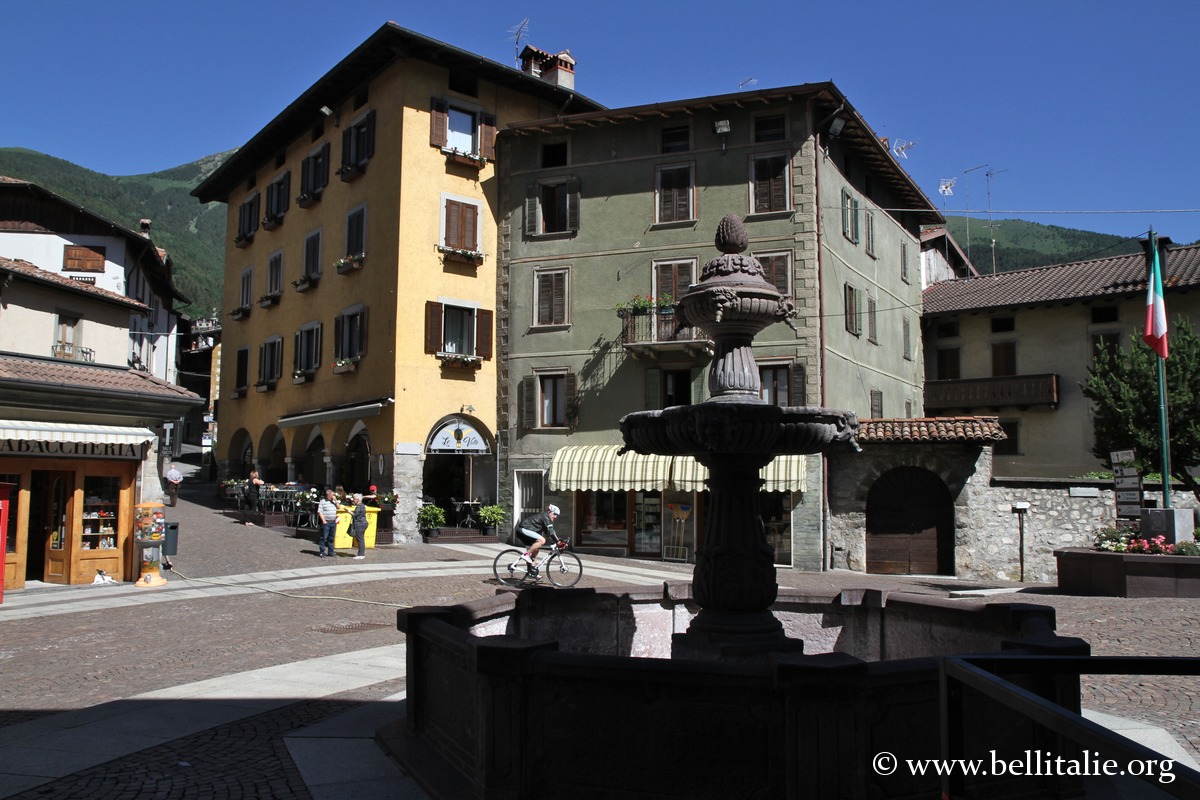
At the foot of Mount Altissimo, Borno is a winter sports resort among others, whose well-kept and pleasant historic centre has ancient remains such as the bases of several towers built in the 10th century.
It is located on the Altogether the Sun Plateau (Altopiano del Sole), the valley between Val Camonica and the Scalve Valley.
The megalithic Sanctuary of Vazel de Undine at Borno is an ancient sacred site with some megaliths engraved from the Copper Age.
The archaeological park of Asinino-Anvòia of Ossimo is a megalithic sanctuary of the Copper Age with alignments of steles and engraved rocks (here copies of the originals in the Capo museum), including stylised faces, necklaces and daggers (see Ossimo archaeological park).
Breno
Breno preserves some of the most important historical traces of Val Camonica.
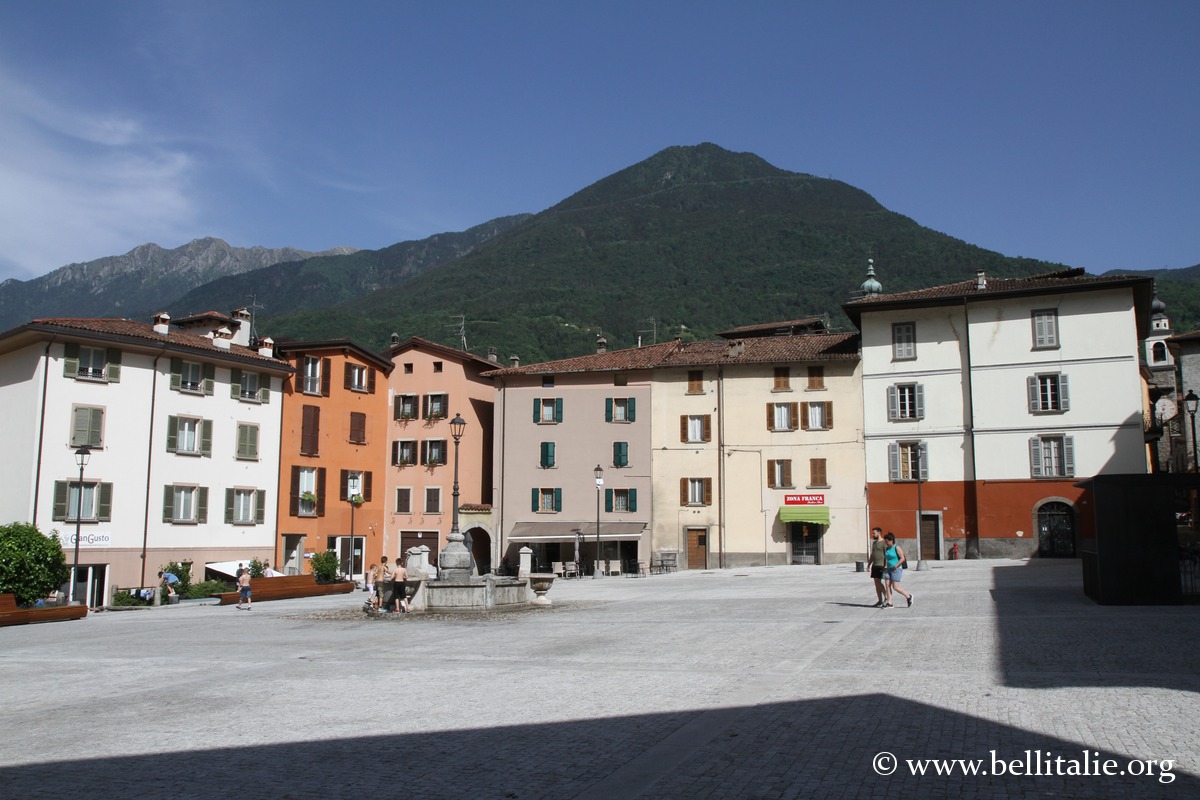
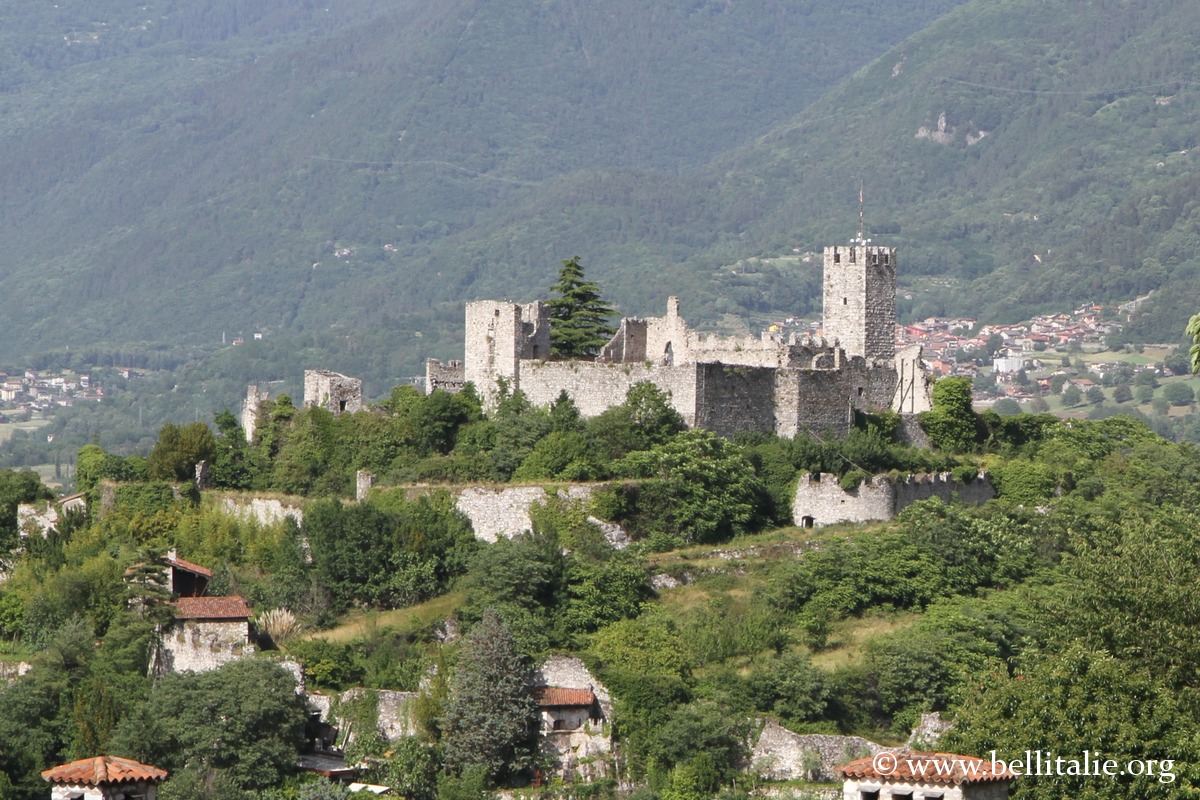
The Castle of Breno is an authentic fortress on a hill near the village occupied since prehistory. It is a beautiful medieval fortification with tower, palace, medieval ramparts, later converted into a modern bastion.
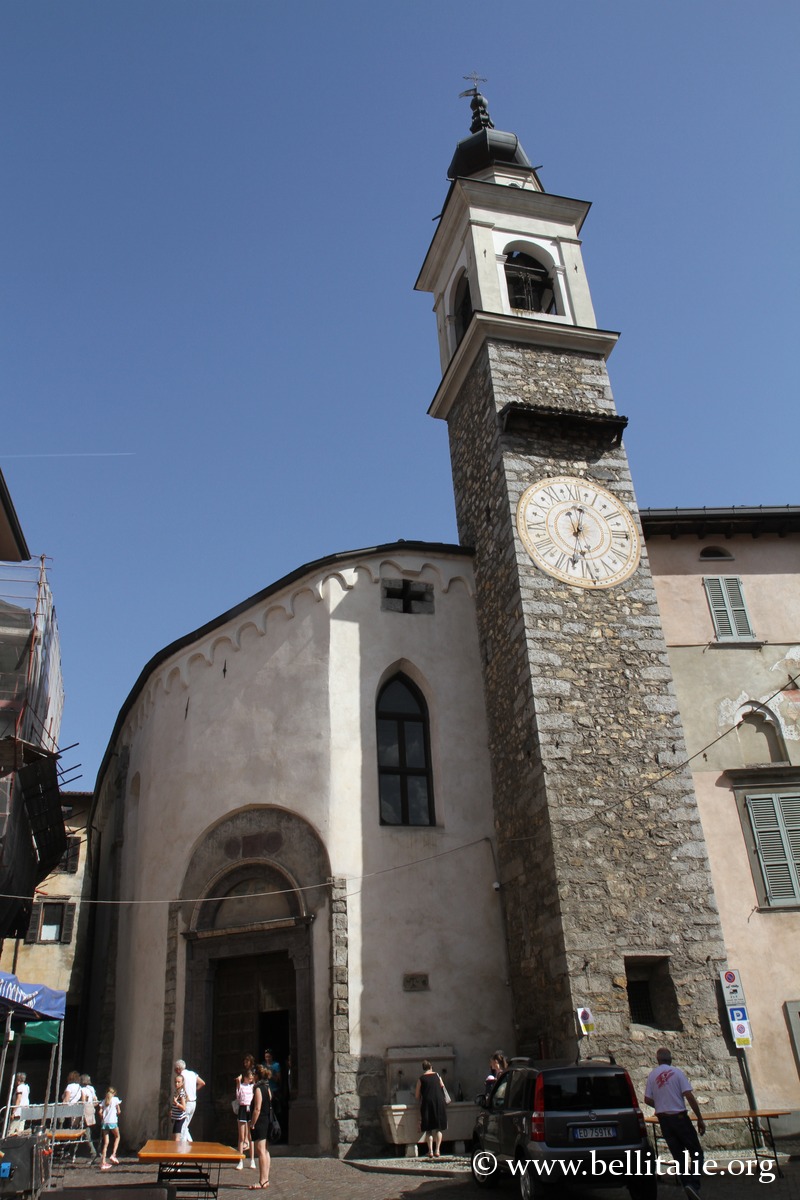
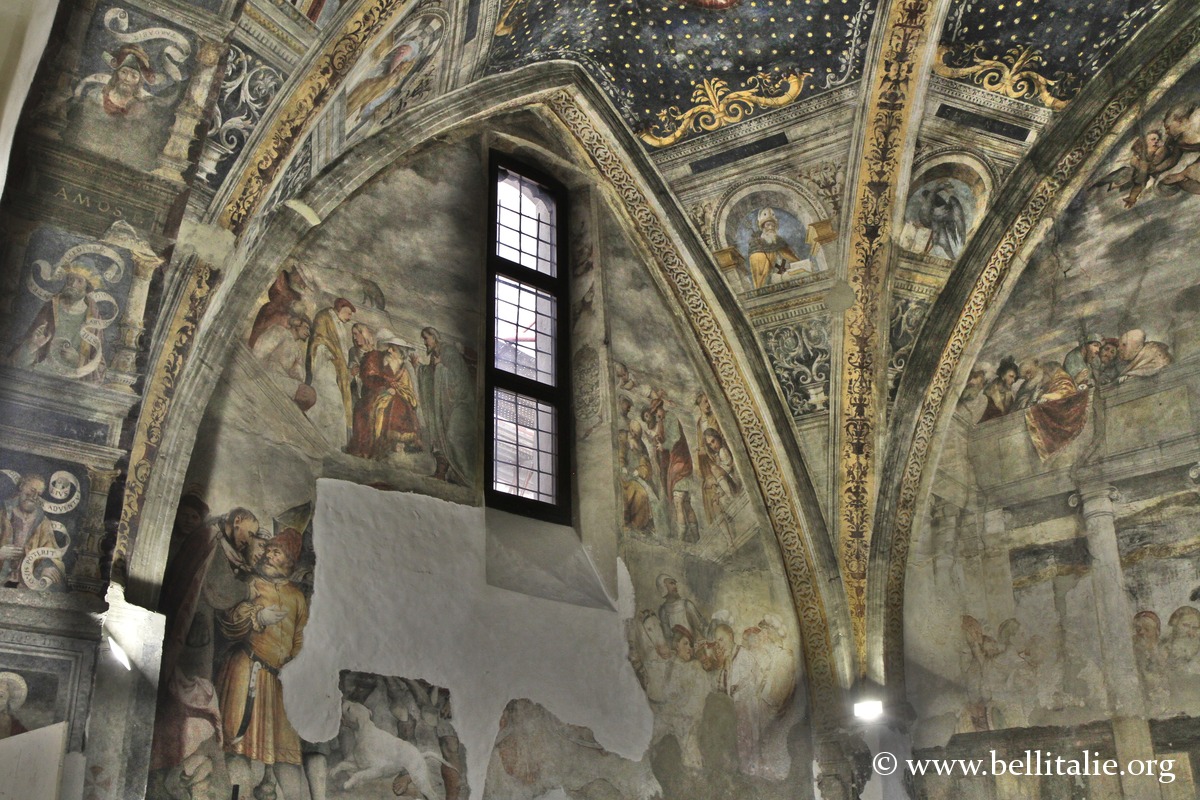
In the historic centre, the now deconsecrated church of Sant’Antonio Abate keeps a beautiful Renaissance portal and frescoes with the Stories of the prophet Daniel by Romanino (1536-37), paintings by Pietro da Cemmo (late 15th century), or an altarpiece by Callisto Piazza (1527).
-
- Breno
-
- Sant’Antonio Abate
-
- Fresques de Romanino, Sant’Antonio Abate
-
- Fresques de Romanino, Sant’Antonio Abate
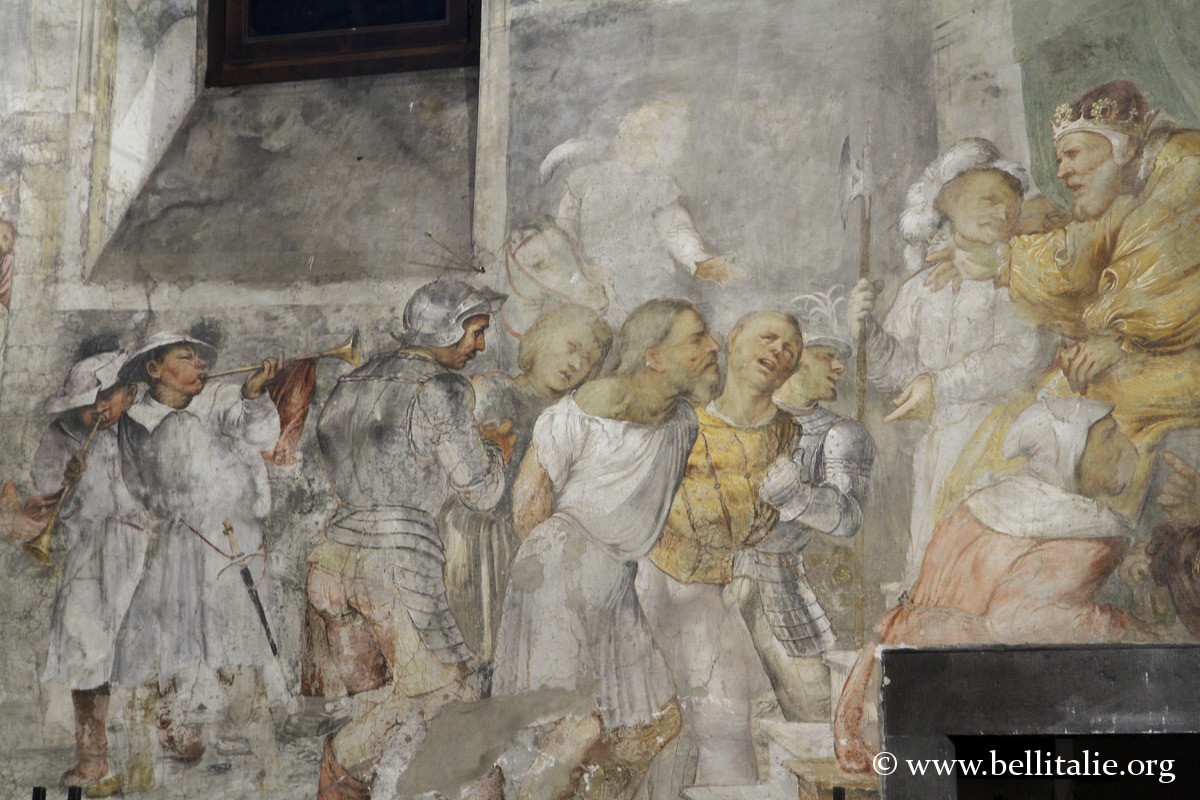
-
- Château de Breno
Sanctuary of Minerva
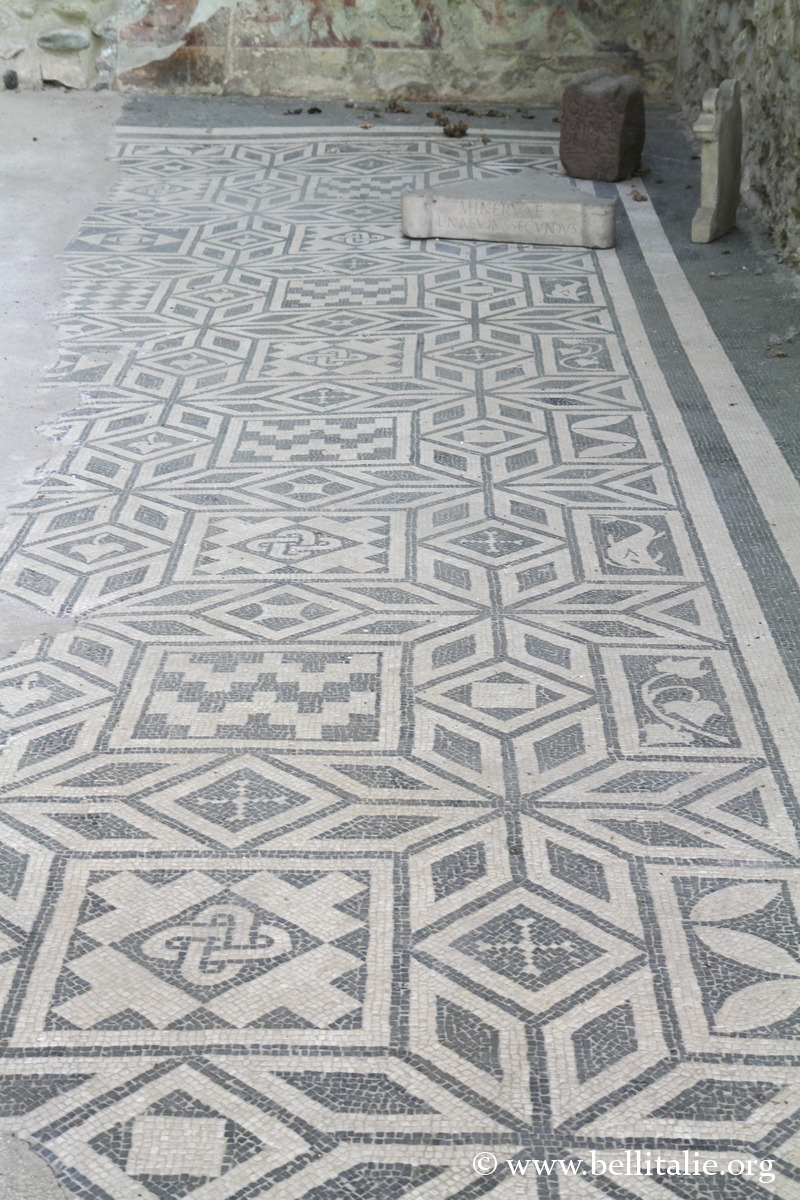
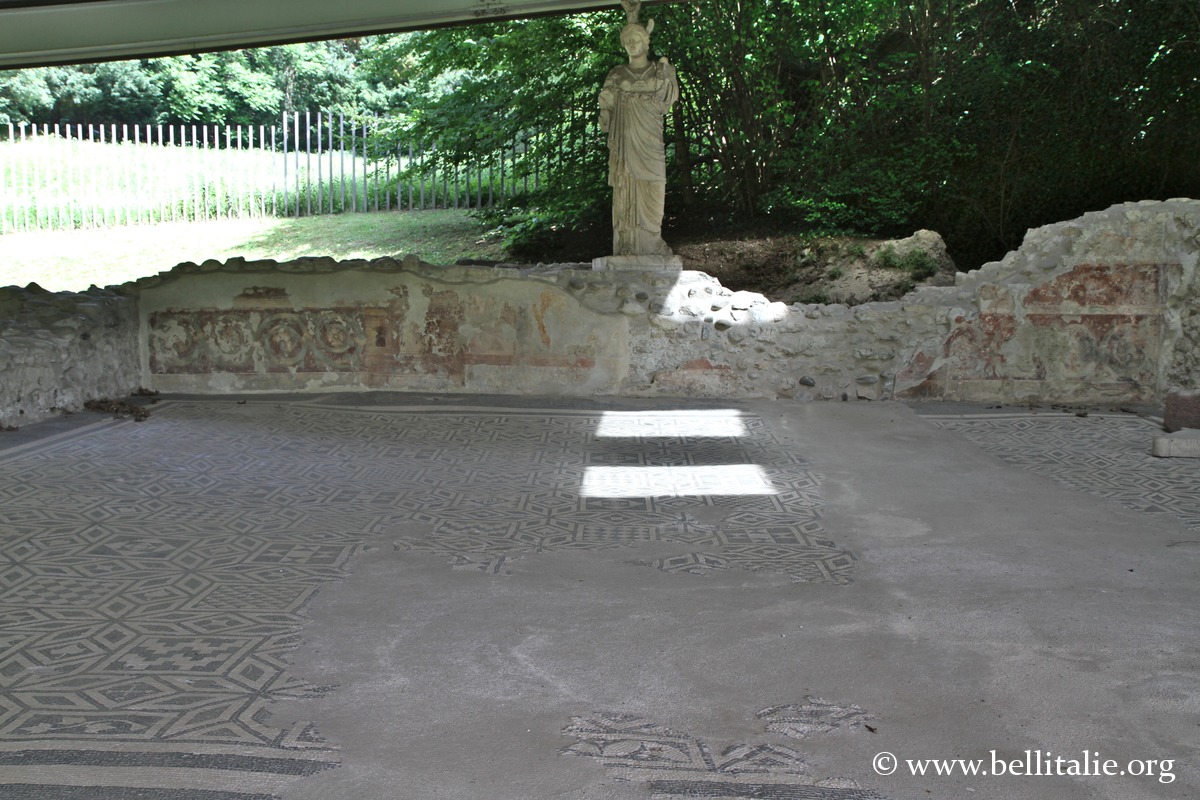
The Roman sanctuary dedicated to the goddess Minerva is located at Spinera di Breno, having incorporated at its construction a previous temple linked to the presence of springs and the river. Today one can see the base of the building, traces of the paintings, a large mosaic, or the copy of the statue of Minerva whose original is in the museum of Cividate Camuno.
Capo di Ponte
Naquane National Park of Rock Engravings
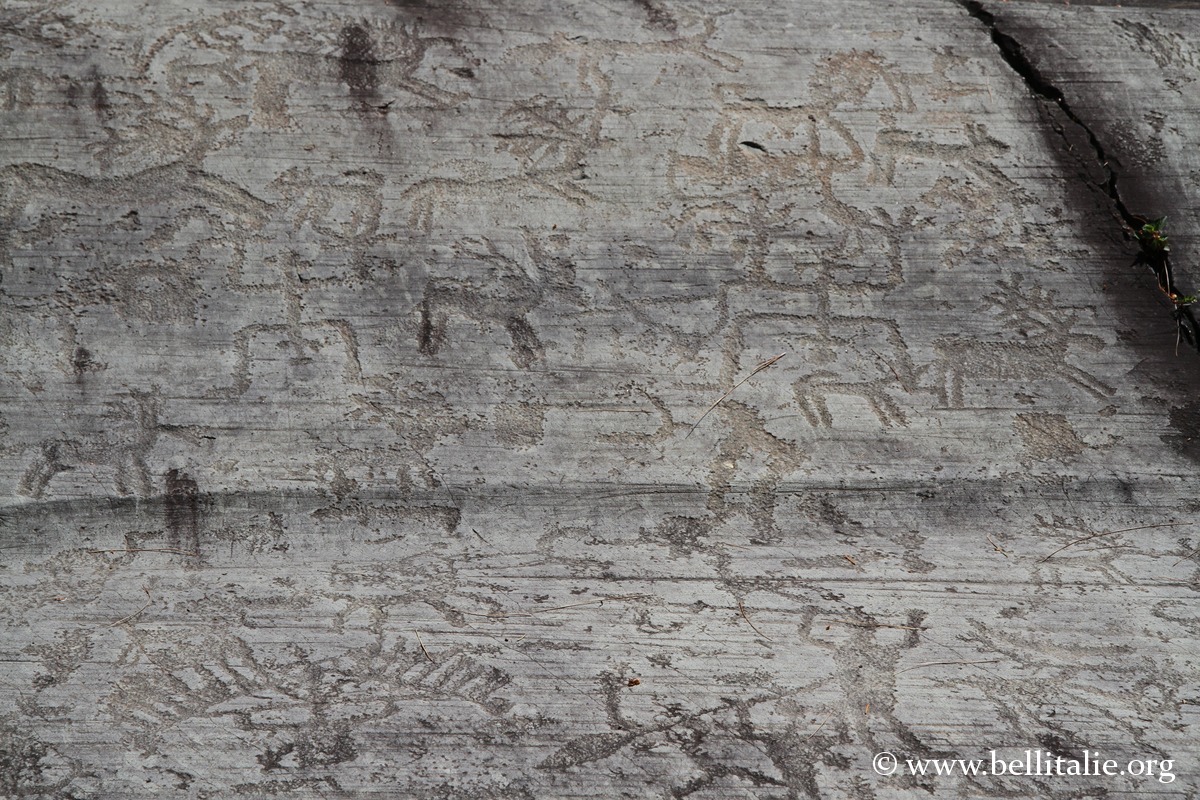 The site of Naquane was the first Italian archaeological park established in 1955, then one of the eight sites inscribed by Unesco as “Rock Drawings in Valcamonica” in 1979.
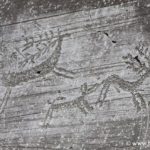
The 5 itineraries cover 3 km through the wooded park, past the 104 rocks engraved with signs and symbols, made at different periods, from the Neolithic (4th millennium BC) to the Iron Age (1st millennium BC), but also later ones.
One of the rocks in particular has an astonishing set of 1000 carved figures, with representations of scenes or symbolic ones (see Naquane National Park of Rock Engravings).
 Mupre – National Museum of Prehistory of the Camonica Valley
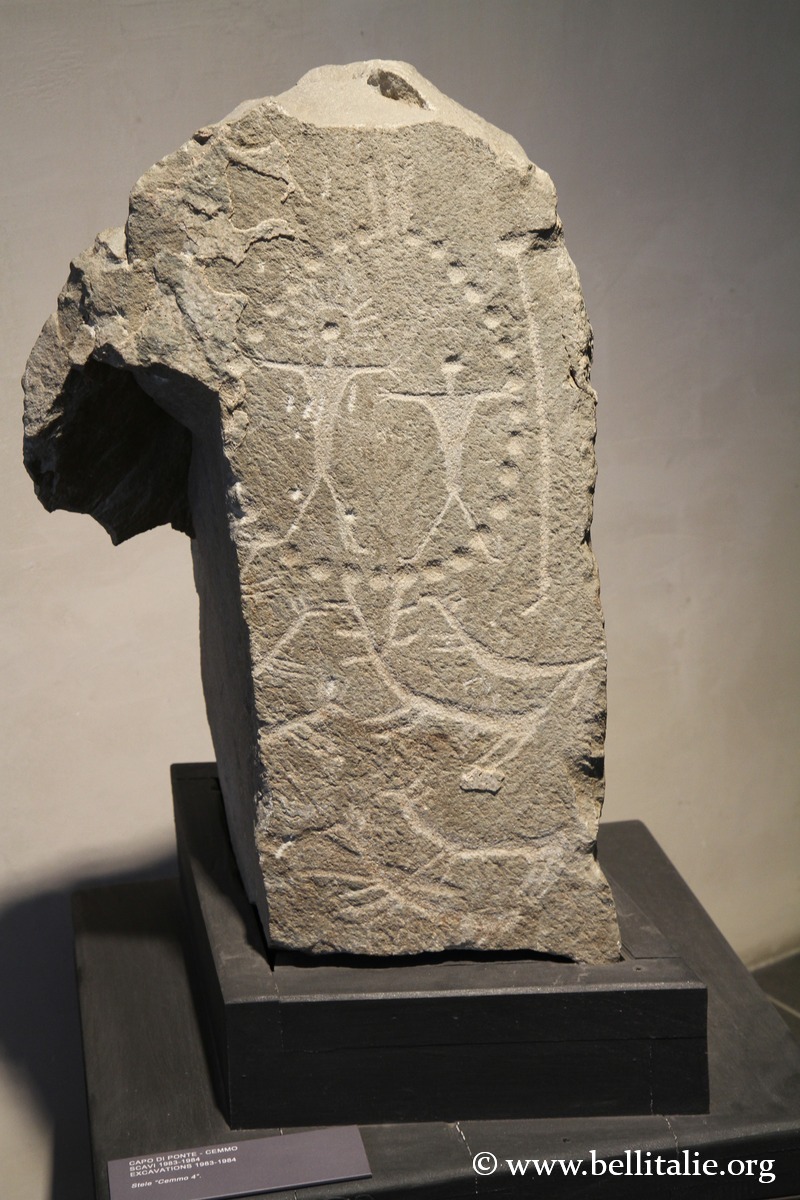
In a building of the 16th-century Villa Agostani at Capo di Ponte, the museum collects important evidence of life in the Camonica Valley in prehistoric and protohistoric times, giving an overall picture. It gathers ceramics, funerary objects and everyday objects, including a few characteristic engraved rocks and menhirs.
Romanesque churches of San Siro and San Salvatore
One of the most beautiful expressions of the Romanesque in the Camonica valley, from the 11th and 12th centuries, the Romanesque church of San Siro stands on the rock dominating the river opposite Capo di Ponte. It keeps a magnificent portal, frescoes from the 15th and 16th centuries and a crypt.
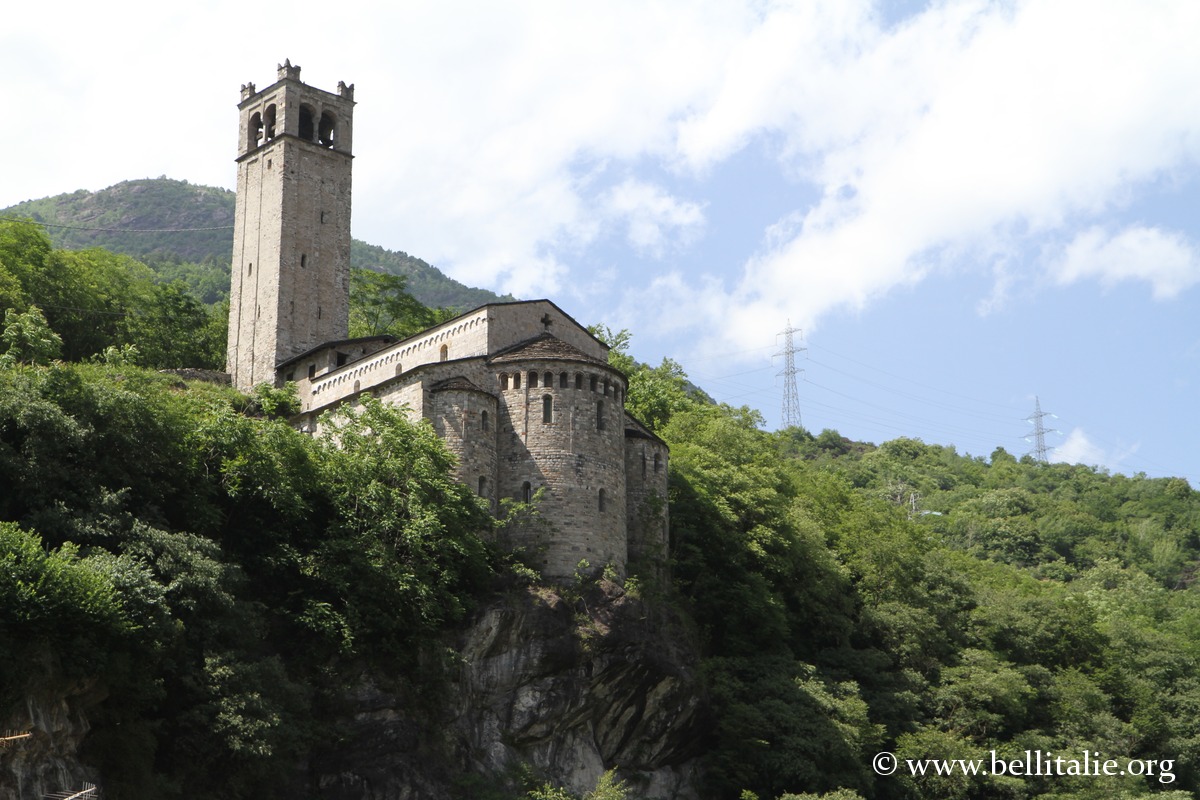
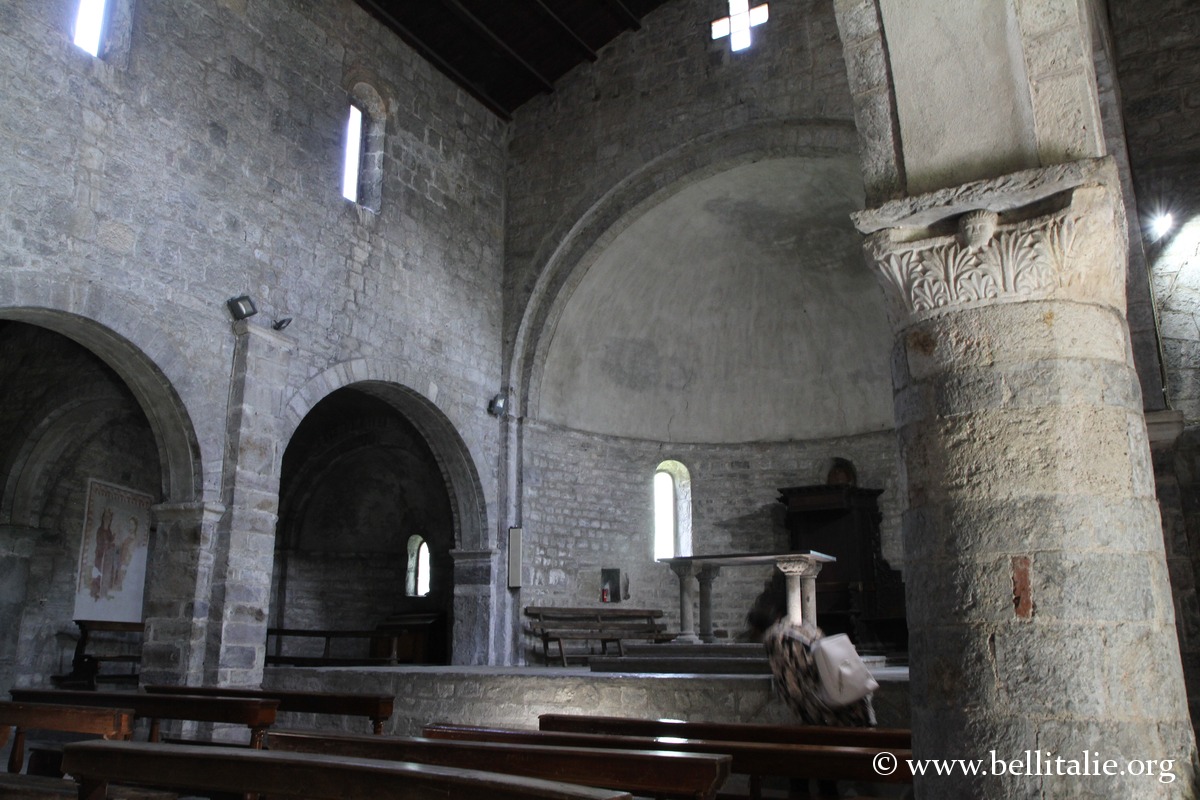
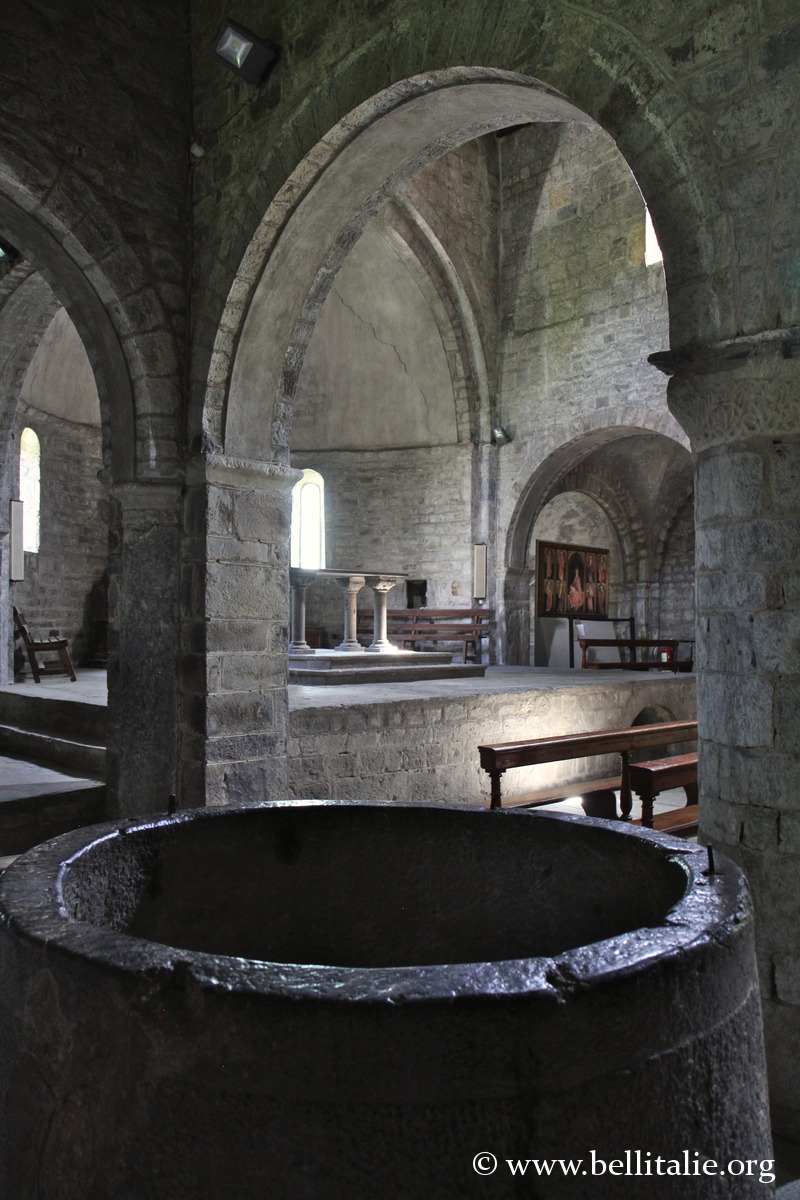
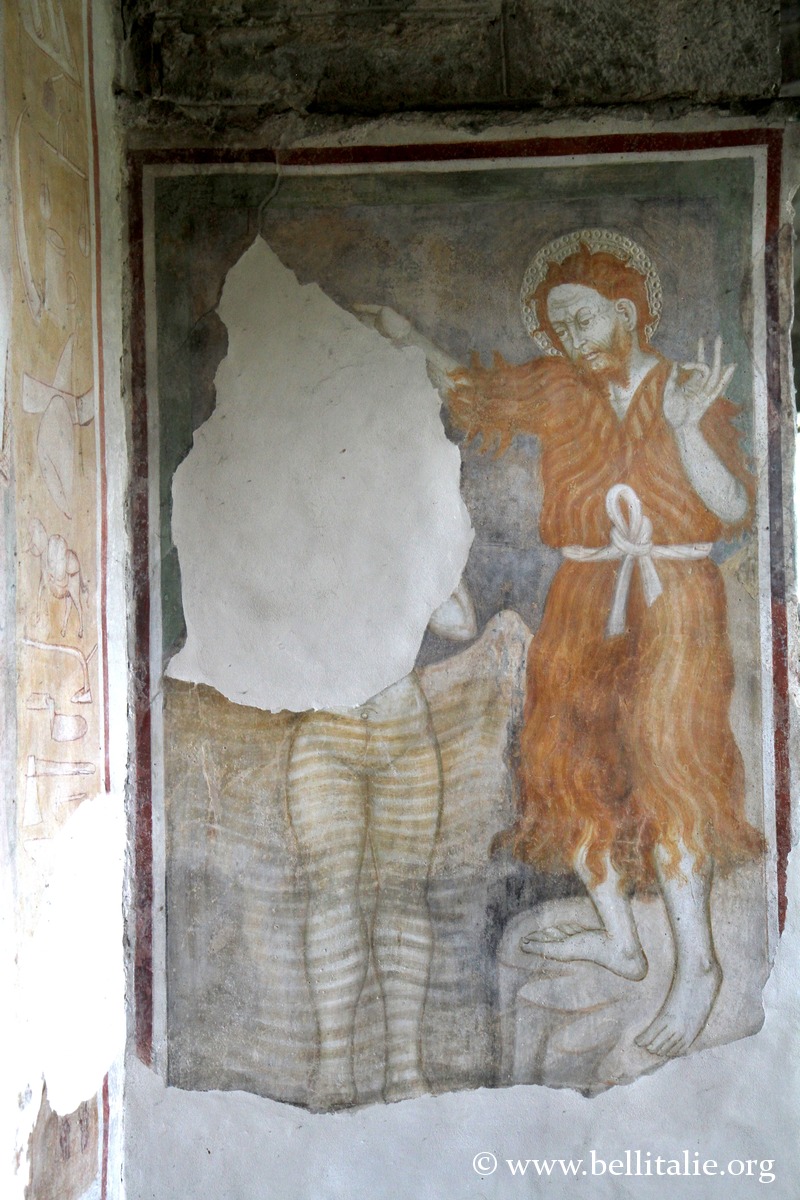
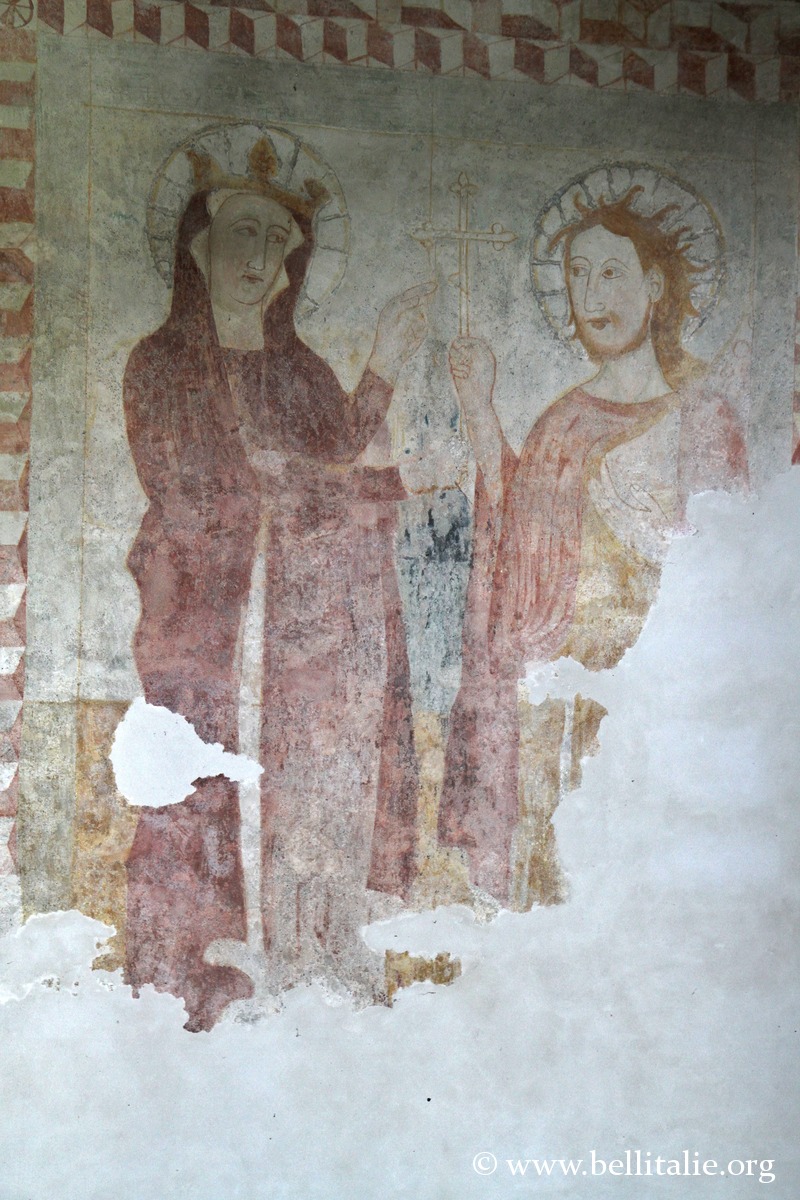
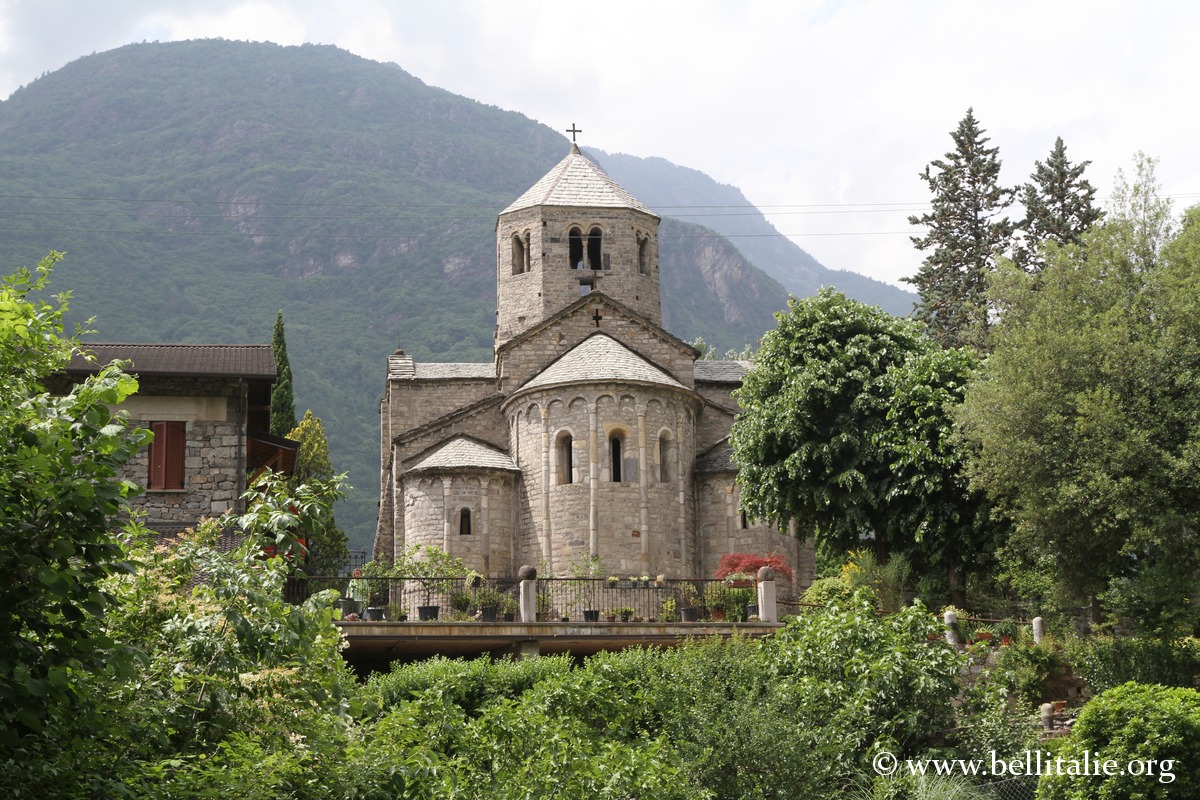 More than a kilometre north of Capo, on the edge of the woods, the church of San Salvatore is the only remaining building of a monastery from the 11th-12th centuries, which is the only evidence of the Cluniac presence in the Camonica valley. It is characterised by an octagonal tiburio and preserves an important garden of precious medicinal herbs, attested since the Middle Ages, notably to assist and care for pilgrims.
Archaeological parks of Cemmo and Seradina-Bedolina
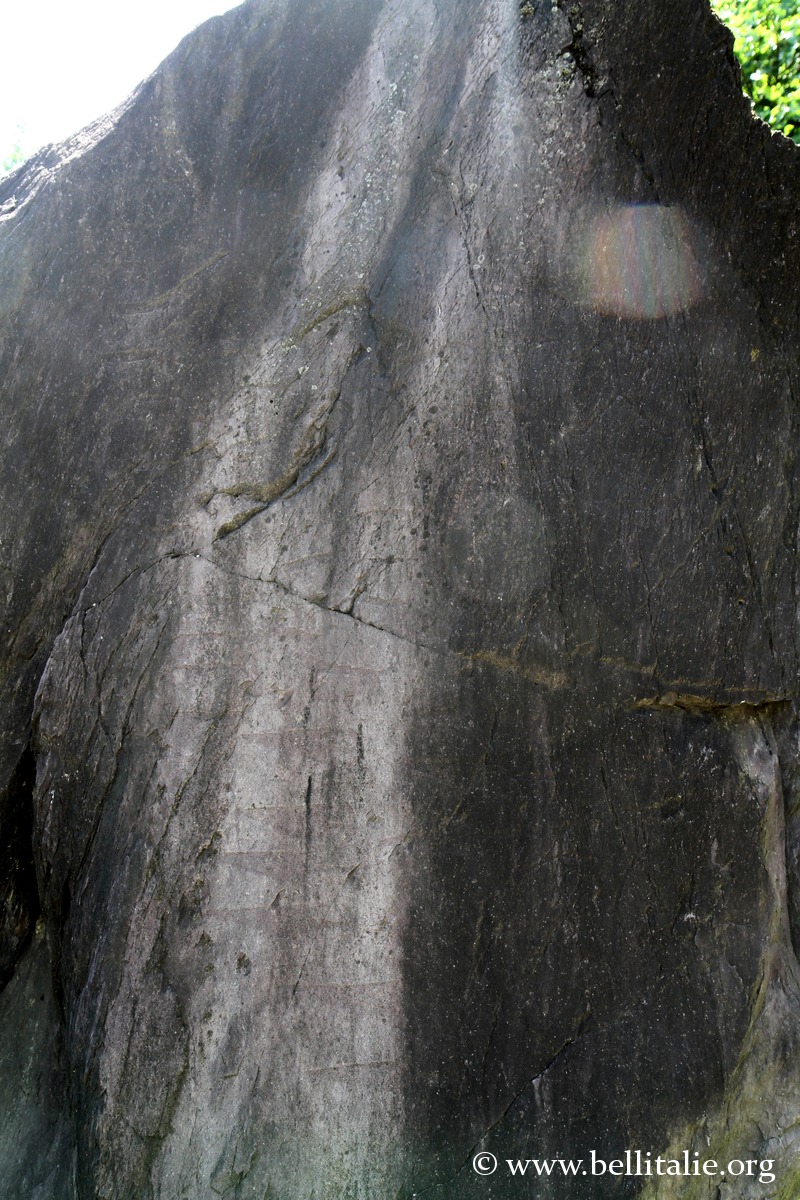 The National Archaeological Park of the Rocks of Cemmo was the first rock art site in the valley to be reported, in 1909, for its two extraordinary menhirs engraved in the 3rd millennium BC, with symbolic compositions, animal figures, weapons, humans, ploughing scenes and chariots.
An older circular sacred area has been identified around it, marked by steles and frequented since the Mesolithic, until the Christian era (read Cemmo menhir park).
The Municipal Archaeological Park of Seradina-Bedolina has rocks with engraved figures dating back to the Bronze and Iron Ages with scenes of combat, hunting, ploughing, huts, pseudo-Etruscan inscriptions. Towards Bedolina one can see the Rock of the map and other scenes from the Iron Age (read Seradina-Bedolina archaeological park).
Sanctuary of the Stations of the Cross at Cerveno
The Via Crucis at Cerveno has in the large building called Capèla, 14 chapels of the Stations of the Cross, decorated with frescoes and preserving 198 life-size coloured wooden and plaster statues from the mid-18th century, telling the Passion of Christ.
Ceto, Cimbergo and Paspardo
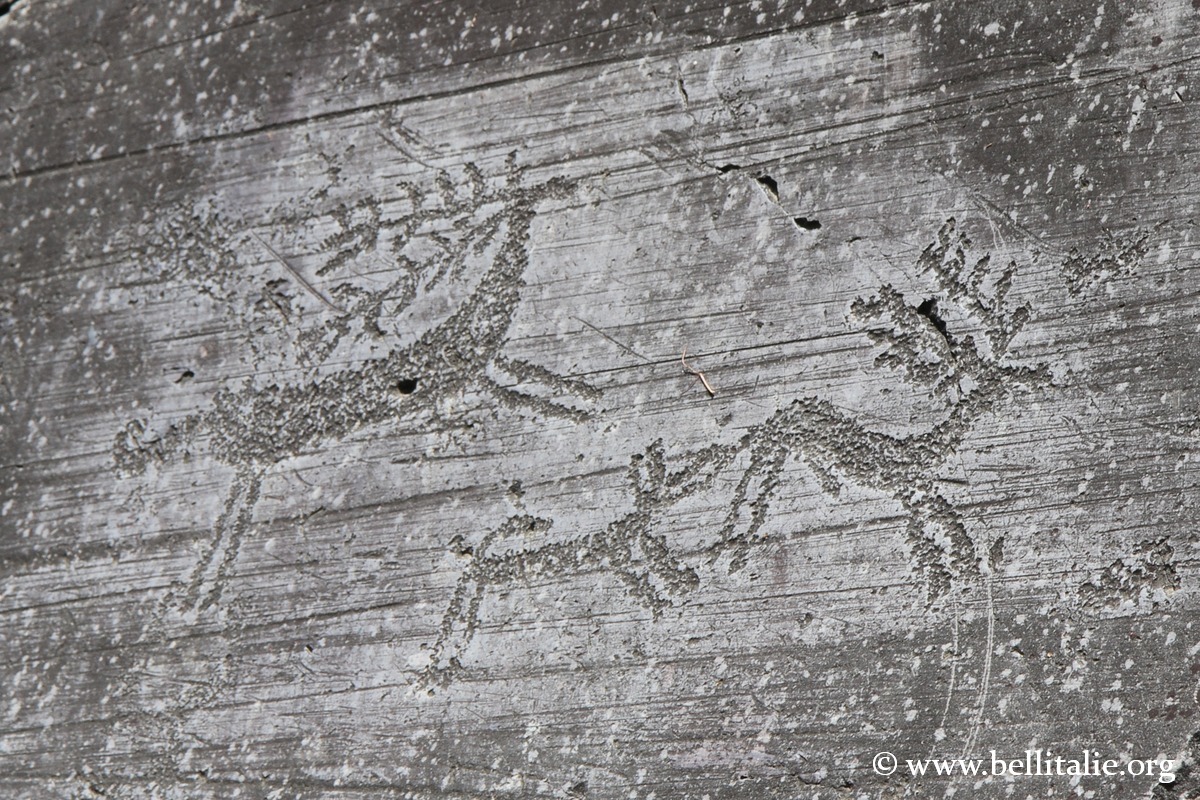 These three municipalities have several sites that are part of a large Nature Reserve with Rock Inscriptions (Riserva Naturale Incisioni Rupestri di …), some of whose itineraries have dozens of engraved rocks, such as the Foppe at Nadro or the Campanine at Cimbergo.
Above the village of Cimbergo, a summit is dominated by the remains of the castle fort of Cimbergo. On one side the view extends over the Camonica Valley, with on the left rising the peak of the sacred mountain of Pizzo Badile, at 2434 metres, for which trails start nearby (read Nature reserve of the rock inscriptions of Ceto, Cimbergo and Paspardo).
Sites from Sellero to Sonico
The Municipal Archaeological and Mining Park of Sellero has four rock art sites, including that of Carpèné (Neolithic and Iron Age) and the mining area of Carona (see Sellero-Carpèné archaeological park)
The multi-thematic archaeological route Coren delle Fate at Sonico is characterised by a very hard grey stone, with many geometric engravings, rectilinear or circular (see Coren delle Fate archaeological route).
Upper valley
Edolo
The Church of Saint John the Baptist of Edolo preserves inside beautiful wooden statues and a superb cycle of frescoes, one of the most important in the region from the 16th century, attributed to Paolo da Cailina il Giovane, on the life of Saint John the Baptist.
The Rocca de Mù and the site of Plate di Icc are two rock engraving sites of this area of the valley, the first near the medieval fortress (from prehistory to the Middle Ages), and the second on a terrace overlooking the valleys (late Neolithic and Iron Age).
Temù
At Temù (Adamello), the Museum of the White War preserves objects and documents dating from the First World War, which was called “White War” in the mountains of the Camonica Valley. It also houses an exhibition room and a library-archive.
Ponte di Legno
Ponte di Legno is one of the best-known winter sports destinations in Italy, with the nearby Presena glacier, bringing together four ski areas: Ponte di Legno, Passo Tonale, Presena Glacier and Temù for a total of 41 slopes, up to 3016 metres of altitude. It is also a summer destination for its proximity to the peaks.
The village notably keeps the church of the Holy Trinity.
Case di Viso
At the end of a small valley near Ponte di Legno, Case di Viso is one of the starting points for beautiful hikes to reach the summits or follow the small valley. You can also simply walk along the village of stone houses on foot from the car park.
On these sometimes wooded paths one often encounters beautiful wildlife, such as deer, ibex and chamois.
Map
 Show interactive map
 Information
- Wikipedia page: en.wikipedia.org
- Tourist portals: www.youvallecamonica.it, www.turismovallecamonica.it, www.in-lombardia.it


Comments