


Below is a selection of the most interesting places to discover in Padua, followed by the Interactive tourist map of Padua
1. Scrovegni Chapel
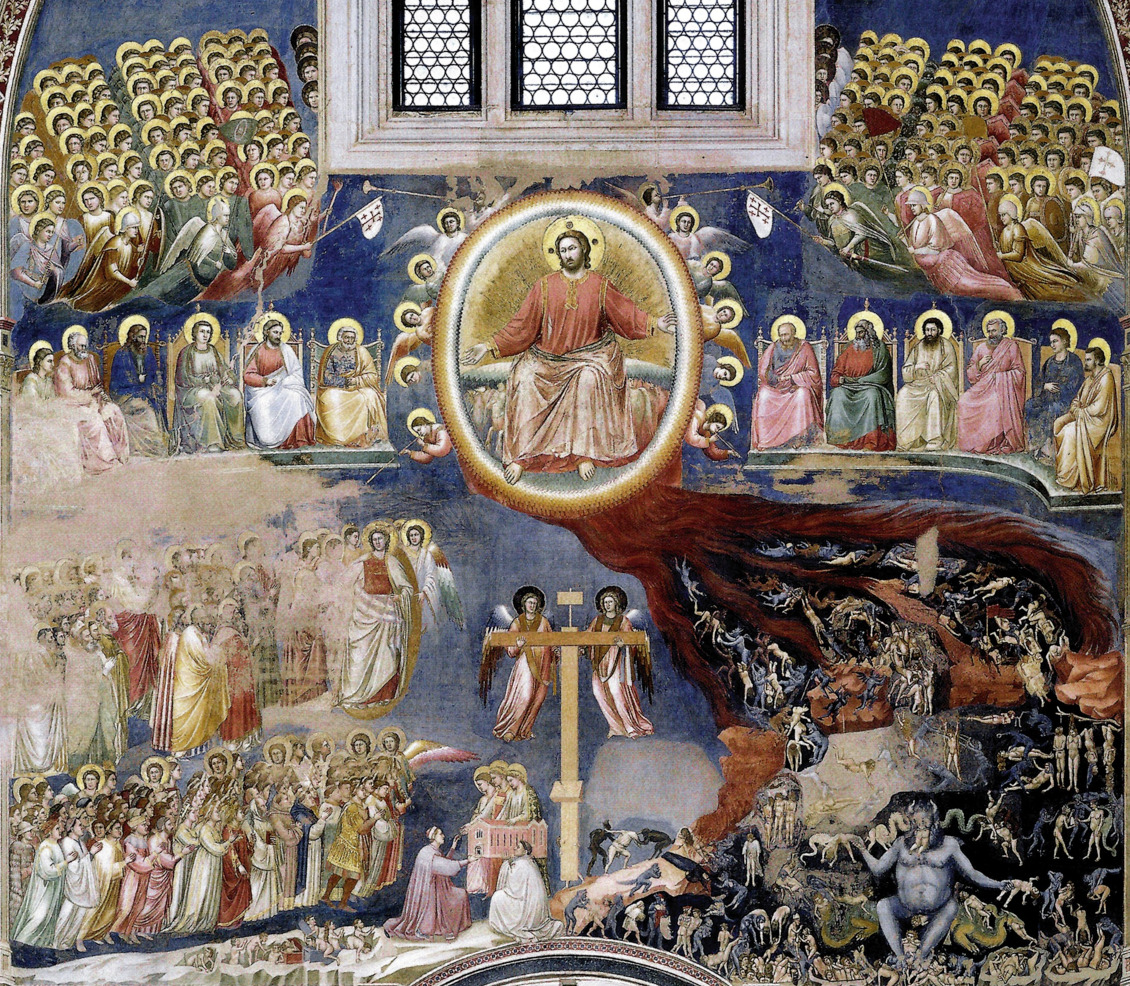
Last Judgment, Scrovegni Chapel (Giotto, 1306)
The simple and sober exterior of the Scrovegni Chapel hides one of the most beautiful fresco cycles in the world, a masterpiece by Giotto, a work at the origin of modern painting. It was at the request of Enrico Scrovegni that the master produced these paintings between 1303 and 1305. This chapel was commissioned by Enrico for the salvation of the soul of his father Reginaldo, a usurer and banker, feared during his lifetime, and even placed by Dante in the hell of the Divine Comedy.
They narrate passages from the Gospels, with episodes from the life of Joachim and Anne (the parents of the Virgin), the life of the Virgin Mary and the life and death of Christ.
Reservation is mandatory to visit; the ticket also includes the Eremitani Museum and the Zuckermann Palace.
2. Basilica of Saint Anthony of Padua
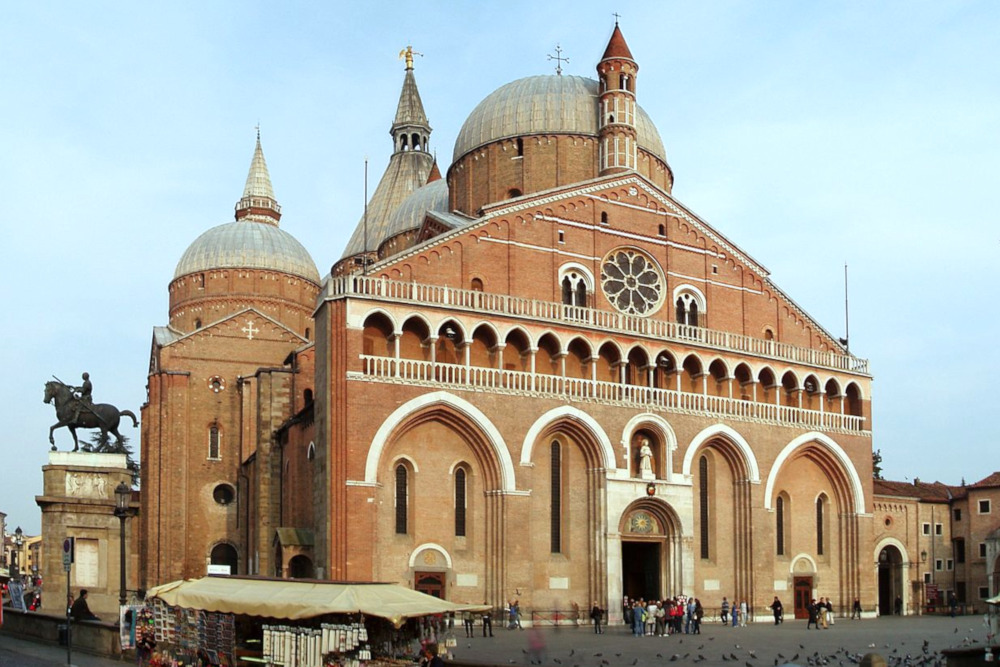
Basilica of Saint Anthony
Saint Anthony, a Franciscan from Lisbon (1195-1231), protector of the city and much loved by its inhabitants, is called “the Saint” by the people of Padua. The basilica preserves his relics, which are venerated during a procession on June 13.
The monument combines different architectural styles, including the Romanesque facade, Byzantine domes, small bell towers, and inside a Gothic ambulatory with seven chapels.
Among the rich chapels, the San Giacomo Chapel is decorated with 14th-century frescoes by Andriolo de Santi. The Chapter Hall preserves a fragment of a Crucifixion attributed to Giotto. The Madonna Mora Chapel comes from the former church of Santa Maria Mater Domini. The saint’s relics are located in the center of the ambulatory.
In the square in front of the basilica, the equestrian monument to Gattamelata is a bronze statue by Donatello, an innovation at the time, being the first work of its kind.
3. Piazza delle Erbe and Piazza della Frutta
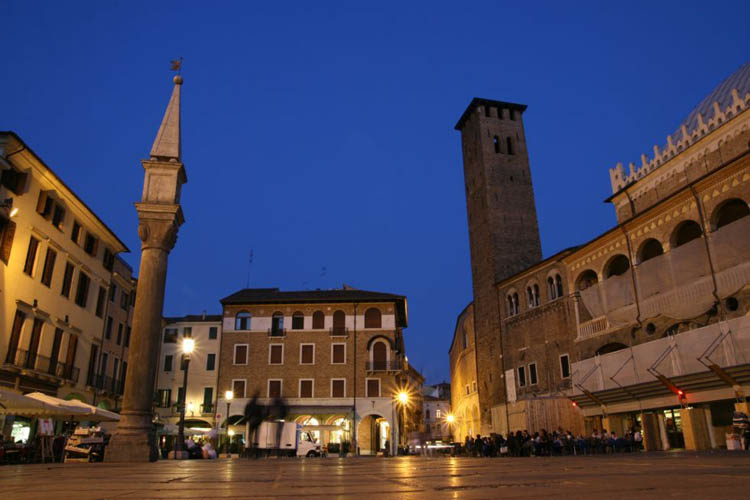
Piazza della Frutta
The Piazza delle Erbe, an ideal place to have an aperitif, remained for centuries the market space, named in various ways over time, where the stairs were called “scala delle Erbe” at the time when vegetables were sold there.
On the other side of the Palazzo della Ragione, separated by a covered passage, the Piazza della Frutta was also a market square, where fruit was sold. The Peronium is a medieval column whose name possibly derives from the Latin perones (leather shoes).
The passage between the two squares, called “Volto della Corda” in memory of the cheaters and debtors who were whipped there with a rope. As a warning, the ropes were permanently hung on the five stone rings set into the wall.
4. Palazzo della Ragione
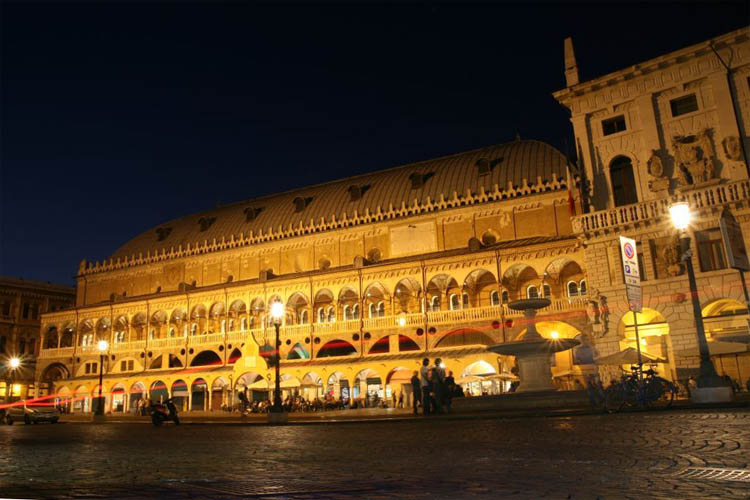
Palazzo della Ragione
This palace, palazzo della Ragione, is the most imposing in Padua, built between 1218 and 1306, and seat of the Courts and of the city administration. It is called “the Salon” because its first floor is a vast room accessed by the “Scala delle Erbe” on the Piazza delle Erbe, 80 meters long and 27 meters wide, entirely decorated with frescoes.
It unfortunately lost frescoes by Giotto in the fire of 1420. It is however one of the vastest pictorial cycles in the world with its paintings mixing astrological, religious and animal images, symbolizing the activities of the city.
A block of black porphyry is called “pietra del Vituperio”. Insolvent debtors had to climb onto it to undress and be beaten on their buttocks before having to leave the city.
Nearby the “Palazzo delle Debite” was a prison that was connected to the Palazzo della Ragione by a passage.
5. Prato della Valle
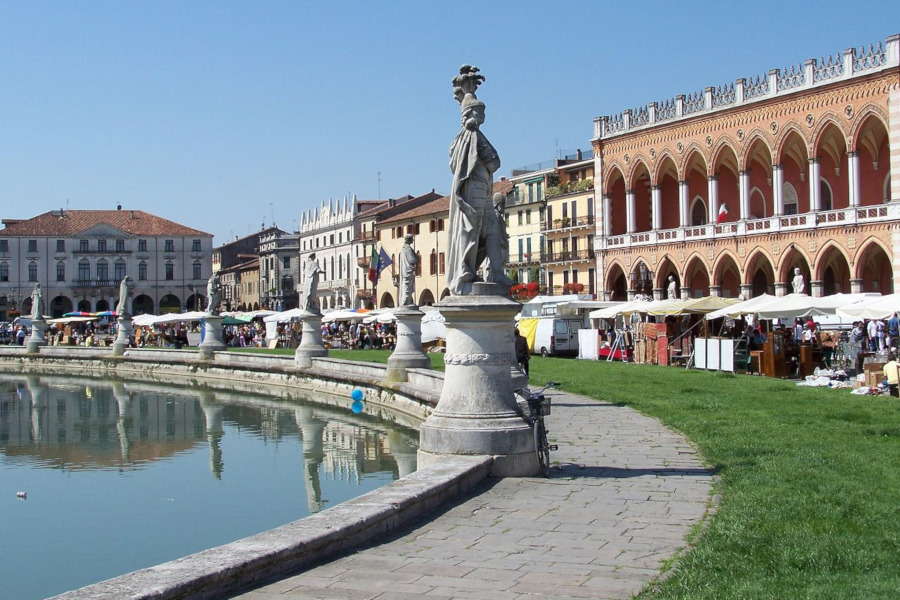
Prato della Valle
The Prato della Valle is the second largest square in Europe after Red Square in Moscow, with almost 9 hectares, including in the center the oval-shaped central island of the Memmia Island, a green space surrounded by a canal crossed by bridges and 78 statues of personalities.
On this site south of the historic center stood a large theater and a Roman hippodrome. It is also here that Saint Justina and Saint Daniel were martyred. Fairs and festivals enlivened it in the Middle Ages.
6. Civic Museums
The Civic Museums (Musei Civici or Musei Eremiti) located on the Piazza Eremitani include the Archaeological Museum and the Museum of Medieval and Modern Art, housed in the cloisters of the former convent of the Eremite friars of Saint Augustine. Recently, they also include the Museum of Applied Arts and the Bottacin Museum.
The archaeological museum gathers pieces from the pre-Roman, Roman and early Christian eras, as well as an Egyptian section enriched thanks to the Paduan explorer Giovan Battista Belzoni.
The Museum of Medieval and Modern Art contains mainly works by great masters of Italian painting from the 14th to the 19th centuries. Masterpieces stand out, such as the Crucifix by Giotto and those by Venetian painters such as Boccaccini (Madonna and Child), Veronese, Tintoretto (Supper at the House of Simon and Crucifixion), Tiepolo.
7. Cathedral and Baptistery
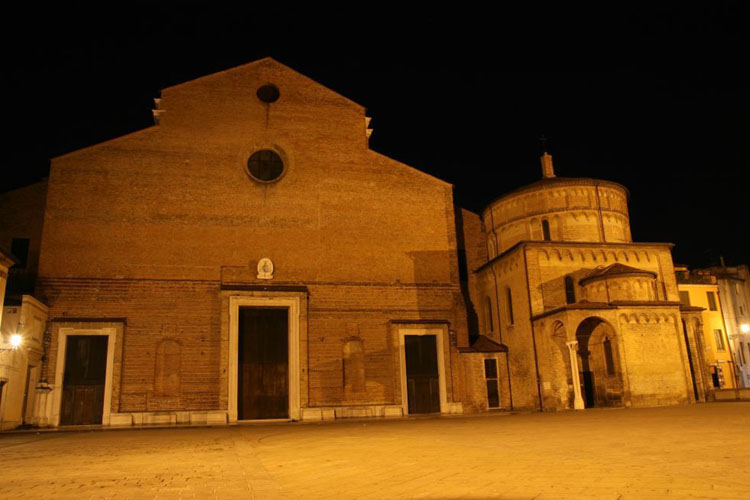
Piazza del Duomo
The Cathedral dedicated to Santa Maria Assunta was built from the 16th to the 18th century on a design by Michelangelo Buonarroti. The facade is unfinished, while the vast interior is very simple and without great appeal.
On the other hand, the adjacent baptistery preserves a cycle of frescoes by Giusto de’ Menabuoi. His paintings are surprising with their myriads of faces of angels and saints who seem to look at you when you raise your eyes to the dome, as well as the stern gaze of Christ Pantocrator in the center. On the walls are painted scenes from Genesis, the Prophets and Evangelists and of Christ and the Baptist.
8. Palazzo Bo and university
The University of Padua, which was founded in 1222, remained prestigious for a long time, particularly in scientific research, having seen Leon Battista Alberti, Galileo or Copernicus pass through.
In the 15th century it settled in the halls of Palazzo Bo. It notably preserves the Anatomical Theatre (1594) in walnut wood.
The Hall of the Forty keeps forty portraits of foreign students, and the wooden chair from which Galileo taught mathematics and physics from 1592 to 1610.
9. Clock Tower and Piazza dei Signori
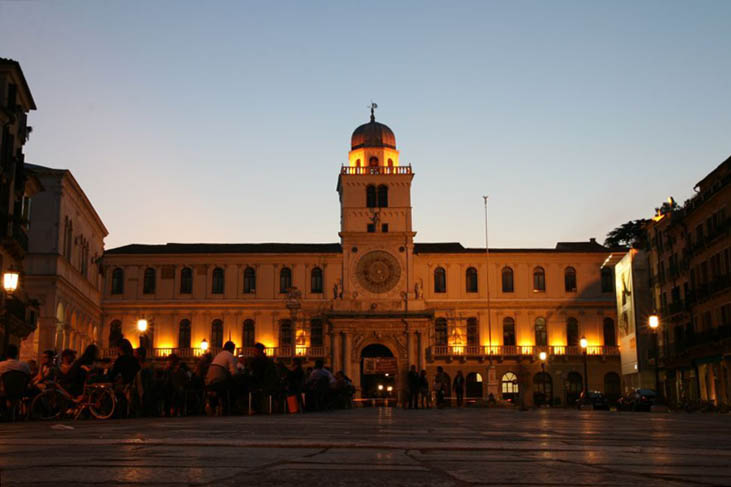
Piazza dei Signori
On the pretty Piazza dei Signori, the elegant Clock Tower features an astronomical clock that indicates the day, month, lunar phase and astrological sign. It dates from the period when the Most Serene Republic of Venice conquered Padua in 1405.
It was originally a medieval tower that served as a fortified entrance, separating the Palazzo Capitanio from the Palazzo dei Camerlenghi, remodelled between 1426 and 1437.
It can only be visited by reservation, to see the old clock mechanism.
10. Botanical Garden
The one in Padua is the oldest botanical garden in the world, founded in 1545, still in the same place, associated with the city’s University and inscribed as a UNESCO World Heritage Site in 1997. It preserves nearly 7,000 plant species, as well as a Biodiversity Garden inaugurated in 2014. 5 environments are recreated there: the Mediterranean scrubland, the Alpine mountains, freshwater ponds, or a tropical greenhouse.
The library established in 1835 and the Botanical Museum founded as a herbarium can be visited on the occasion of events.
11. MUSME
The museum of the history of medicine of Padua was opened in 2015, inside the former San Francesco hospital. It tells the history of medicine from antiquity to the most advanced current techniques.
Among the rooms of its 3 floors, and with an anatomical theatre, videos and multimedia systems enhance the discovery, around Galileo or the human body for example.
The San Francesco Hospital, built in 1414, remained in operation until 1798. It was the first university clinic in the world.
12. Specola, astronomical observatory
The Specola is a unique place, of historical and cultural importance, which was initially intended to house a prison, but which was transformed in the 14th century into a watchtower by the lords of the Carraresi by including it in the Castelvecchio castle.
It was in 1767 that it became an astronomical observatory, transformed into an astronomical museum in 1994, with since 2002 a research centre of the National Institute for Astrophysics,
13. Euganean Hills Regional Park
At the gates of Padua, the Euganean Hills are an opportunity for beautiful excursions in the warm season, a Natural Regional Park created in 1989.
It is a massif resulting from underwater volcanic eruptions, where olive groves, vineyards and forests of chestnut and oak trees grow, between old medieval villages such as the town of Arquà Petrarca, old paths or the Praglia Abbey (read also: Euganean Hills).
14. Other attractions and curiosities
The Zabardella Museum is a museum of local art and popular culture housed inside a medieval palace.
the Zuckermann Palace (ticket included in the municipal museums ticket) is a historical museum with collections of medals, coins, fabrics, ceramics and classic furniture;
The Precinema Museum, inside the Palazzo Angeli is dedicated to religious art,
Church of Santa Maria Dei Servi (14th century).
Basilica of Saint Justine of Padua (16th century).
Oratory of Saint George (14th century).
The Caffè Pedrocchi is a historic place in Padua, famous for its mint coffee sprinkled with cocoa
- Ghetto district, around the narrow streets Via Barbarigo, Via Manino, San Canziano, Roma and Marsala.
The works of Kenny Random, with its beautiful murals (Via Roma, Via Sauro, Via Sant’Agnese, etc).
Porta Portello and Navigli : lively district with its bars, terraces, riverside, etc.
- Venetian Villas a few kilometres from Padua, including Villa Barbarigo to the south and Villa Contarini to the north.
Boat excursions from Padua to Venice, also an opportunity to discover the villas lining the canal such as Villa Pisani, Villa Widman and Villa Foscari.
15. What to eat in Padua
The cuisine of Padua is a cuisine built around the traditional kitchen garden and poultry yard, especially poultry such as goose, capon, duck, guinea fowl, rooster and chicken. They enhance the bigoli (thick spaghetti) and risotti, cooked with peas, asparagus, radishes. Pasta, beans and even cabbage soup are often found as a “first course”.
For example, “l’Occa in Onto”, is a goose accompanied by bigoli, salted and preserved in its own fat. Other main courses are stews, sometimes with goose breast, salami, tripe, or sausage. Horsemeat and mule meat dishes and cured meats are also eaten.
In pastry, let us mention the fugassa padovana (focaccia), the figassa (fig cake), the smegiassa (with raisins) and the sbrisolona.
A tradition is also linked to Sant’Antonio with the Pan del Santo, the Dolce del Santo, the Amarettoni and the Merletti.
Map
 Show interactive map
 Information
- Website of the municipality of Padua
- Wikipedia page: en.wikipedia.org
- Tourist portal of Veneto: www.veneto.eu
- Blogs: www.viaggiareunostiledivita.it



Comments