


This page completes the
General presentation of Lake Como
The 185 km of shoreline of Lake Como follow the lake’s inverted Y shape, skirting the long northern arm and the two southern arms. The towns, sites and villages along it are numerous. In addition, you can hike in the heights and discover sublime and varied panoramas over the lake and the alpine chain.
Among the main places that stand out, there is first of all the town of Como, at the southern end of the western arm. Among the lakeside villages, Bellagio is located at the junction of the two southern arms, a holiday resort for centuries. On the western side, the Isola Comacina lies at the foot of the Sacred Mount of Ossuccio. It is close to one of the main attractions of the lake, the Villa Balbianello, located at the tip of a small peninsula with its beautiful garden, appreciated by filmmakers (Star Wars Episode II, Casino Royale). Further north, Menaggio is another charming village, known for its villas and natural sites.
The eastern shore, generally less appreciated and less urbanized, also has some remarkable sites: the village of Varenna, the medieval village of Corenno Plinio, and the Abbey of Piona. In addition, trails, natural sites, excursions and panoramas to discover are numerous.
Several sites can be conveniently connected by boat, even those located on opposite shores, including Varenna, Menaggio and Bellagio which are very close as the crow flies, while at the same time enjoying the crossing and the viewpoint it offers.
Below we travel along the shores and their sites, from north to south, starting with Como at the southern end of the western arm of the lake.
 Show interactive map
 Western shore
Como 
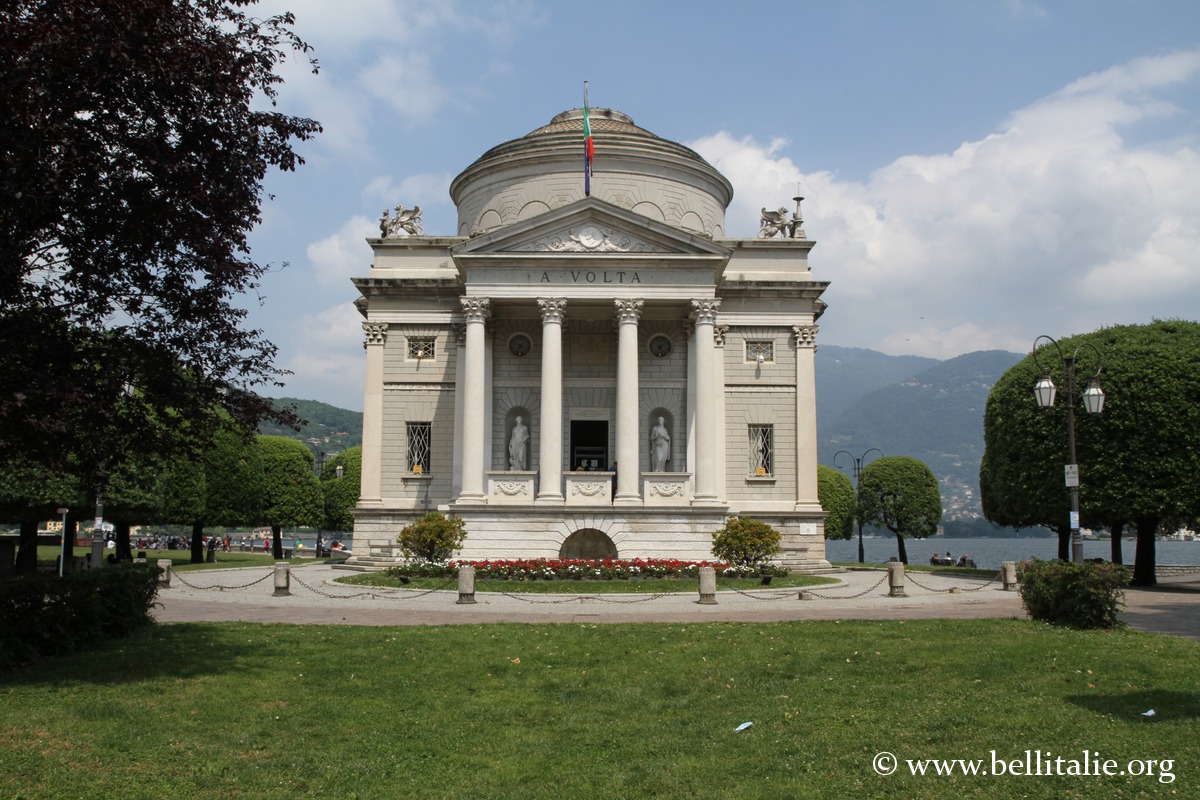
Volta Temple in Como
Como is the beautiful historic town of the lake, located south of the western arm, where nearly 84,000 inhabitants live. It was Celtic before being developed by the Romans.
Its history has left it many historic buildings, including the Broletto palace, the late Gothic cathedral from the end of the 16th century, the basilicas of Sant’Abbondio and San Fedele, the Volta Temple in honor of its famous physicist, arcades and Renaissance houses on the piazza San Fedele, as well as buildings from the 1930s, or the neoclassical Villa Olmo from the 18th century, the city walls or the remains of its old Baradello castle that dominate the village to the south of it.
Surroundings of Como
From Como, you can reach Brunate by funicular, at nearly 800 meters altitude, called the “Balcony over the Alps” for its spectacular view of the alpine arc, where the wealthiest built their Art Nouveau-style villas.
The Lake Como Poetry Way is a famous 16 km walking route that skirts the south of the lake passing through Como, from the heights of Brunate in the east to Cernobbio in the northwest.
The Spina Verde Regional Park extends over the hills northwest of Como. It borders Switzerland, with historical sites such as the Baradello castle and the Cadorna Line
Cernobbio
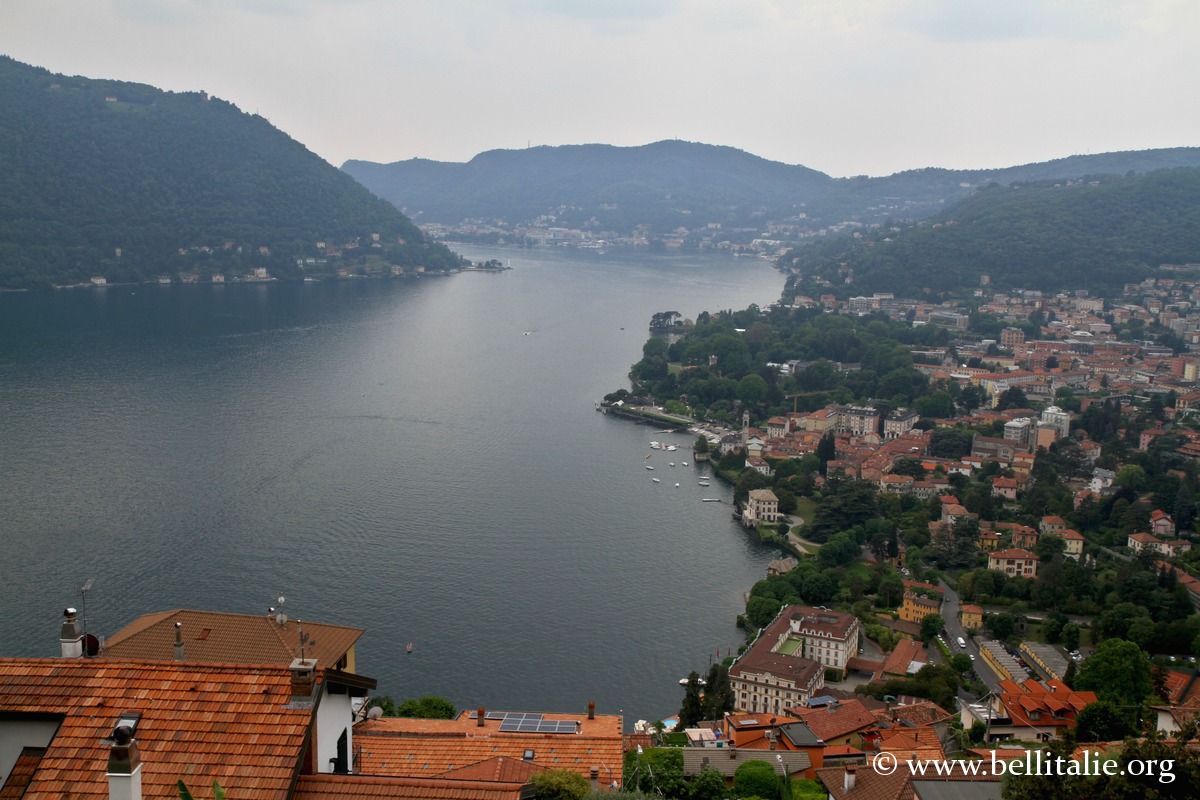
Cernobbio and Rovenna
Close to Como, at the foot of Mount Bisbino which quickly reaches 1300 meters, Cernobbio is an elegant village. Along this portion of the coast, the views of the lake are magnificent and several beautiful villas have been built. Piazza Risorgimento is at the heart of the village and directly overlooks the lake.
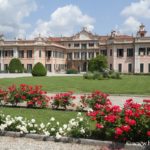
The Villa Erba, which was built in 1898, is a large complex consisting of several residential houses, greenhouses, a dock, stables, service houses, and surrounded by a vast park. It was the residence of the family of the famous director Luchino Visconti, and today a conference center.
The most prestigious building is the Villa d’Este, which overlooks the lake, dating back to the 16th century and transformed in 1873 into a luxury hotel, with a beautiful Italian garden.
Along the lake, you can also see the Villa Bernasconi in Art Nouveau style, the Villa Pizzo with its two buildings, and the Villa Fontanelle from the 18th century in a very beautiful park.
The village is also a starting point of the Via dei Monti Lariani, a well-equipped hiking trail, traversing the mountains west of Lake Como over 100 km, in 5 or 6 stages to Sorico.
Laglio and Torriggia
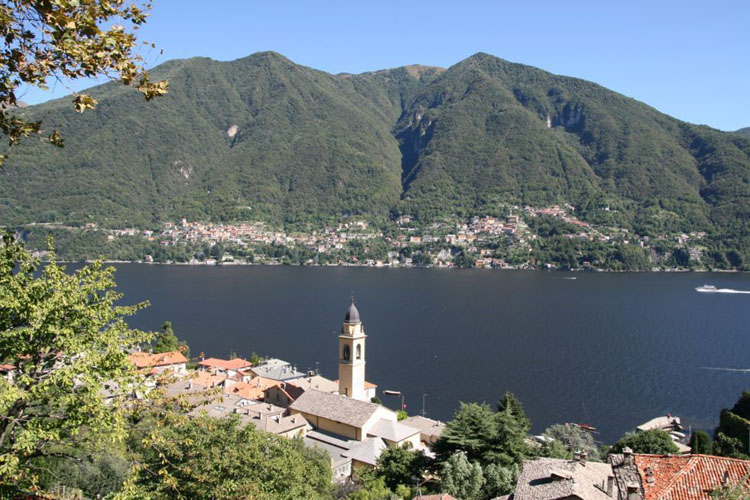
Laglio
The small village of Laglio with the hamlet of Torriggia faces a narrow portion of the lake. This village came out of anonymity when George Clooney bought the Villa Oleandra from the 18th century there for his vacations in Italy.
Besides the pleasant lakeside promenade, the Buco dell’Orso is a karst cave with three small underground lakes. Among the olive trees and vineyards of the heights, you discover beautiful views.
In the cemetery of Laglio, there is the pyramid of Joseph Frank, a stele nearly 20 meters high, erected in 1851, imitating the pyramid of Caius Cestius in Rome.
Argegno
The village of Argegno is crossed by the Telo river, spanned by an old stone bridge. The village is picturesque with its stone houses, and a very beautiful view of the lake.
Val d’Intelvi and Balcony of Italy
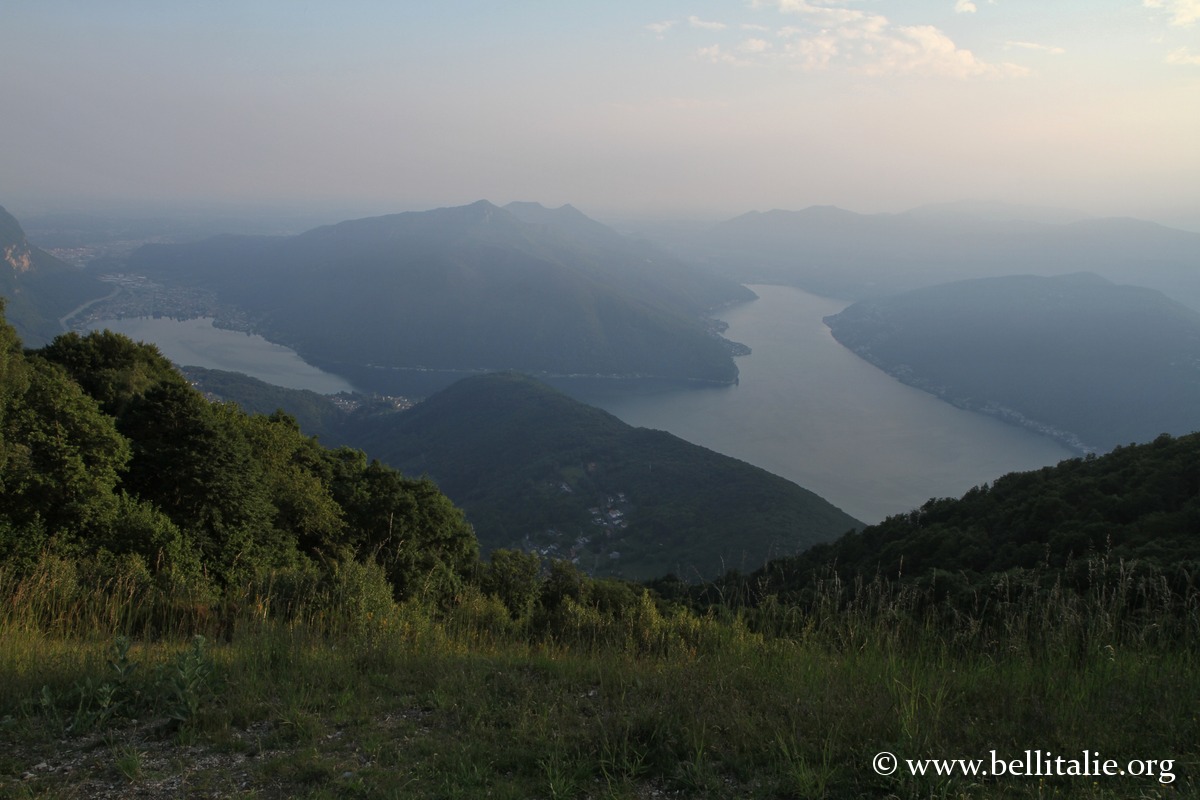
Balcony of Italy
There are only a few kilometers between Lake Como and Lake Lugano, on the Swiss border, connected in particular by the Intelvi Valley, between Argegno on the first and Osteno for the second, passing through Lanzo via Val Mara.
From the top of the Sighignola at 1320 meters altitude, reachable by road or by trails, you can admire a spectacular panorama from the terrace called “Balcony of Italy“, over Lake Lugano and the Alps with Mont Rose to the Matterhorn. A bar-restaurant is usually present.
The road leading there was built shortly before the outbreak of World War I, as part of the fortification works of the Cadorna Line.
Tremezzina
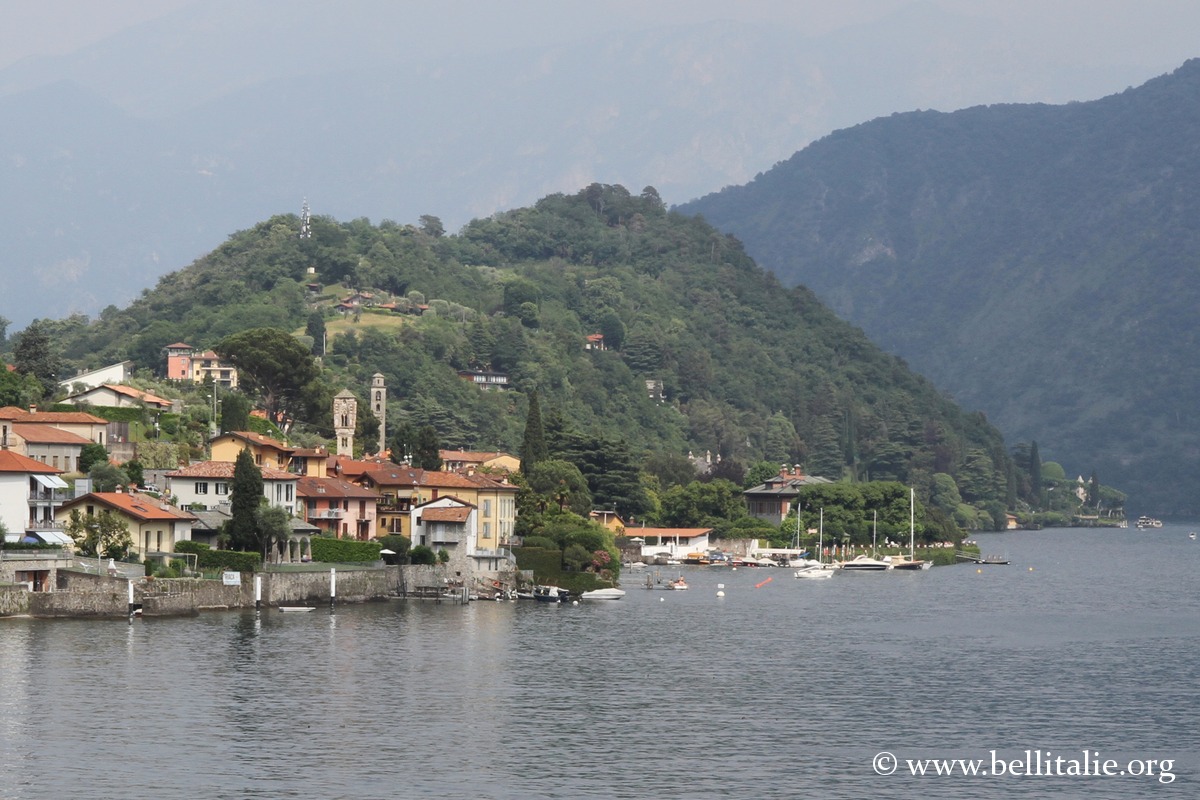
Tremezzina is a municipality gathering from south to north the villages of Ossuccio, Lenno, Mezzegra and Tremezzo, passing by the Isola Comacina, the sacred mount and the Villa Balbianello.
Ossuccio
The views are very beautiful around the villages of Lenno and Tremezzo. The latter has kept the beautiful church of San Lorenzo, as well as the Villa Carlotta, a superb Baroque achievement. In the heights in the hills, Rogaro was a village of medieval origin, where the church with the statue of the Black Madonna that comes from the sanctuary of Einsiedeln in Switzerland, and the tower of medieval origin remain.
The Villa Carlotta, which is in a panoramic position, is open from March to November, visitable only by reservation. It has an important botanical garden, including the Italian Garden and the Romantic Garden. The museum preserves works of art and objects, having belonged to Princess Carlotta, wife of the Duke of Saxe-Meiningen, including The Last Kiss of Juliet and Romeo by Francesco Hayez or the statue of Palamedes by Canova.
Sacred Mount of Ossuccio
Sacred Mount of Ossuccio
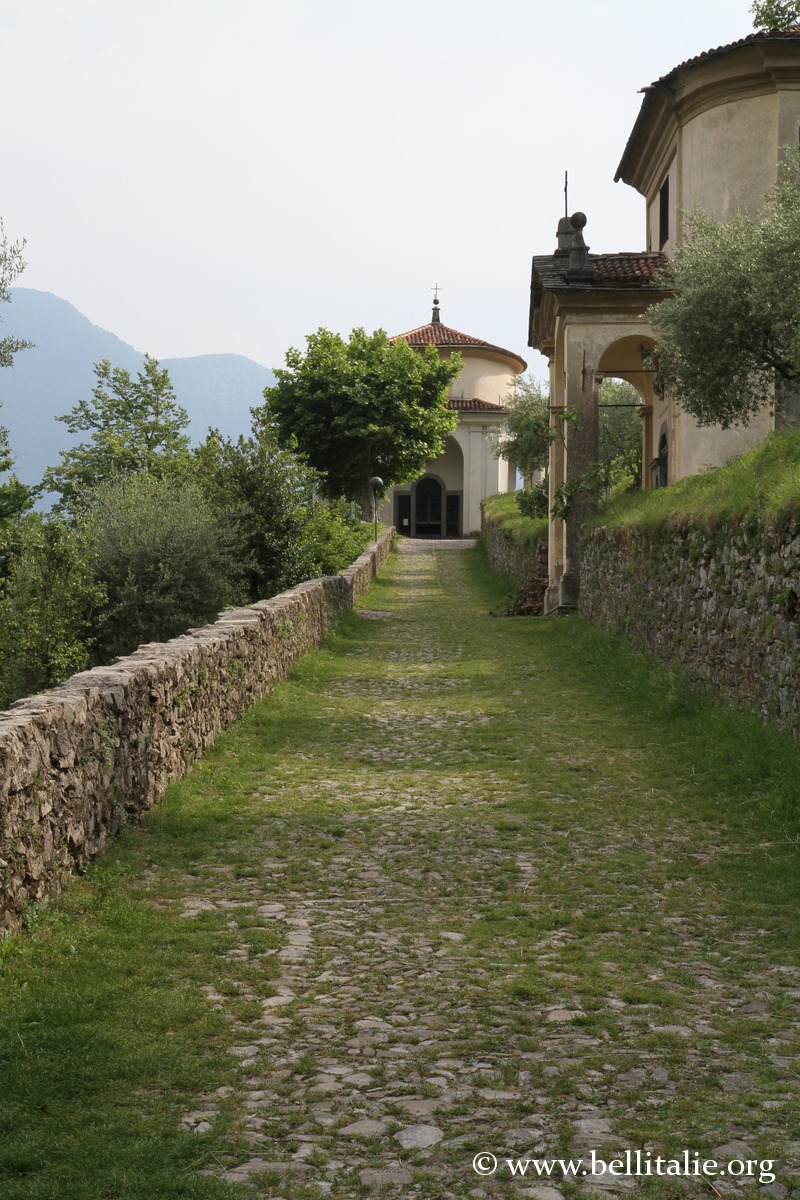
Located in the municipality of Tremezzina, the Sacred Mount of Ossuccio is a UNESCO World Heritage site, perched at 419 meters altitude, facing the Isola Comacina, with 14 chapels built between the 16th and 17th centuries.
Isola Comacina
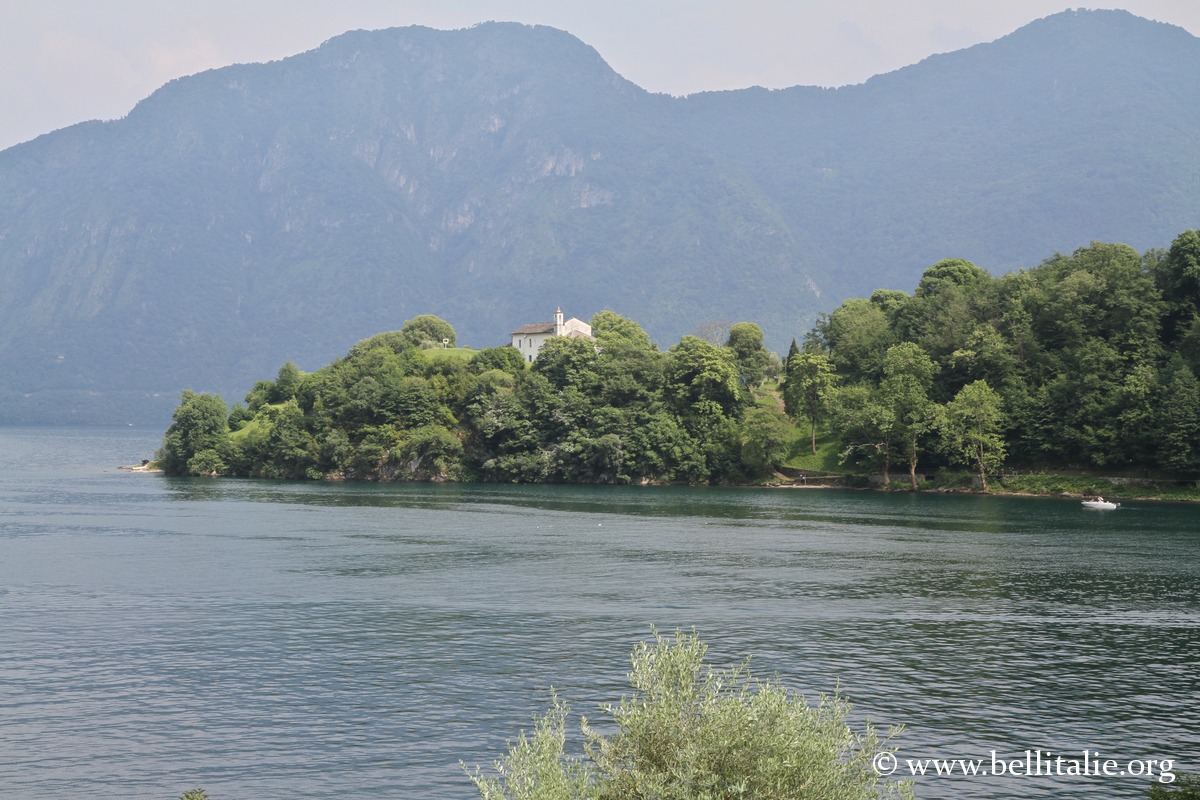
It is the only island of the lake, very close to the shore, a charming place mixing nature and archaeology. There stand the remains of the church of Sant’Eufemia dating from the 11th century, one of the examples of Romanesque art around the lake, with the beautiful crypt and the portico, a marble colonnade from Roman times.
Isola Comacina
Its vegetation covers its historical past, when it was a fortified citadel built by the Romans and the Byzantines, razed by the Comaschi in 1160, because it had supported its rival Milan.
Three Houses for Artists were built here between 1936-40 by the architect Pietro Lingeri in Rationalist style, intended to host for short periods artists seeking inspiration.
Villa Balbianello
Located in Lenno on the small peninsula of Lavedo, the Villa Balbianello is an enchanting place, perhaps the most beautiful villa of Lake Como, often appreciated as a cinematic setting, like scenes from Star Wars Episode II or Casino Royale.
It dates back to the 18th century with its Renaissance style, placed in a dominant position facing the lake, at the tip of the peninsula. It can be reached from the parking lot on foot, or by water taxi from Lido di Lenno (€6 one way, €8 round trip) and thus enjoy a view of the villa from the lake.
The interior deserves as much a (guided) visit as the exterior. You can however visit only the gardens (about €12 for the gardens, and €23 to add the guided tour), with its views and its careful layout in a dominant position over the lake. The last owner of the villa, Guido Monzino, left his mark and his tastes in the arrangements, in particular the library.
Menaggio
Menaggio
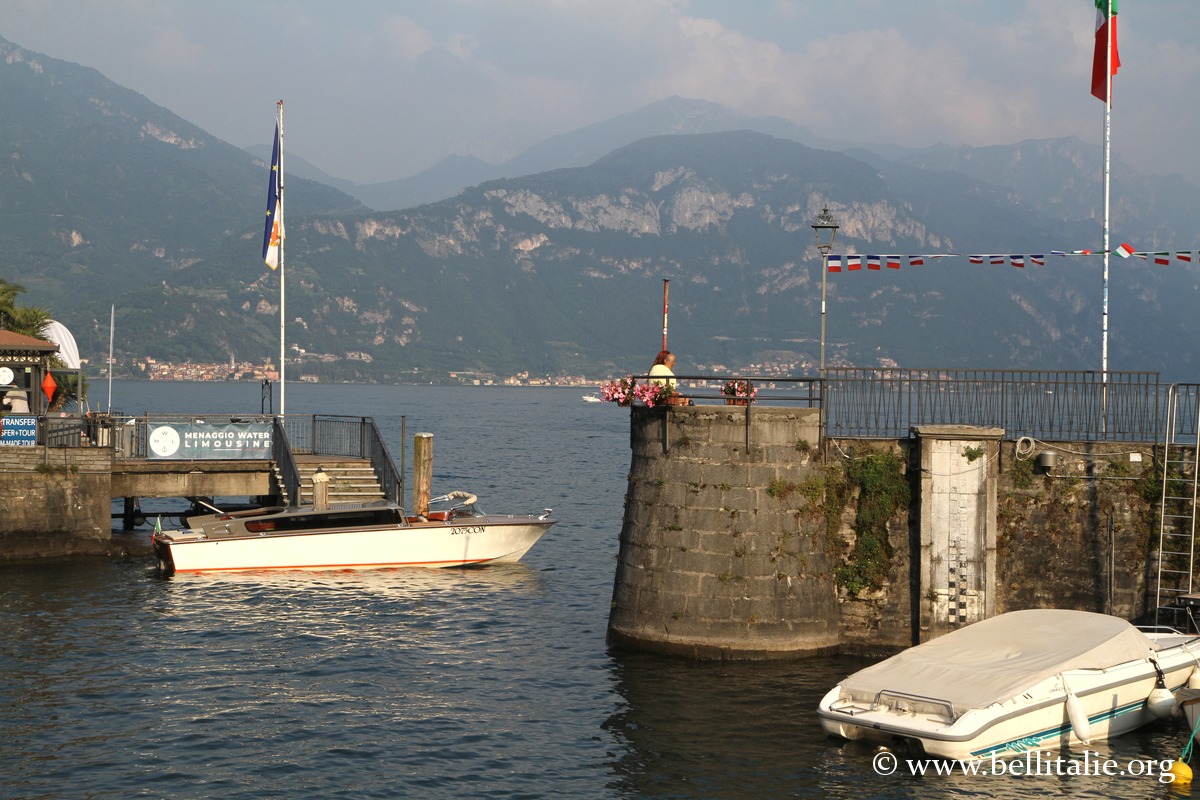
Menaggio is another charming village, and relatively peaceful, at the foot of Mount Grona and its panoramas over the lakes.
The lakefront is charming, between the small port and the lido, and the historic center around its central square has bars, shops and restaurants.
Besides a few churches, several private villas are located in the municipality, such as the Villa Mylius Vigoni nestled in an English garden (visits in season by reservation) and the Villa Govone.
You can take the walk of the old Strada Regina, leading to Rezzonico, or discover the pretty valley with the Val Sanagra Park mixing nature and remains.
Central shore and Triangolo Lariano
The Triangolo Lariano occupies the space between the two arms of Lake Como, north of the town of Erba and its small lakes, formed by a mountain massif where Monte San Primo culminates at 1682 meters altitude. You discover pretty landscapes there, woods alternating with meadows, as for example on the road connecting Caglio to Nesso.
The shores are quite steep, both to the west towards Nesso, and along the eastern arm, whose heights are traversed by beautiful trails, such as the Olive Trail with its beautiful views over the lake arm, where in places the mountain plunges steeply into the waters. Approaching Lecco, there are some beaches, including a public garden that borders the lake at Valmadrera, when the relief flattens and urbanization spreads.
Bellagio
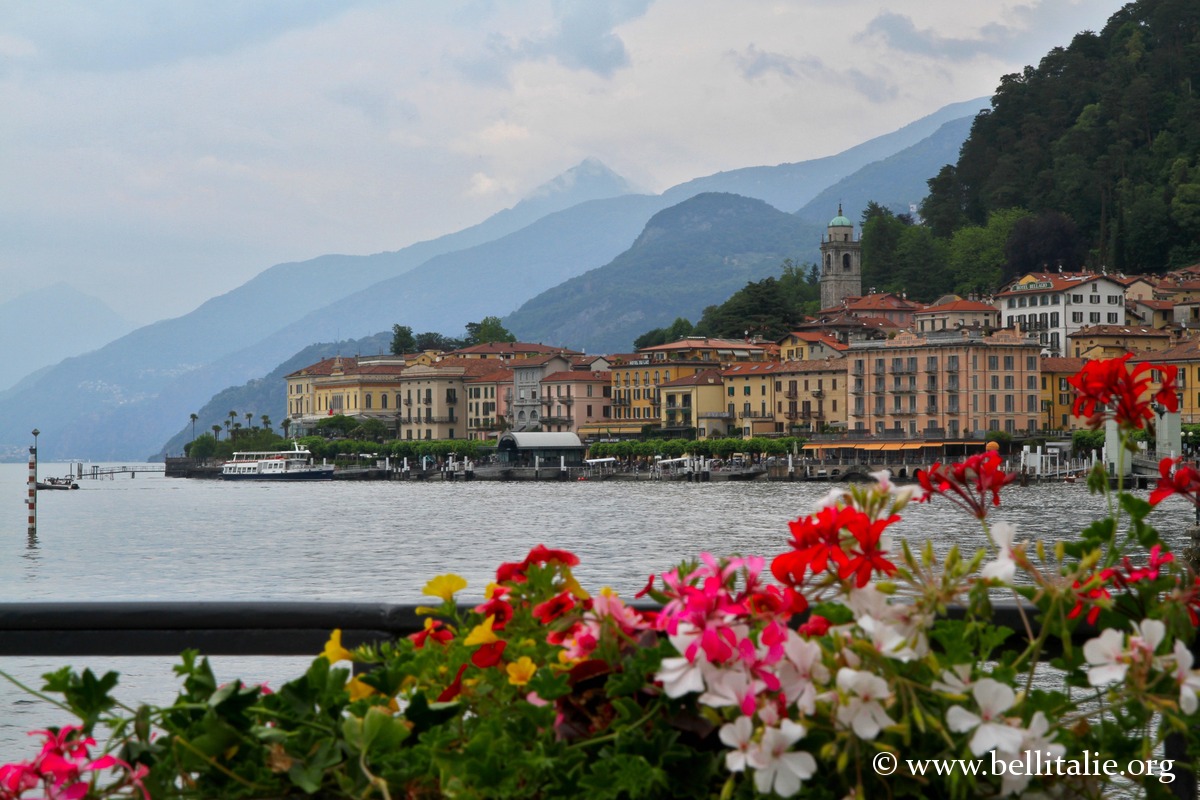
Bellagio
At the junction of the two southern arms in the form of a point of land, Bellagio is a beautiful village, designated as the “pearl of Lake Como”. It has been a holiday resort for centuries, whose villas were frequented by historical figures such as Napoleon, Liszt or Manzoni. Despite its somewhat excessive tourism, it is a place of great magnetism, on a small peninsula framed by the two arms of the lake that meet at the tip, at the Punta Spartivento.
Its historic center is remarkable, with its picturesque alleys of colorful houses, stairways and old churches, essentially the Basilica San Giacomo. Among the luxurious villas built here from the 18th century, two stand out and can be visited: the Villa Serbelloni, 19th-century neoclassical on its promontory with its terraced garden, and the Villa Melzi, 19th-century neoclassical embellished with a beautiful English garden.
Monte San Primo
The Triangolo Lariano occupies the space between the two arms of Lake Como, north of Erba and its small lakes, with a mountain massif where Monte San Primo reaches 1682 meters altitude. A short hike allows reaching the summit from the parking lot.
Madonna di Ghisallo
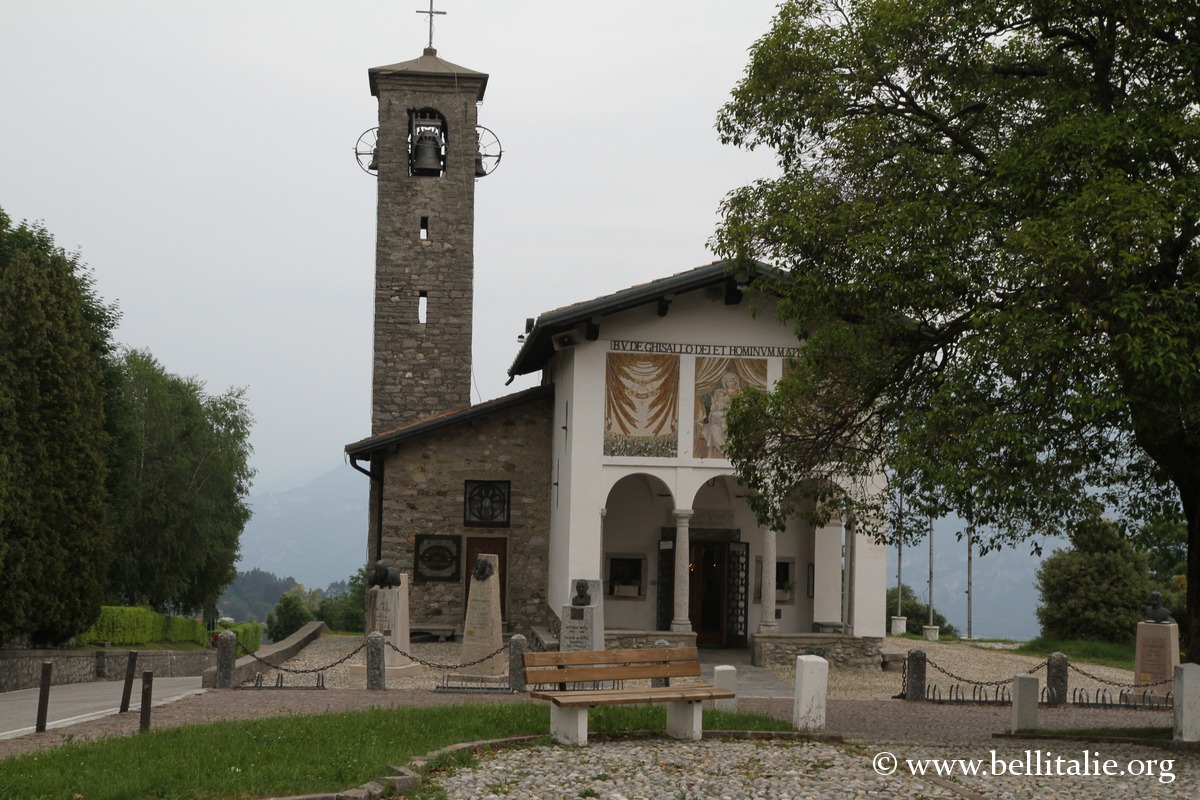
Madonna di Ghisallo
About 10 km south of Bellagio towards Erba, the road climbs the slopes and passes by the Madonna di Ghisallo (17th century), a church dedicated to the patroness of cyclists. Around the virgin, bicycles and jerseys of famous riders, trophies and photos are sheltered.
The sanctuary is at the top of a climb coming from Bellagio, at 754 meters altitude, where the finish line of certain cycling competitions was located, including the Giro d’Italia. Riders rested here after the race, often visiting the virgin of the place, then Pius XII consecrated her as “universal patroness of cyclists” in 1948. A Cycling Museum was built here, near the church.
Nesso
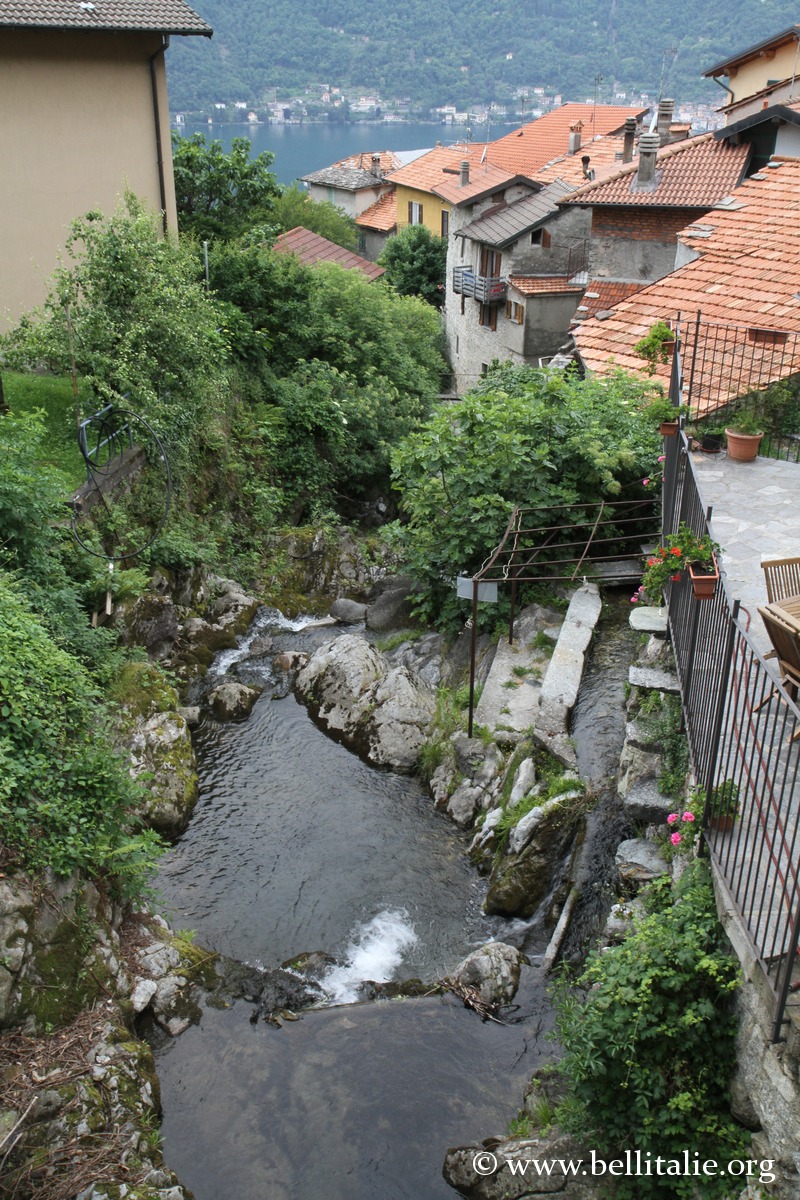
Nesso
Nesso is a small village whose houses climb along the mountain, crossed by a stream, with beautiful views of the lake. The Orrido di Nesso is a narrow gorge where the water falls into the lake as a cascade, crossed at the very end at the edge of the lake by an old and picturesque stone bridge, the Ponte della Civera.
The views of the lake are very suggestive along the winding road between Nesso and Lenzello, winding, at the foot of the mountain.
Olive Trail
The Olive Trail takes its name from the Olive Coast, an 8 km section of path in the municipality of Oliveto Lario, this coast being traversed by several trails, sometimes steep, through the olive trees where very beautiful views open up, then in the heights chestnut trees, hazelnut trees, oaks, and some meadows.
From Onno, several trails reach La Madonnina (905 m) near Crezzo passing through panoramas, one being steep and requiring ropes, another is calmer following a mule track crossing chestnut woods. You can also reach by another trail the Madonna di Ghisallo and Magreglio at the foot of Mount San Primo. You can also reach the latter starting from Vassena by an old mule track.
From Limonta, you can calmly reach Civenna and Guello.
Eastern shore
Lecco
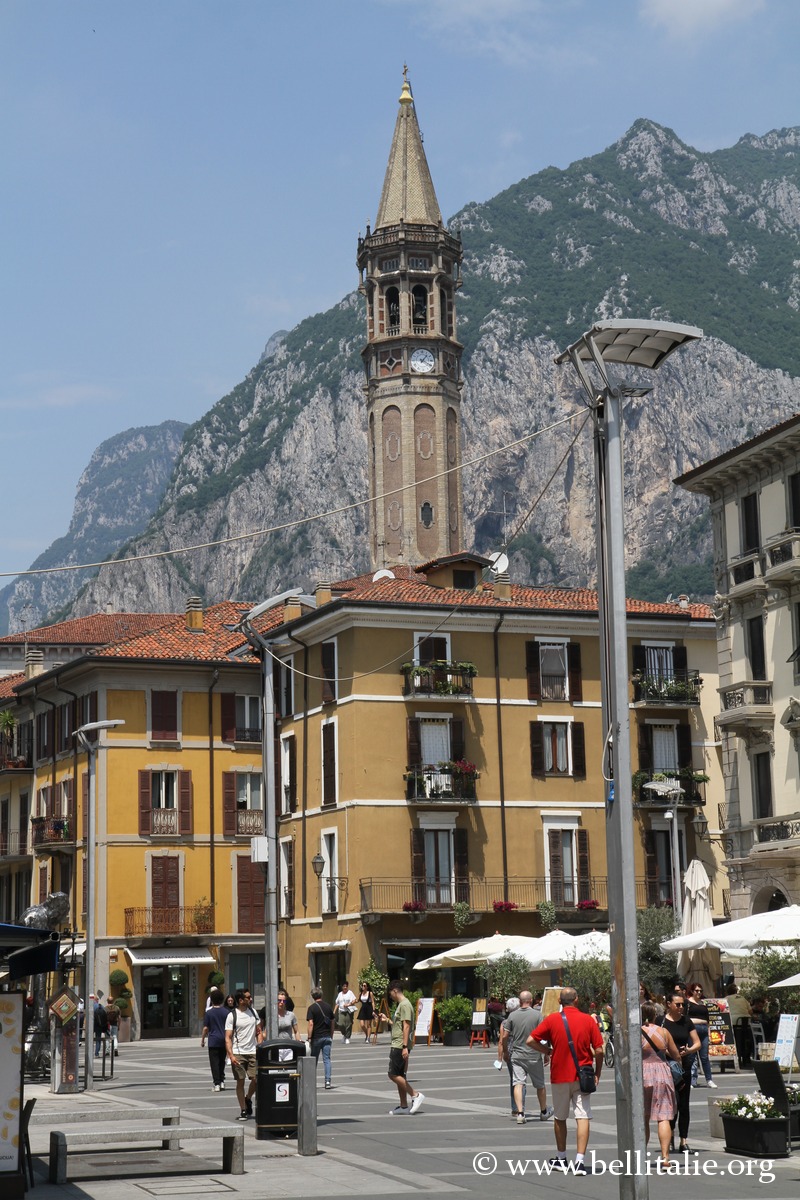
Lecco
At the southern tip of the eastern arm of the lake, Lecco is one of the main towns of Lake Como, with nearly 46,000 inhabitants.
It is a small town without great wonders, but it is quiet and pleasant, frequented above all by Italians, with its lakefront, squares, bars, terraces, and restaurants. From its buildings emerges the original neo-Gothic bell tower 96 meters high, the most emblematic building of Lecco, belonging to the Basilica of Saint Nicholas. The latter preserves frescoes from the school of Giotto.
The town is linked to Manzoni, who drew here his inspiration for his famous novel The Betrothed. A square is dedicated to him, and a museum is dedicated to him in the Villa Manzoni, where the writer spent his childhood, with the 10 rooms where manuscripts, memories and works of the writer are exhibited.
The other notable places of the town are the long Piazza XX Settembre, which is the former Market Square with the Viscontea Tower (16th century); the Basilica San Nicolò, the 19th-century Town Hall called Palazzo Bovara, the Palazzo delle Paure early 20th century, or the Azzone Visconti Bridge. The latter was built in the Renaissance, to connect Lecco to the Duchy of Milan, and is still the main access to the town when arriving from Milan or Como
Outside the center, the Palazzo Belgiojoso from the 18th century houses the Archaeological Museum, the Historical Museum and the Natural History Museum.
In the heights, in good weather beautiful views of the surroundings are discovered, as from Piani d’Erna or from Mount Resegone.
10 km north of Lecco, at Mandello del Lario is the Moto Guzzi Museum in the historic factory that saw the birth of the brand, with 150 exhibition pieces: production motorcycles, sports motorcycles, experimental prototypes and engines.
Varenna
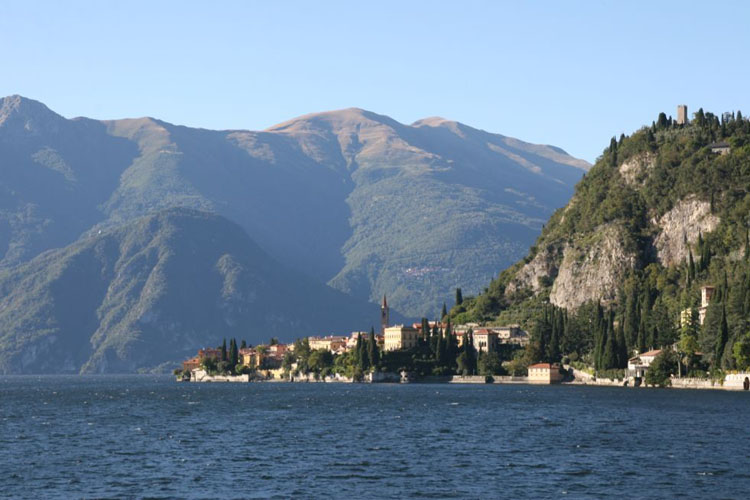
Varenna
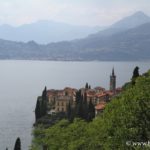
Varenna is one of the most charming villages of Lake Como, surrounded by beautiful historical and natural sites. Its pretty historic center preserves a medieval church, alleys and small squares.
The superb Villa Monastero is built on the edge of the lake, with its large botanical garden that runs along the shore for 2 km.
Overlooking the village, the Castle of Vezio is of medieval origin. Remains of walls surrounded by a garden remain, as well as the tower from which a panorama over the lake opens up.
Bellano
The small village of Bellano, which has a pretty lakefront, is mainly visited for the Orrido di Bellano, one of the main natural attractions of Lake Como. It is a natural gorge with a large waterfall at the end, carved by a torrent, and accessible by a walkway attached to the rock face.
The Ça del Diavul is a small tower with the history of the site, frescoes have been found here that represent the devil and mythological figures.
Corenno Plinio
Dervio is a large village, occupying a small plain, with holiday villages.
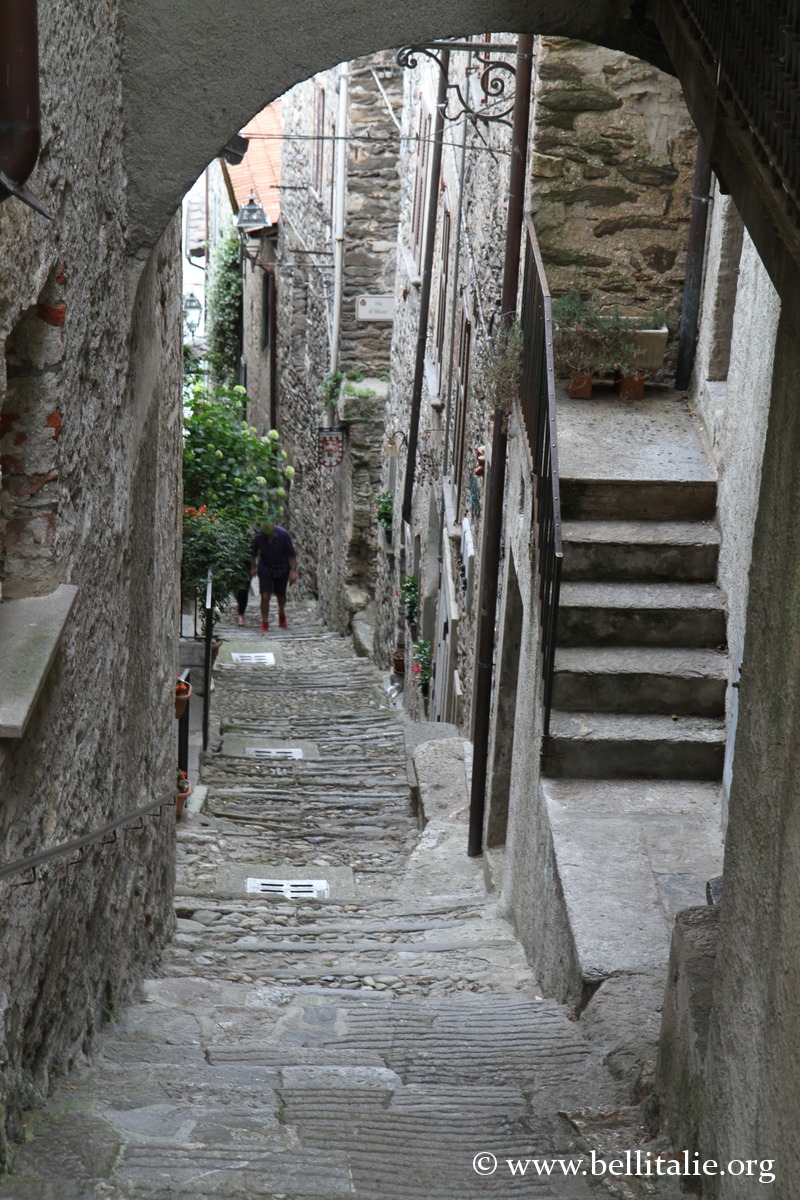
Just to the north, Corenno Plinio is a small fishing village, which was important in the Middle Ages, with the remains of the castle, 14th-century mausoleums, alleys and stairways that descend towards the shore and the port.
Abbey of Piona
Abbey of Piona
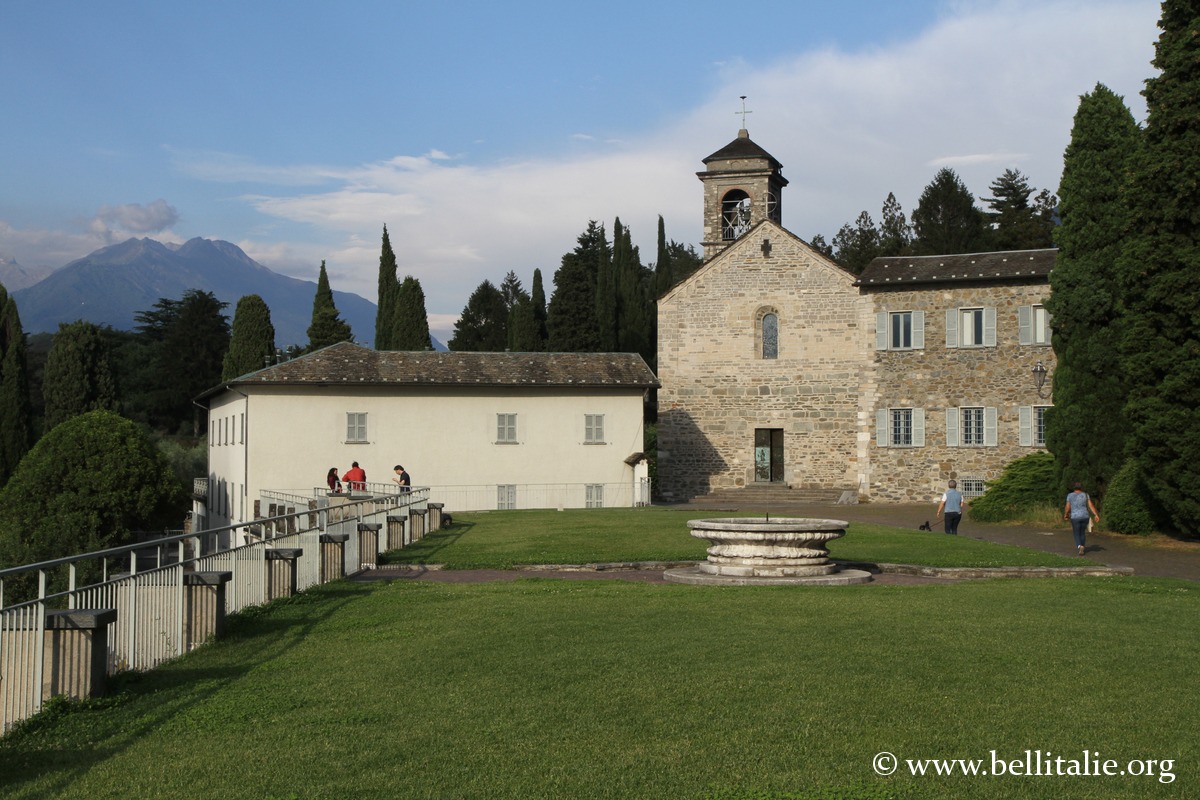
The Abbey of Piona is one of the most remarkable sites of Lake Como, on the small peninsula of Olgiasca which a small cobblestone road leads to.
This Cistercian sanctuary still occupied by the monks dates back to the 7th century. It is a superb, inspiring and restful place, notably thanks to its beautiful panorama over the lake.
The abbey is a beautiful example of Lombard Romanesque architecture, with its beautiful quadrangular bell tower, whose small church preserves remains of ancient frescoes.
It also has a pretty cloister mixing Romanesque and Gothic, very quiet and inspiring contemplation.
Colico
At the very north of the lake, Colico is at the entrance of the Valtellina and has several beaches.
The Fort Montecchio Nord which was built during World War I has kept its gun emplacements, and not far away are also the remains of the Fort of Fuentes, older, dating from the 17th century.
Troggia Waterfall
20 km by road from the lake shore, the Troggia Waterfall, with its 100 meters, crosses the entire Val Biandino.
Discovering the lake by boat
The Gestione Navigazione Laghi company connects the main localities on the shores of the lake: Bellagio, Menaggio, Varenna, Lecco, Como, etc. (more information: http://www.navigazionelaghi.it).
You can also enjoy private boat excursions between several sites, possibly with guided tours, or rent a boat.
Trails
Sentiero del Viandante
The beautiful route of the Sentiero del Viandante (Wayfarer’s Trail) runs along the heights to the east of the lake, starting from Abbadia Lariana, nearly 45 kilometers long towards the north to Piantedo.
It is fairly easy, mainly made up of trails and mule tracks, passing through Varenna, Bellano, Dervio and the surroundings of Colico.
It was the ancient path connecting Lecco and the Valtellina valley, formerly called Via Ducale or Via Regia, until the 19th century.
Itineraries also start from Dervio, allowing short excursions in one of the territories where the panoramas are the most fascinating, with its historical testimonies, buildings, vineyards and woods.
The return can be made by public transport, land or lake.
Via dei Monti Lariani
The Monti Lariani – not to be confused with the mountains of the Triangolo Lariano which are called Monti Lambriani – border the western side of Lake Como.
The itinerary of the Via dei Monti Lariani connects Cernobbio to Sorico. It is a well-equipped trekking path, traversing the mountains over 100 km at an average altitude between 800 and 1000 meters, which can be divided into 5 or 6 stages:
- Cernobbio (201 meters) – Rifugio Prabello (1200 meters), with about 1000 meters of elevation gain, climbing Mount Bisbino and beginning the first ridge section between the Valle Breggia Ticinese and the shore of Lake Como.
- Rifugio Prabello – Rifugio Boffalora (1250 m), with 800 meters of elevation gain.
- Rifugio Boffalora – Grandola ed Uniti, with 250 m of elevation gain.
- Grandola ed Uniti – Garzeno (662 m), with an elevation gain of 700 meters.
- Garzeno – Peglio (633 m), with an elevation gain of 350 meters.
- Peglio (m. 633) to Sorico (m. 200), with an elevation gain of 500 meters.
Map of the lake’s places
Show interactive map Information
- Wikipedia page: en.wikipedia.org
- Tourist portals: www.in-lombardia.it, www.lombardiafacile.regione.lombardia.it


Comments