


Origins and Roman era
Theorigin of Verona is uncertain, as sources such as Polybius, Livy or Pliny the Elder cite various peoples such as the Etruscans, Veneti or even the Cenomani Gauls, whose presence is attested by the Romans in the 3rd century BC.
Allied to Rome, the inhabitants helped in the conquest of Cisalpine Gaul in the 2nd century BC.
Roman law was adopted there in 89 BC, and Verona obtained Roman citizenship in 49 BC when it was elevated to the status of a municipality.
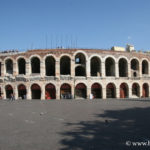
The city prospered both under the Republic and under the Roman Empire, notably thanks to its strategic position along a river and at the crossroads of three great roads: the via Postumia, the via Gallica and the via Claudia Augusta. It was under Vespasian that the city reached its peak. With more than 25,000 inhabitants, arenas were built in the 1st century to enhance the daily life of the citizens.
The walls were widened in 265 by Gallienus, and Verona served as a military base. But it was one of the first cities to be overrun by the barbarians at the fall of the Empire, being one of the first on the road to Rome.
Medieval era
Odoacer, who dominated the region for two decades, capitulated before the king of the Ostrogoths, Theodoric the Great, after the Battle of Verona (489).
Theodoric made Verona an important military center and built a great castle there.
After the brief reconquest by Justinian in 553, the Lombards defeated the Romans in 568 and occupied Italy.
In 774, Charlemagne defeated the Lombards and his son Pepin inherited the former Lombard Kingdom. The Holy Roman Empire later ceded the province of Verona to its vassal, the Duke of Bavaria.
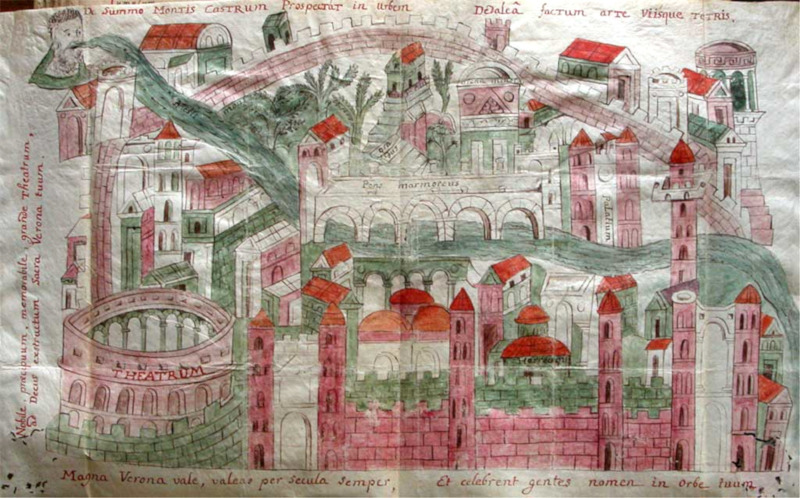
Copy of a 10th-century original depicting Verona
Verona remained loyal to the Holy Roman Empire during the struggles between the latter and the Papacy, then the commune was declared in 1136 with the election of the first consuls.
The first oppositions between Guelphs and Ghibellines – the “two great” parties that divided the communes of Italy, according, to put it briefly, to their leaning toward the Pope or the Empire – were virulent in Verona, with the Sambonifacio on one side and the Montecchi on the other.
The expansion of the communes manifested itself first economically, then through a territorial expansion that saw the appearance of the first seigneuries – of a more or less feudal type – accompanied by the suppression of republican liberties.
In 1232, Ezzelino da Romano annexed Verona to the March of Treviso, bringing the city to the side of the Empire. This figure imprisoned the Guelphs of the city and did not hesitate to annex and pillage numerous Guelph possessions in Italy, bestowed with the title of “Vicar of the Empire in Italy”.
At his death in 1259 during a “crusade” that Pope Alexander IV launched against him, Verona was the only one, among all of Ezzelino’s conquests, where the Ghibellines kept power.
The della Scala took power from 1267, and it was especially under Cangrande I della Scala that Verona experienced a new flourishing period. Dante dedicated to him the canticle of Paradise of the Divine Comedy. Cangrande extended the seigneury over Treviso, Padua, Vicenza, Belluno … He died prematurely at 38 and his successor Mastino II della Scala was defeated by a league of neighboring lords. From 1387, the city was briefly dominated by the Visconti, then by the dukes of Carrara. But the Venetians took advantage of internal struggles to invest the city.
Modern and contemporary era
In 1405, the Veronese swore loyalty to Venice. The city experienced peace and prosperity until the attack by the League of Cambrai in 1501. At the end of the war, around 1517, Verona again experienced tranquility for many decades.
During the Renaissance, the city lived an exceptional artistic flowering.
But during the disastrous plague of 1630, the population went in a few years from 53,333 to 20,738 inhabitants.
The army of Bonaparte invaded Italy in 1796, but the Veronese courageously revolted against the French presence and Bonaparte sold Verona to the Austrians. In 1805, Napoleon fighting against the Austrians retook Verona.
At the fall of the French empire and the Congress of Vienna in 1822, the Austrians returned to settle for half a century, until 1866.
In 1866, Savoy conquered Venetia, during the Italian reunification under the impetus of Vittorio Emmanuele, King of Piedmont-Sardinia. It was annexed by a plebiscite to the Kingdom of Italy of Vittorio Emmanuele II.
Verona was bombed during World War II.
Information
- Wikipedia page: en.wikipedia.org



Comments