


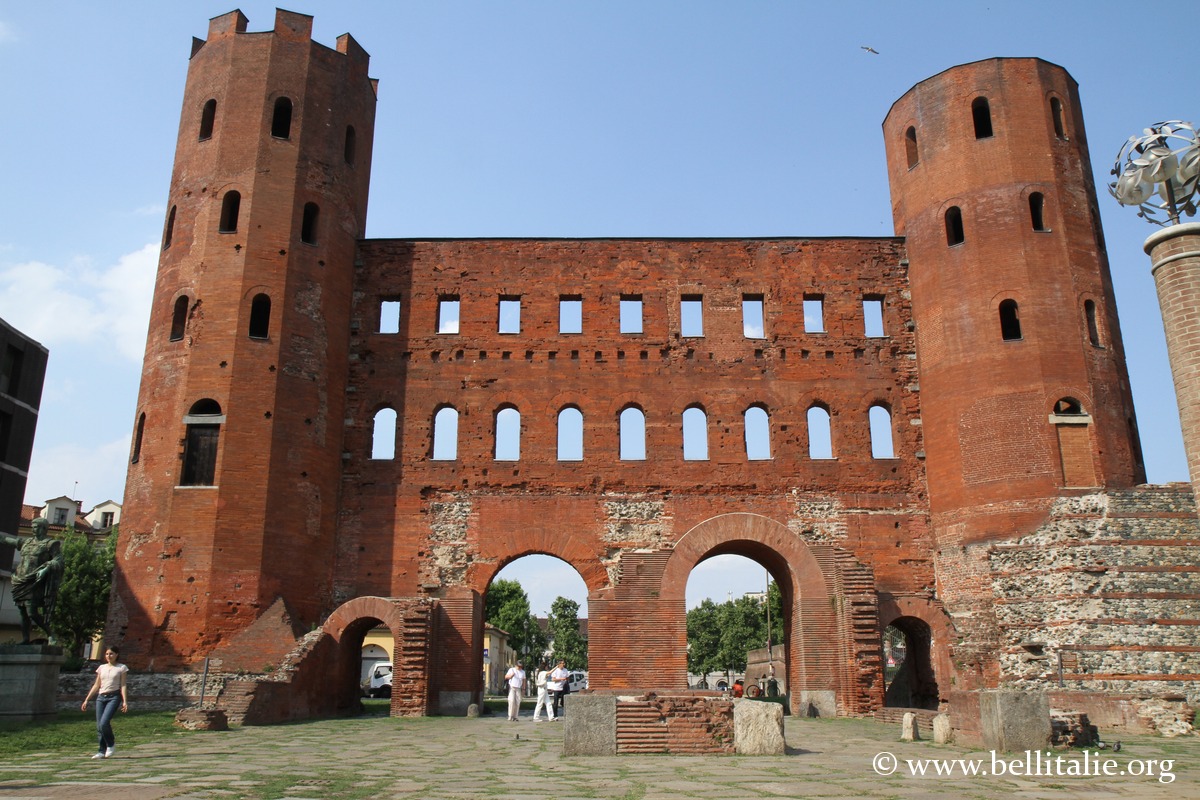
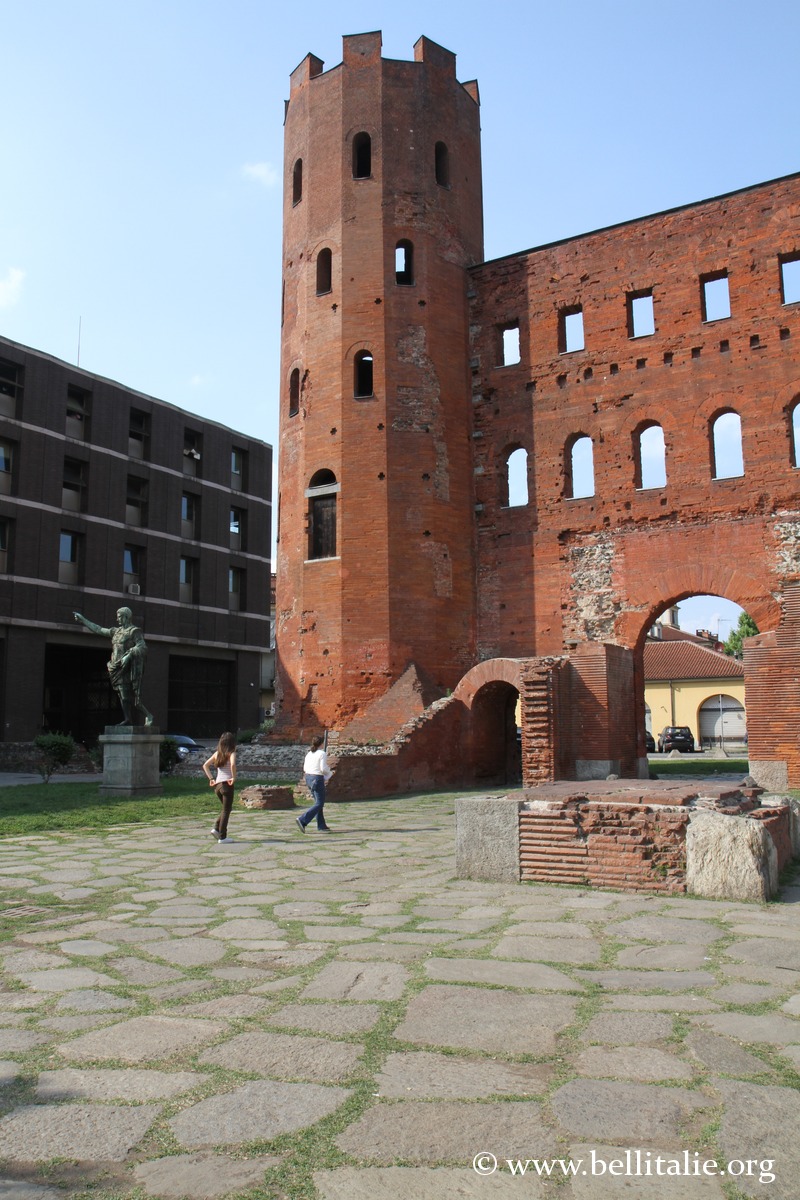
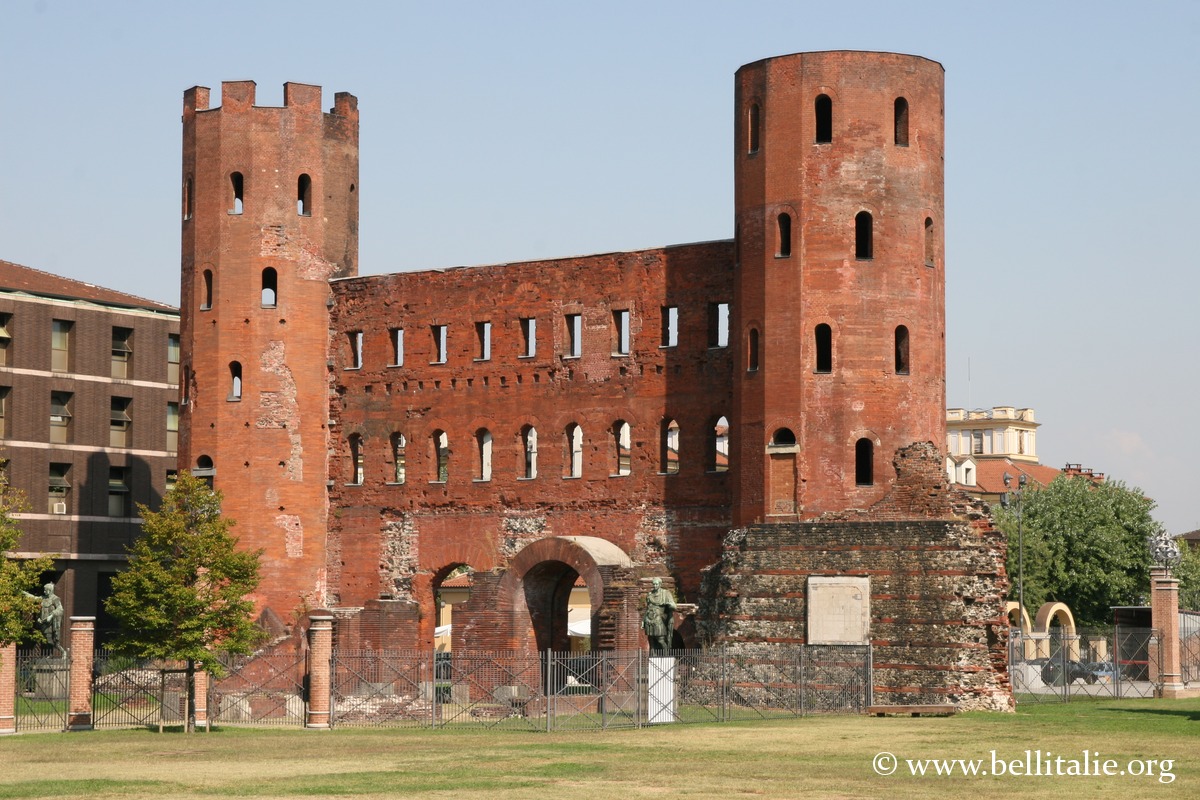
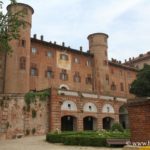
Within a small archaeological area laid out in 2006, the current Palatine Gate dates back to Roman times, but was reworked in the Middle Ages to make it a fortification, with the reconstruction of one of the two sixteen-sided polygonal towers and the addition of battlements.
It was originally one of the four gates built towards the end of the 1st century BC to access the castrum of the Roman city of Augusta Taurinorum, which stood near the Royal Palace. Another of these gates was the origin of the castle that became the current Palazzo Madama.
The south-east tower and the central gate are the only original elements.
It narrowly escaped the urban redevelopment of Turin in the 18th century and was restored from the beginning of the 20th century.
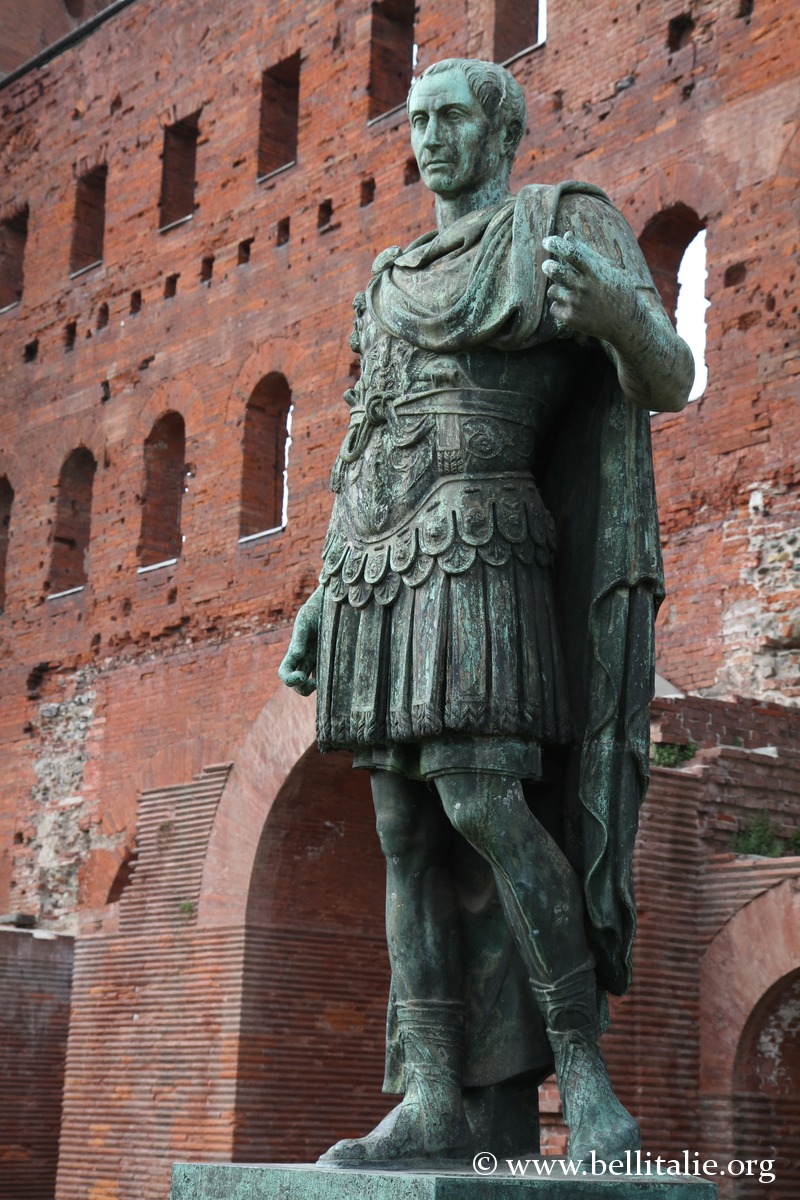
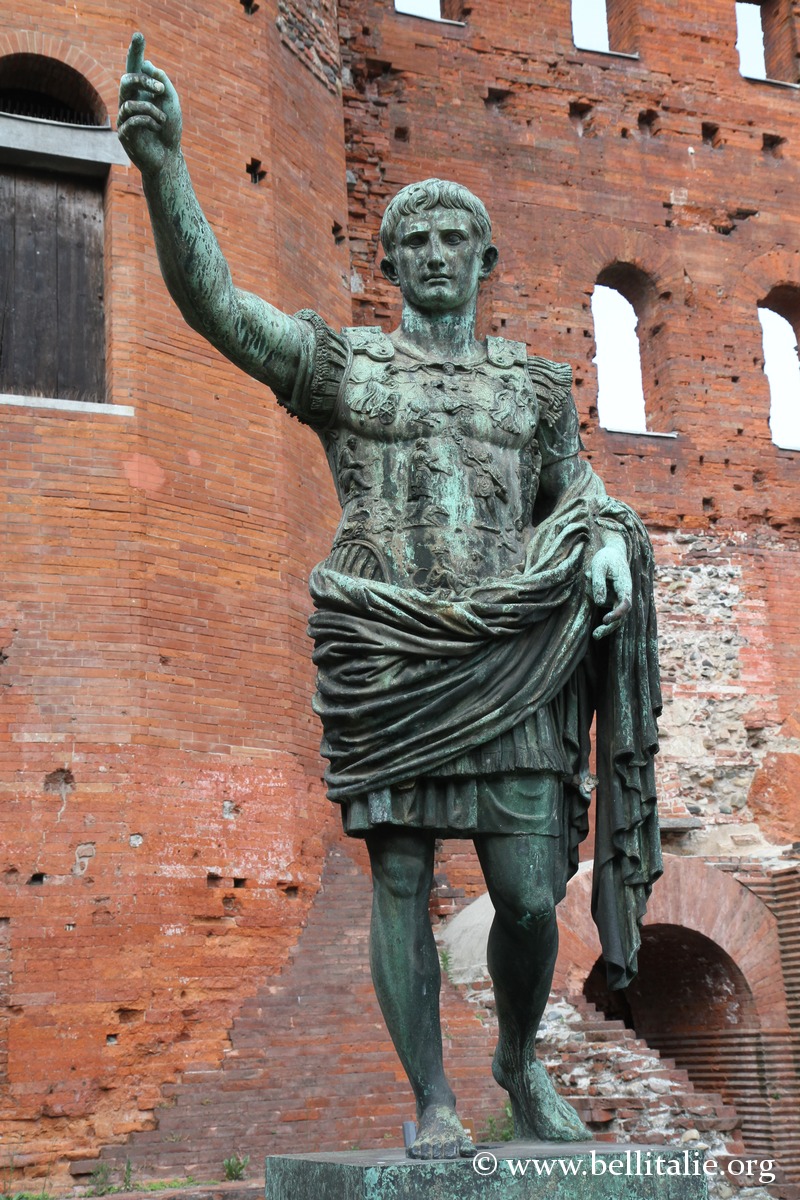
Bronze copies of two ancient statues have been installed opposite, Octavian Augustus on the left and Julius Caesar on the right.
Description and history
The Palatine Gate, like those that gave access to the castrum, was probably earlier than the walls that leaned against it, as was often the case in Roman times to mark the passage with monumental entrances to the urban centre. Towards the end of the Republican era, this kind of gate often had two faces and a central courtyard open towards the inside and closed on the outside. The towers served to reinforce the outer curtain wall first, and then also the inner curtain wall. In the courtyard, there could be a checkpoint and a toll.
This gate is similar to the one that is now incorporated into Palazzo Madama, with two sixteen-sided towers more than thirty metres high, erected on a square base, separating a central body of nearly 20 metres with two central openings and two pedestrian passages on the sides. The brick facing was flanked on a conglomerate of stones and concrete.
The towers, today empty, had floors.
The exterior facade was decorated whereas the interior one was smooth.
The gate was probably transformed into a castrum from the 11th century, completed with defensive battlements in the 15th century. It kept its function as an access to the city until the renovations of the 18th century, after which it was incorporated into a prison complex.
With the new prisons opened in 1872, the gate was partly freed from the monuments that leaned against it and two passages were reopened.
At the beginning of the 20th century, the gate began to be restored to its ancient appearance. This work was slow and discontinuous, and finally the last restorations took place in the 1990s.
Map and address
Piazza Cesare Augusto, 10122 Torino
If you see this after your page is loaded completely, leafletJS files are missing.
Information
- Sites about Turin: www.museotorino.it
- Wikipedia article: en.wikipedia.org
- What to see in Piedmont
- Turin

- Saint Michael’s Abbey, La Clusa
- Lake Maggiore

- Susa Valley and Chisone Valley
- Susa

- Lake Orta

- Cuneo and Surroundings
- The Langhe
- Montferrat
- Roero and surroundings
- Asti

- Alba
- Domodossola and Val d’Ossola
- Valsesia
- Sanctuary of Mount Oropa

- Saluzzo and surroundings
- Usseaux and Fenestrelle Fort
- Casale Monferrato
- Vercelli
- Ivrea, Canavese and Biellese
- Novara

- What to see and do in Turin
- Turin in 1 day, 2 days and more
- Piazza Castello in Turin

- Royal Palaces and Museums of Turin
- Egyptian Museum of Turin
- Mole Antonelliana

- Turin Cathedral of Saint John the Baptist
- Piazza San Carlo in Turin
- Palazzo Madama, Turin
- Royal Palace of Venaria
- Other monuments and places in Turin

- Stupinigi Hunting Lodge

- Rivoli Castle
- Moncalieri Royal Castle
- Turin Hills



Comments